Greece, Venezuela discuss cooperation
Venezuelan President Nicolas Maduro has invited the newly-elected Greek prime minister to Caracas, TeleSUR English said on February 9.
“I have invited Alexis Tsipras, comrade Alexis, to visit us as soon as he can, here in Venezuela,” Maduro told Venezuelan public TV.
“He plans to come to Latin America. He mentioned all the pressures that he is under. Because of a savage, savage neoliberal system that has been applied in Greece.”
Tsipras expressed an interest in touring Latin America, starting with the Bolivarian Republic of Venezuela.
-
-
Leaders of Ukraine, Russia, Germany and France emerged from negotiations in Minsk, Belarus on the morning of February 12, after 16 hours of talks, and announced that agreement had been reached for a ceasefire in Ukraine's civil war. The conflict has divided Ukraine since the overthrow of the unpopular, but democratically elected, president Viktor Yanukovich in February last year. -
A special commission of the two largest associations of Latin American nations, the Community of Latin American and Caribbean States (CELAC, which includes all of the Latin America and the Caribbean) and Union of South American Nations(UNASUR, which represents South American countries) met to discuss US attacks on Venezuelan democracy in a February 11 meeting. Held in Montevideo, Uruguay, to analyse the relationship between the United States and Venezuela as well as the situation inside Venezuela, the joint commission was convened at the request of Venezuelan President Nicolas Maduro. -
A coup plot against the Venezuelan government has been foiled, with both civilians and members of the military detained, President Nicolas Maduro revealed on February 12 in a televised address.
-
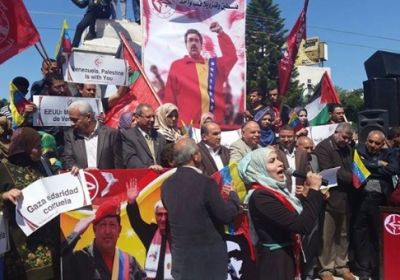
Around 60 people attended a public forum in Sydney on February 9 to commemorate the 33rd anniversary of the re-establishment of the Palestinian People's Party (PPP). The party was retitled from its original name of Palestinian Communist Party, which was founded 96 years ago. Shamikh Badra outlined the history of the PPP, from its early days in 1920s Palestine, to its re-founding in 1982. He explained the role of the PPP after it joined the Palestinian Liberation Organisation (PLO) in 1987 and fought for militant policies within the Palestinian liberation movement. -
A statement released by the Confederation of Revolutionary Trade Unions of Turkey (DISK) in Diyarbakir says the union has 12,000 members who have pledged their willingness to assist in the reconstruction of Kobanê following the offensive from ISIS which left much of the city in ruins.
-
As Scots gathered together at Christmas and Hogmanay last year, conversations inevitably turned to politics. Most were agreed that the year ahead would be an interesting one. The impact of the independence referendum on September 18 last year, won by the “No” vote, is still being felt throughout Scottish society. Its impact is reverberating across the British state as well. -
Disunited Kingdom: How Westminster Won a Referendum But Lost Scotland By Iain MacWhirter Cargo Publishing, 2014, 174 pages The independence referendum on September 18 last year has been hailed by many as the most important event in the recent Scottish history. The result was far closer than any supporter of independence would have dared predict even a few months before the vote. About 1.6 million voters (45%) refused to be swayed by a sustained fear campaign by the British state and its allies ― voting “Yes” to Scottish independence. -
The US’s role in Latin America is facing a growing challenge. The 33 member states of the Community of Latin American and Caribbean States (CELAC) vehemently rejected North American intervention in the continent, and particularly the US-led blockade of Cuba and recent sanctions against Venezuela. These positions were part of the “Belen Declaration”, approved during CELAC’s third annual presidential summit, held on January 28th and 29th in Belen, Costa Rica. -
The world has started looking at Kobane and the other two liberated cantons of what the Kurds call Rojava (Western, or Syrian, Kurdistan) since the resistance in Kobane liberated the town from the brutal Islamic State (IS) forces. Their success is not good news for Turkish President Recip Tayyep Erdogan, achieving a symbolic victory against an underhanded ploy by Turkey’s regime to crush Kurdish resistance in Syria and weaken the Kurdish resistance against the Turkish state. -
“I want to see Cuba before everything changes,” is how many reacted to Barack Obama’s surprise December 17 announcement that he would restore diplomatic relations with Cuba — severed by the US in 1961 — and urge Congress to lift the US blockade. Seeing Cuba for oneself can only be encouraged, but those who fear that it will soon be transformed by American tourists, US corporations and commercialism need not rush to book flights. -
Venezuelan President Nicolas Maduro told a meeting of the Community of Latin American and Caribbean States (CELAC) in Costa Rica on January 28 that Latin America is living in a “new historic era” marked by unity and great opportunity. CELAC was first launched in 2011 in Venezuela, uniting all countries in the Americas except for the United States and Candada. It was set up as a counter-point to the Organisation of American States, which traditionally been dominated by the US.