-
As 35 busloads of teacher-training students from Michoacan headed for Guerrero state to join increasingly militant protests for justice, students from major universities in Mexico City called a two-day strike on October 13. The protests were in response to the disappearance of dozens of students. -
New information was released on October 14 at the Financing Development with Transparency annual conference about the controversial operations of US mining company Newmont. Journalist Raul Weiner and accountant Juan Torres released their investigation, claiming it proves the US transnational committed tax fraud by not paying the Peruvian state about US$137 million last year alone. Newmont owns Yanacocha in Peru, a set of five gold mines that make up the second largest gold exploration in the world. The transnational also owns an expansion project called Conga.
-
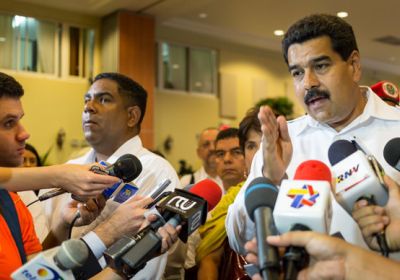
In celebration of the nationally acclaimed Day of Indigenous Resistance on October 13, Venezuelan President Nicolas Maduro handed over collective land titles to 14 original communities. Maduro also established a presidential council for indigenous peoples, lowered the threshold age for indigenous pensioners, and announced the creation of an institute to protect the country’s 44 native languages.
-
Although I had met Luis before, I first got the chance to really speak to him at a BBQ he hosted at his house in late 2010. We spoke for hours that day about many things, including his health. Luis explained to me that his body was riddled with cancers, and that the doctors had told him he probably only had six months to live. “When did they tell you that?” I asked. “Six months ago,” he replied with a grin on his face. “Don’t worry, I still have plenty of fight still left in me.” -
“This was a debate on two models: nationalisation or privatisation,” Bolivian President Evo Morales told a large gathering of supporters after being re-elected with a large majority on October 12. “Nationalisation won with more than 60 percent.” -
"This win is a triumph for anti-imperialists and anti-colonialists," Bolivia's left-wing President Evo Morales told thousands of supporters from the balcony of the presidential palace on the evening of October 12 after a crushing win in that's day's presidential poll, Reuters said. -
In the first round of the Brazilian presidential elections on October 5, the results were “logical”. President Dilma Rousseff, standing for re-election as the candidate of the Workers' Party (PT), will face ex-governor of Minas Gerais, Aecio Neves from the Brazilian Social Democracy Party (PSDB) in the second round on October 26.
-
After more than 50 years in Ecuador, the US Agency for International Development (USAID) closed up shop last month. The Ecuadorian government said USAID has been asked to leave Ecuador, while a US Embassy official claimed it was USAID’s decision.
-
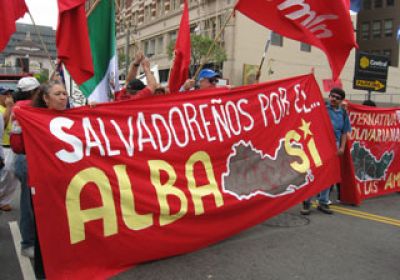
The administration of Salvadoran President Salvador Sanchez Ceren celebrated its 100th day in office last month, taking the chance to report on actions taken to advance towards equality. Among the achievements of the leftist Farabundo Marti National Liberation Front (FMLN) administration is the opening of 43 new community health clinics, along with the first specialised pharmacy for patients with chronic illnesses.
-
We Move Tonight: The Making of the Grenada Revolution By Joseph Ewart Layne St. George’s, Grenada: Grenada Revolution Memorial Foundation, 2014 Paperback 203 pp. “A big revolution in a small country” is allegedly how Fidel Castro described the overthrow of Grenada’s authoritarian government when being questioned on the matter back in 1979. -
Latest polls suggests Bolivian President Evo Morales will be reelected for a third term in a landslide victory on October 12. One week before the vote, Morales' support hit 57.3%. The latest statistics from pollster Tal Cual Comunicacion Estrategica indicate a huge win for the left-wing Morales, first elected in 2005 on the back of huge protests against neoliberialism.
-
The Venezuelan National Assembly swore in grassroots leader Juan Contreras to assume the vacant post of the late deputy Robert Serra on October 7. Serra, a 27-year-old socialist deputy, was stabbed to death alongside his partner Maria Herrera in their Caracas home on October 1. Legislators also voted to ban former right-wing Colombian president Alvaro Uribe from entering Venezuela. Venezuelan President Nicolas Maduro has accused Uribe of being linked to the killings.