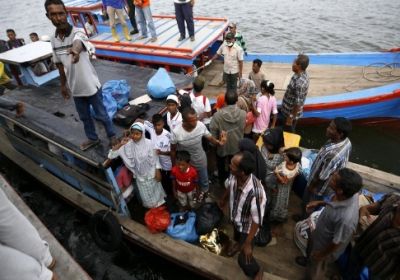
Ecuadorean President Rafael Correa announced on May 16 that the Community of Latin American and Caribbean States (CELAC) will provide assistance to the thousands of Asian immigrants stranded off the coast of Thailand.
“This world is crazy, it shows a total disregard for human life to have people stranded on a boat, dying of starvation without being allowed to get off the boat,” Correa stated during his weekly presidential address.
 Chile has been hit by another round of protests by student groups demanding substantial reforms to the country’s education system.
Two student activists were killed in Chile on May 14 amid nationwide protests. The two students were shot in the city of Valparaiso, near the Plaza Victoria, at the end of a huge rally. Local media said both students were gunned down by a Valparaiso store owner as they attempted to hang a banner over his shop.
Chile has been hit by another round of protests by student groups demanding substantial reforms to the country’s education system.
Two student activists were killed in Chile on May 14 amid nationwide protests. The two students were shot in the city of Valparaiso, near the Plaza Victoria, at the end of a huge rally. Local media said both students were gunned down by a Valparaiso store owner as they attempted to hang a banner over his shop.
 Demonstrators demanding justice in the case of the 43 disappeared Ayotzinapa students. Photo: Clayton Conn/TeleSUR.
The lawyer representing the parents and relatives of 43 missing Ayotzinapa students criticised the Mexican government on May 14 for stopping a meeting between experts from the Inter-American Court of Human Rights and army officials.
Demonstrators demanding justice in the case of the 43 disappeared Ayotzinapa students. Photo: Clayton Conn/TeleSUR.
The lawyer representing the parents and relatives of 43 missing Ayotzinapa students criticised the Mexican government on May 14 for stopping a meeting between experts from the Inter-American Court of Human Rights and army officials.
 President Nicolas Maduro at International Workers' Day celebrations in Caracas, May 1.
Braving the heat, more than 100,000 Venezuelans flooded the streets of Caracas on May 1 to commemorate the International Workers' Day and gains for working people under the Bolivarian Revolution.
President Nicolas Maduro at International Workers' Day celebrations in Caracas, May 1.
Braving the heat, more than 100,000 Venezuelans flooded the streets of Caracas on May 1 to commemorate the International Workers' Day and gains for working people under the Bolivarian Revolution.
 Photo: CISPES.org.
Hundreds of thousands of people filled the streets of San Salvador on May 1 to celebrate May Day and the victories of the working class. Marchers raised demands for justice, equality and self-determination,
Photo: CISPES.org.
Hundreds of thousands of people filled the streets of San Salvador on May 1 to celebrate May Day and the victories of the working class. Marchers raised demands for justice, equality and self-determination,  President Rafael Correa led some 55,000 workers into Santo Domingo plaza. Photo: TeleSUR.
May Day celebrations in Quito took on a divided political nature with two marches happening simultaneously,
President Rafael Correa led some 55,000 workers into Santo Domingo plaza. Photo: TeleSUR.
May Day celebrations in Quito took on a divided political nature with two marches happening simultaneously, 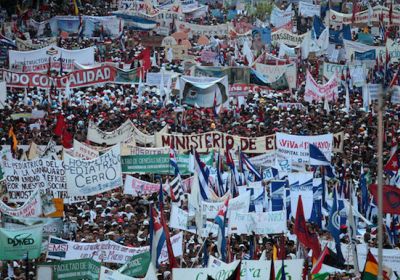
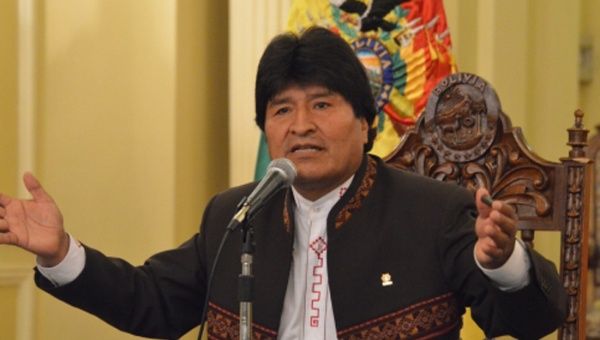 Evo Morales. Photo: ABI — Agencia Boliviana de Información.
Bolivia's left-wing president Evo Morales announced various salary rises on May 1 in honour of International Workers’ Day,
Evo Morales. Photo: ABI — Agencia Boliviana de Información.
Bolivia's left-wing president Evo Morales announced various salary rises on May 1 in honour of International Workers’ Day,