-
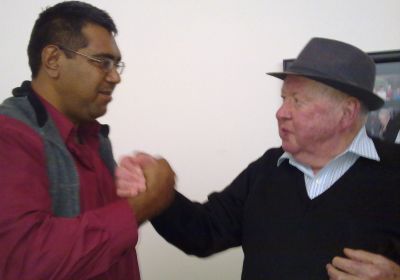
Mark Fordham, an Aboriginal activist from the Northern Territory and member of the Liquor Hospitality and Miscellaneous Workers Union, is touring the east coast to raise awareness about the jobs with justice campaign. The campaign aims to force the government to provide real jobs and services to remote Aboriginal communities in the NT (see article page 7). In Sydney, Fordham spoke to waterside workers with Maritime Union of Australia (MUA) officials. He thanked maritime workers for their solidarity with the Gurindji workers who walked off Wave Hill station in 1966. -
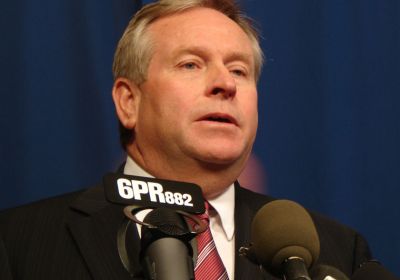
Western Australian Liberal Premier Colin Barnett has said many of the 200 remote Aboriginal communities in WA will be shut down. ABC Online reported on October 14 that Barnett said: "There's no doubt that under policies really initiated by the Federal Government, small, isolated Aboriginal communities were promoted. "The reality is that there's no employment prospects in those areas, or very limited." Barnett’s comments were in relation to the small community of Oombulgurri, where there are 50 residents and 14 public servants.
-
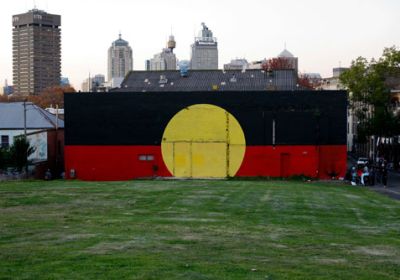
Sydney’s Redfern Block is a colourful place. It’s houses and flats are covered by political posters and banners, graffiti and dot paintings. But new colours now appear on the doors of residents — eviction notices. The Redfern Block is set to be demolished and replaced by the $60 million Pemulwuy housing project. The last 75 residents have until November 19 to leave but will be able to reapply to return in 2013 when the new project is set to be complete. But those accused of selling drugs will be denied housing. -
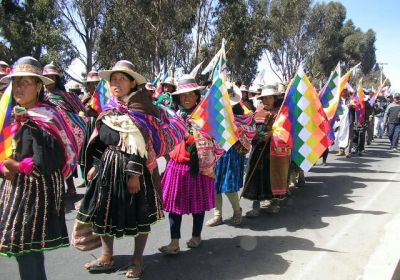
Alina Canaviri Sullcani is a Bolivian indigenous peasant now visiting Australia. Canaviri is active in Santa Cruz as a leader of the National Federation of Indigenous Peasant Women of Bolivia “Bartolina Sisa” and the Movement Towards Socialism (MAS) party led by President Evo Morales. Canaviri spoke at the Latin America solidarity conference in Melbourne over October 8-9 and will be a featured guest at the solidarity conference held in Sydney over October 16 and 17 (visit www.latinamericasolidarity.org for details). -
The Greens and the Australian Labor Party signed an agreement on September 1 to form a minority government on certain conditions, one of which was support for amendments to the constitution to recognise Aboriginal people. The government has agreed to hold a referendum on the issue. The proposal has sparked debate among Aboriginal activists about its usefulness for the Aboriginal rights struggle. -
Police violence has come under the spotlight once again, as it tends to do every six months or so. Sometimes it is when two or more incidents occur together, or it is when the media have decided that the last story about misbehaving police has been forgotten, and now is the time for a new one.
-
The following is abridged from a September 29 statement issued by a delegation of north Queensland Indigenous traditional owners in Canberra. They went to meet Opposition leader Tony Abbott to ask him to drop his move to overturn Queensland’s Wild Rivers legislation. After the delegation's visit, the federal government referred the issue a parliamentary committee to report back no later than next March. * * * -
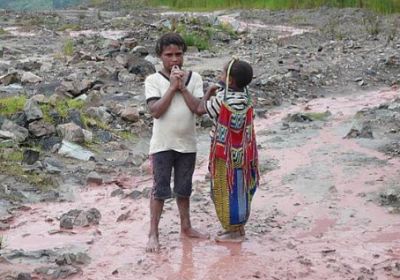
The fight against the dumping of toxic waste off the coast of Madang in Papua New Guinea suffered a setback when a court injunction against the Ramu nickel mine, which is building a pipe to dump its waste into the ocean, was reversed. The injunction was dropped after the three remaining plaintiffs pulled out of the case against the US$1.4 billion Chinese-owned mine, the September 24 Sydney Morning Herald said. -
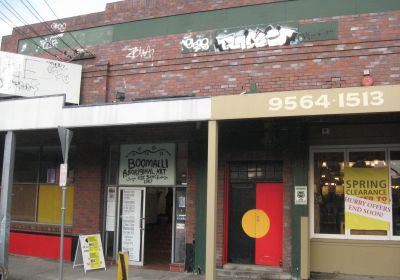
Amnesty International’s Demand Dignity and Eora College art exhibition opened at the Boomalli Aboriginal Arts Gallery on September 22 to a crowd of 50 people. The exhibition was based on the theme of the UN Declaration on the Rights of Indigenous Peoples. The artworks were produced by talented students from the Eora TAFE College. The Demand Dignity campaign aims to eradicate poverty by making human rights law. As part of the campaign, Amnesty International has criticised Australia’s NT intervention policy, which was launched by the Coalition government of John Howard in 2007. -
On October 8, the Maritime Union of Australia (MUA), Queensland branch of the Electrical Trades Union and the Australian Manufacturing Workers Union will sign a “social compact” with the North Queensland Lands Council (NQLC). The compact will mark a new stage in collaboration between trade unions and Indigenous organisations, especially in those regions targeted in the mining and resources boom. -
Twenty people attended a September 28 Indigenous Social Justice Association (ISJA) meeting to hear Bruce Campbell, from the WA Deaths in Custody Watch Committe, discuss the campaign for justice for Mr Ward. On Invasion Day (January 26) 2008, Mr Ward, a respected Aboriginal elder, was arrested and died of heat stroke in the back of a prison van the next day while being taken 360km in 42°C heat. -
Nineteen seventy nine was a very good year for the Western Australian ruling class. The corporate puppet masters had the ideal puppet in Premier Charles Court, and the most right wing, racist Liberal Party in Australia. With a heavily gerrymandered parliament, Court rode roughshod over union rights, civil liberties, Aboriginal rights and Aboriginal land. Enter the Kimberley Land Council (KLC) who had recently formed to represent the Aboriginal communities in the far north of WA. The KLC was determined to take a stand against the mining land grab.