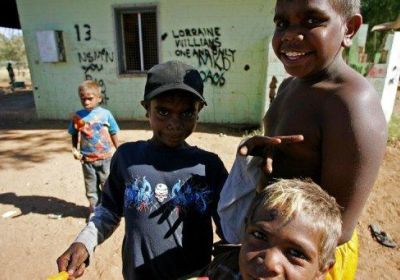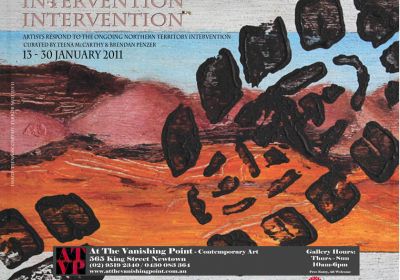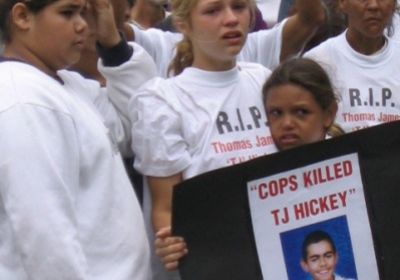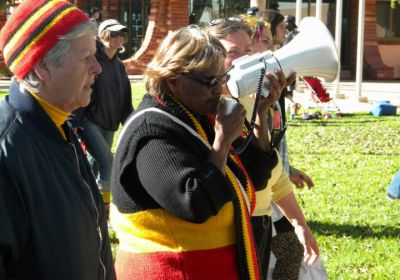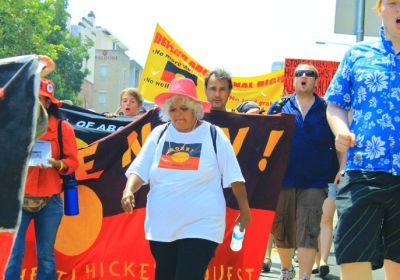
During the lead-up to the federal election, there has been almost total silence on Aboriginal rights and the Northern Territory intervention.
Aboriginal communities and towns across the NT have suffered three years of income quarantining, compulsory leases over land and housing, a bilingual education ban in schools and cuts to funding for employment programs and services.
The corporate media and politicians have ignored the problems caused and made worse by these racist and paternalistic policies.
-
-
Barbara Shaw, a well-known Indigenous activist and leader of the Intervention Rollback Action Group in Alice Springs, said on July 27 that she would stand as a candidate in the Northern Territory seat of Lingiari in the August 21 federal election. Shaw will stand for the Greens against Labor’s Warren Snowdon, who holds the seat and is federal Indigenous health minister. -
The First Nations Political Party (FNPP) is a new party contesting the upcoming federal election. The party will contest two lower house seat a and field a four-person senate ticket in WA. It will also run a senate candidate and content a lower house seat in the Northern Territory. Aboriginal activists Marianne Mackay and Glenn Moore began working towards forming an Indigenous political party in late 2009. They have a goal to getting Aboriginal people elected to parliament. “We need a pure Aboriginal voice in parliament”, Moore told Green Left Weekly. -
· Indigenous juveniles aged 10-17 were 28 times as likely as non-Indigenous juveniles to have been detained. Adults are 13 times more likely. · The infant mortality rate for Indigenous Australians is 9.7 per 1000 live births compared with 4.4 per 1000 live births for non-Indigenous Australians. · The gap between Indigenous and non-Indigenous life expectancy: 11.5 years for males and 9.7 years for females. · The Indigenous unemployment rate is 16% compared with 5% of non-Indigenous Australians.
-
From June 30 to July 20, a group of Aboriginal rights and environment activists from New South Wales used a decommissioned red school bus to travel to Alice Springs. The purpose was to expose government and media silence over the appalling conditions and treatment of Aboriginal people living under the NT intervention. The passengers attended the Defending Indigenous Rights convergence in Alice Springs. They also visited town camps and remote communities to witness the effects of the intervention’s discriminatory measures such as income quarantining and compulsory land leases. -
Chasing the Lollyman Presented by deBASE Productions State Library of Queensland, Brisbane “Move them along!”, referring to police strategies to deal with loitering Aboriginal people on Australia’s urban streets, was a phrase parodied to hilarity by Mark Sheppard during his acclaimed one-man show, Chasing the Lollyman, which ran at the State Library of Queensland during NAIDOC Week.
-
Ewan Saunders, Socialist Alliance candidate for Brisbane, recently returned from the Justice Ride to Alice Springs. * * * On July 14, after almost 50 hours spent on the road over four days, I, along with about 20 others, rolled back into Brisbane at 11.30pm. The trip back from Alice Springs was the last leg of a two-week Justice Ride that changed the lives of a busload of people, many of whom hadn’t considered themselves “activists” before the bus left on July 1. -
Boomalli, one of Australia’s longest running Aboriginal artists’ co-operatives, is threatened with closure. Based in Sydney’s inner-city suburb of Leichhardt, Boomalli was set up in 1987 by Aboriginal artists to get their art recognised. Boomalli means “to strike, to make a mark, to fight back, to light up,” in the languages of the Kamilaroi, Wiradjuri and Bundjalung peoples of New South Wales.
-
On July 31, 100 anti-uranium mining protesters rallied outside the Esplanade Hotel in Fremantle, which was hosting the Australian Uranium Conference. WA Liberal Premier Colin Barnett lifted the ban on uranium mining in November 2008 soon after winning office. There are no commercial uranium mines operating in the state but the Australian Uranium Association has identified eight major uranium deposits in WA. The Anti-Nuclear Alliance of WA (ANAWA), which organised the protest, said there are 137 mining companies with uranium interests in the state.
-
Last year, 20-year-old Aboriginal dancer Rarriwuy Hick was put on welfare quarantining under the Northern Territory intervention. The difference was that she was living outside the government's prescribed zone — in New South Wales. Hick spoke to Ash Pemberton, from Green Left Weekly and Resistance about her experience with welfare quarantining and the affects of the intervention on her home community of Dhalinybuy in east Arnhem Land. *** What led to you being put onto welfare quarantining while you were living in NSW? -
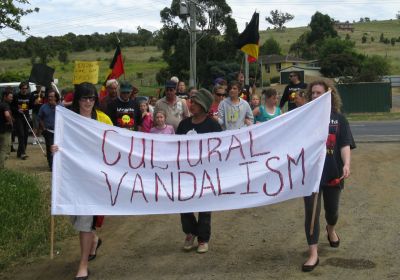
"Stop Unimin from totally destroying Stradbroke Island”, Aboriginal leaders Dale Ruska and Sam Watson, urging supporters to attend a rally outside the Magistrates' Court on July 14. “Stop this mining vandal and thief. The Stradbroke Island people need your support. The state government has taken Unimim to court. They must be judged and they must be stopped!" -
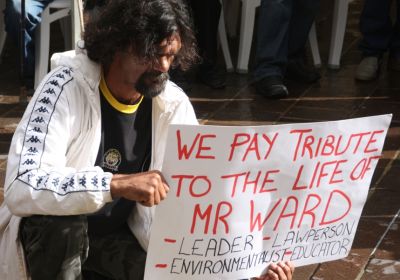
Five hundred people rallied outside the Perth Supreme Court Gardens on July 11 to demand that the coronial investigation into Mr Ward's tragic death be reopened. Mr Ward, a respected Aboriginal elder, was literally cooked to death in the back of a prisoner van while being driven from Laverton to Kalgoorlie to face court for a traffic offence in January 2008. The coroner found that temperatures inside the van reached 47° Celsius and that metal surfaces in the van would have reached 56°C.