
More than 100 people rallied outside the South Australian Parliament on March 25 in solidarity with the people of the Middle East.
The focus of the rally was the attacks on protesters by snipers in Yemen, the invasion of Bahrain by Saudi troops and the ongoing civil war and bombing in Libya.
People from various Middle Eastern communities waved flags and placards demanding an end to the military crackdowns.
-
-
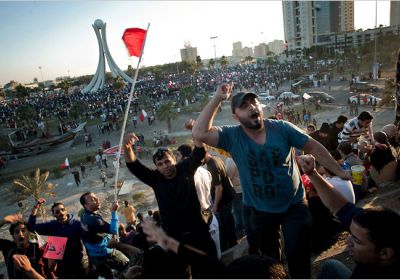 The pro-democracy movement in Bahrain has been severely weakened by the brutal wave of repression that began on March 15. Attempts to reignite pro-democracy protests have been broken up by government security forces and strikes have been called off. Troops from Saudi Arabia and the United Arab Emirates entered Bahrain on March 14 to help the Bahraini government “restore order” by attacking thousands of pro-democracy protesters.
 -
About 30 people attended a rally in King George Square on April 1 to call on Western powers to stop the bombing of Libya. Adrian Skerritt, from the Stop the War Collective, told the rally: “The main reason for intervention by the US and its allies in Libya is that the West cannot handle being sidelined by the popular revolutions which have swept the Arab world in recent months. “Yet, the US has acted against Gaddafi because he is isolated in the region. They haven't intervened in Yemen or Bahrain, where the repression is just as severe, because they are client states of Saudi Arabia.
-
 The US-NATO intervention in Libya, with United Nations Security Council cover, is part of an orchestrated response to show support for the movement against one dictator in particular. In doing so, it aims to bring the Arab rebellions to an end by asserting Western control, confiscating their impetus and spontaneity and trying to restore the status quo. It is absurd to think that the reasons for bombing Tripoli or for the French airforce’s “turkey shoot” (the bombing of fleeing Libyan soldiers) outside Benghazi are designed to protect civilians.
 -
Power worship is what the corporate media does best, and there has been plenty of that on display in recent Libya coverage. Donning his “white man’s burden” hat, Peter Hartcher, in the March 22 Sydney Morning Herald, responded to the United States/European Union bombing by saying: “To the relief of millions in Libya and millions more around the world, the West has unsheathed the sword against [Gaddafi’s] resurgent forces.” Such comments are the background noise that has lent a veneer of legitimacy to the West’s imperialist adventures since the end of the Cold War.
-
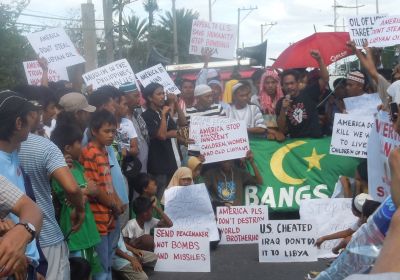 On March 25, much of the community in Maharlika Village in Manila turned out after Friday prayers to protest against the Western powers’ military attacks against Libya. Maharlika Village is a predominantly Moro community in Taguig City, in the south-east of Metro Manila. The protest was organised by the local council, community leaders, religious leaders from the community’s 16 mosques, the Bangsamoro Solidarity Movement and the Anak Mindanao Party (Amin).
 -
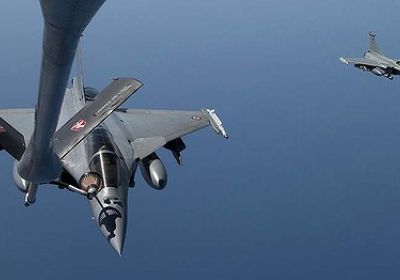
The United Nations Security Council voted on March 19 to approve a military intervention into Libya, with 10 votes in favour and five abstentions.
-
“Commanders in Afghanistan are bracing themselves for possible riots and public fury triggered by the publication of ‘trophy’ photographs of US soldiers posing with the dead bodies of defenceless Afghan civilians they killed”, said the March 21 British Guardian. The photos, compared by officials in NATO’s occupying forces to the infamous Abu Ghraib pictures depicting US soldiers torturing Iraqis, were published by German newspaper Der Spiegel.
-
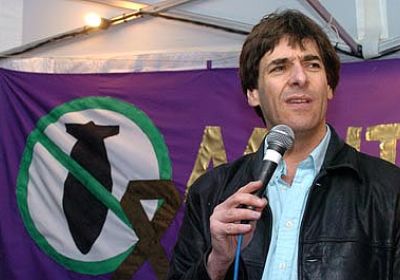 Isn’t it marvellous that all these governments are determined to do “something” about Colonel Gaddafi? For example Hillary Clinton said she supported military action once the Arab League — made up of countries such as Bahrain, Syria, Yemen and Saudi Arabia — backed air strikes. And it is encouraging that the policy of not tolerating a dictator has the backing of so many dictators.
 -
“Pakistan has demanded an apology and explanation from the United States over a drone strike in a tribal region, which officials said killed 35 people,” ABC.net.au said on March 18. It said it was the seventh US drone strike in nine days. The article said it was the most lethal drone strike North Waziristan region since the US military escalated its bombing of Pakistani areas near the Afghan border in 2008. A Pakistani foreign ministry spokesperson Tehmina Janjua said: “The government of Pakistan strongly condemns the drone strike which has resulted in a large number of casualties …
-
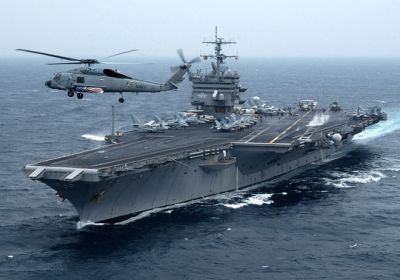 On March 17, the United Nations Security Council (UNSC) “effectively authorized the use of force in Libya”, the UN News Center said that day. “Acting under Chapter VII of the UN Charter, which provides for the use of force if needed,” the report said, “the Council adopted a resolution by 10 votes to zero, with five abstentions, authorizing Member States ‘to take all necessary measures … to protect civilians and civilian populated areas under threat of attack in the Libyan Arab Jamhariya, including Benghazi, while excluding an occupation force.’”
 -
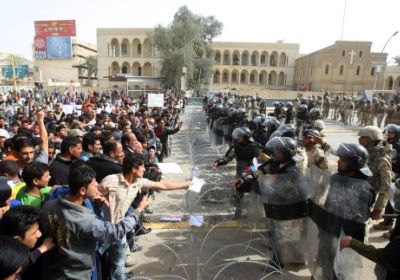
Thousands of protesters took to the streets across Iraq on March 4, defying a curfew and repression to demand democracy and economic justice, the March 5 Los Angeles Times said.