-
High school has always been turbulent at best, but never before was I confronted with institutionalised oppression in the way that I was when it came to Year 9 sex education. Year 9 is the final year in my school where all students have access to sex education regardless of their subject choice, after this a student has to choose a physical education (PE) subject to learn more about it. -
Like most sectors of society, the education system in Australia is under attack. For decades, education has been underfunded, so when Prime Minister Julia Gillard announced that she intended to fund the Gonski reforms, many people were temporarily relieved. Then she said that, to pay for primary and high school education reforms, the government would cut funding to universities. Private schools won’t lose funding and, in some cases, will get more. Yet the ailing TAFE system would get nothing. So much for an education revolution. -
Julia Gillard was greeted by a vibrant protest by students, unionists and Aboriginal activists when she spoke in Fremantle on June 12.
-
This statement was released by Socialist Alliance on May 25. *** The Gonski review into school funding showed the need for an immediate injection of funds into public schools. The independent Gonski review into school funding reaffirms what many teachers and parents already knew. Current school funding arrangements are dysfunctional and inequitable. The failure to reform the way we resource our public schools has come at a big social and economic cost. Gonski’s recommendations are far from perfect — it recommends continued public funding of elite private schools. -
Socialist activists are involved in political struggles across many different issues. From equal marriage rights to defending education, refugee rights to the environment, socialists help organise and lead these campaigns, and seek to win important political reforms around them. It might seem contradictory for socialists to fight for reforms. Since socialists oppose capitalism and the capitalist state, why is it that they campaign for measures that encourage the expansion of the capitalist state? -
About 100 people attended a rally at the University of Sydney on May 23 to protest the police brutality that has occurred at picket line held at the university earlier this month. Staff at Sydney University are involved in an enterprise bargaining process between the National Tertiary Education Union (NTEU) and the university administration. The university administration is trying to force through changes that would undercut pay and conditions for university staff, including more casualisation and creating teaching-only positions. -
The Socialist Alliance estimated in 2010 that its key policies for social justice and environmental sustainability would cost a minimum of $81-140 billion a year. Any budget devised by a party focused on putting people and the planet before profits would look significantly different to the “safe” yet largely austere budget the federal Labor government released last week. -
A meeting was held in Geelong on April 30 for students to discuss and plan action against the continued cuts to public sector education. University, TAFE and High School students were invited. At this meeting, the Student Action Collective (SAC) was formed and a list of immediate demands, mid-term and long-term goals were developed. -
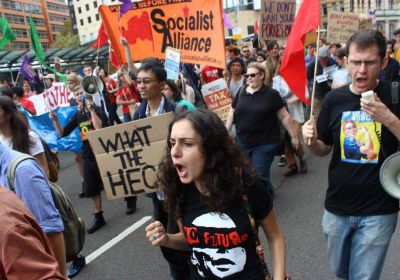
Staff and students from universities around Australia held demonstrations on May 14 to protest the Gillard government’s $2.3 billion cuts to higher education. The National Tertiary Education Union (NTEU) called a 24-hour strike which coincided with a student strike called by the National Union of Students. Students were encouraged to skip class for the day and join picket lines and rallies.
-
In 2006, a generation of Chilean secondary students learnt how to mobilise, blockade streets, raise demands and carry out occupations. But they also learnt how they could be defeated by a system capable of accommodating and coopting mobilisations. It is important to note that this revolt, referred to as the “penguin revolution”, did not arise out of nowhere. Its origins lay in the mobilisations for student transport concessions in 2001 and the creation of a series of collectives and small groups. Demands -
The first School of Rebellion, held in association with Marxism 2013 over the Easter weekend in Melbourne, drew about 30 kids for a weekend of thinking, talking, making noise, art, music, poetry, mess and friends. It was declared “awesome” by a random sample of kids, teachers and parents and the program will definitely be back, bigger and better, for Marxism 2014. -
University students across Australia will take to the streets on May 14 to protest the federal Labor government’s $2.8 billion cuts to higher education. The call by the National Union of Students (NUS) for a “student strike against education cuts” has not only received support from students, but also the National Tertiary Education Union (NTEU), which covers university staff. On a number of campuses, NTEU members have been resisting cuts that university administrations claim are necessary due to lack of government funding.