-
The campaign against savage cuts to public services in the recent South Australian budget is gaining momentum. More than 10,000 unionists rallied in Victoria Square on October 26 and marched through lunchtime crowds to Parliament House. Nurses, prison officers and firefighters are among the many sectors angry at the cuts, which will cost up to 4000 jobs and affect vital services. The following day, hundreds protested at Parliament House against cuts of $850,000 to the health budget, which threaten the viability of country hospitals at Keith, Moonta and Ardrossan. -
The Socialist Alliance national office has produced its analysis of the August 21 federal election. It traces the precise mix by electorate of the increased Green, Coalition, independent and informal vote, produced as voters deserted Labor. The differences among the seat-by-seat contests in an Australian federal election have never been so great. The general disillusionment with the two major parties expressed itself in quite different ways in different electorates and areas.
-
On September 1, Luke Foley, the newest Labor member of the New South Wales Legislative Council, rose to make his inaugural speech to the chamber. Foley began: “It is with pride and humility that I enter this place, Australia’s oldest Parliament, as a representative of Australia’s oldest, and greatest, political party — the Australian Labor Party.” Oh dear. What a day for Foley to praise the ALP in NSW. -
In 2007, federal election candidates made much of the seven vultures that were feeding on the carcass of the Howard government as it flailed around shifting further and further to the right. Those seven vultures were: • the denial of climate change; • touting of the war in Iraq; • Work Choices; • policy failure on education spending; • poor vision of infrastructure; • destruction of research and development; and • persecution of refugees with the Pacific Solution. -
Rather than giving us the government we deserve, the August 21 federal election delivered an outcome the two old parties deserved. Because both Labor and the Coalition focused on negative campaigning, sloganeering and scapegoating refugees and other minorities, a large number of voters decided to vote for alternatives with some vision. A hung parliament with the Greens holding the balance of power in the Senate was only a partial reflection of this growing disenchantment with the two-party system. -
Whichever major party wins the August 21 elections, the real job of fighting for progressive change will remain. Not just because Labor and the Liberal-National Coalition have made this election campaign an ugly race to the right, but also because real change never comes simply through a vote. Even an election that registered real victory, such as the defeat of the hated John Howard Coalition government in November 2007, came on the back of sustained political action by millions of ordinary people focused primarily around the campaign against Work Choices.
-
This federal election both Labor and the Coalition have failed to present any serious policies to address climate change. The Greens on the other hand have a plan to cut emissions, but does it go far enough? The Coalition’s Tony Abbott rose to the leadership with the backing of a hardcore group of climate denier MPs. His “direct action” policy on climate change has two big problems: it’s not direct and it’s not much action. -
Breaking story (last updated June 25): Socialists and progressive trade union and social movement activists have reacted sceptically to the leadership change in the Australian Labor Party (ALP) federal government of Australia. Julia Gillard displaced Kevin Rudd as PM on June 24 after a surprise leadership challenge that came into the open the night before. She became the country's first woman PM. Wayne Swan replaced Gillard as deputy PM. -
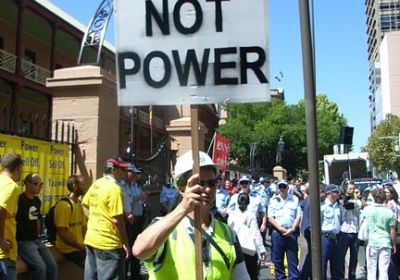
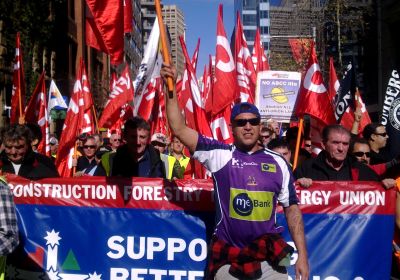
In protests around the country on Workers Memorial Day, April 28, thousands of workers came out to remember those killed on the job and to protest against the Australian Building and Construction Commission (ABCC). Speakers pointed out that since the ABCC was formed, deaths in the construction industry had risen from 3.14 deaths per 100,000 workers in 2004, to 4.27 in 2008. The rate peaked in 2006, at 5.6. The Rudd government’s home insulation program, under which four workers died and there have been 120 house fires, also came under attack. -
- Magan-djin/Brisbane