
 Russia’s current military action in Syria, its first such action outside former Soviet territory, has shocked the world.
Turkish President Tayyip Erdoğan exclaimed, miserably: “Russia has no border with Syria, so why are they so interested in Syria?”
Russia’s current military action in Syria, its first such action outside former Soviet territory, has shocked the world.
Turkish President Tayyip Erdoğan exclaimed, miserably: “Russia has no border with Syria, so why are they so interested in Syria?”
-
Russia’s current military action in Syria, its first such action outside former Soviet territory, has shocked the world.
Turkish President Tayyip Erdoğan exclaimed, miserably: “Russia has no border with Syria, so why are they so interested in Syria?”
-
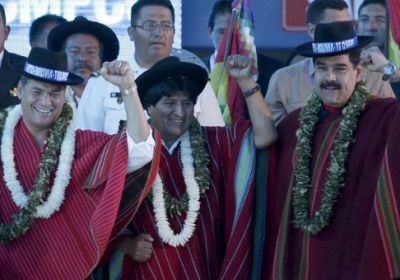 “For now, we are discussing a problem left to us by capitalism - climate change.” This was the conclusion of Bolivian President Evo Morales in his closing remarks to the October 10-12 World People's Conference on Climate Change and the Defence of Life in Cochabamba. More than 5000 people from more than 40 countries took part in the summit, established to give a voice to the poor and marginalised victims of climate change. Proposals and demands agreed on at the summit will be taken directly to the United Nations climate talks in Paris starting on November 30.
 -
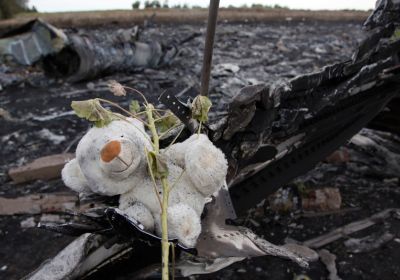 The Dutch Safety Board released its long-awaited report on October 13 into the downing of flight MH17 at the Gilze-Rijen military airbase. It came 15 months after the disaster that killed 298 people, Morning Star said the next day. Board chairperson Tjibbe Joustra criticised the Kiev government for allowing civilian aircraft to fly through a dangerous war zone.
 -
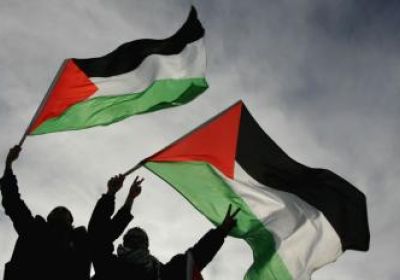 Some things are recurring in the Israel-Palestine conflict. One is that the Israeli version of events is generally the direct opposite of reality. Another is that Western politicians and media uncritically accept the Israeli narrative. A third recurring feature of the conflict is that the most compelling evidence contradicting the Israeli version events is the body count.
 -
 The moment the bomb detonated. Ankara, October 10, 10:04am.
The following statement was released by Selahattin Demirtaş and Figen Yüksekdağ, co-chairs of the Peoples Democratic Party (HDP), on October 12 in response to the October 10 bombing of a peace rally in Ankara organised by the HDP, trade unions and civil society organisations. Following the attack, police blocked ambulances and attacked survivors.
The moment the bomb detonated. Ankara, October 10, 10:04am.
The following statement was released by Selahattin Demirtaş and Figen Yüksekdağ, co-chairs of the Peoples Democratic Party (HDP), on October 12 in response to the October 10 bombing of a peace rally in Ankara organised by the HDP, trade unions and civil society organisations. Following the attack, police blocked ambulances and attacked survivors.
-
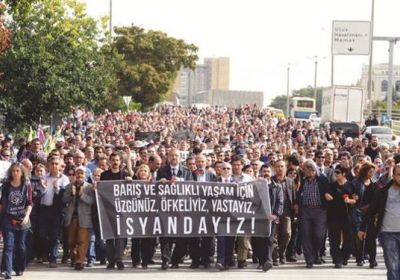 There was massive participation in the general strike declared by four main trade unions on October 12 and 13 in protest at the October 10 massacre in Ankara. The strike brought life to a halt. While there was large participation across Turkey, thousands of workers took to streets in Ankara where the October 10 blasts claimed the lives of at least 128 people and left as many wounded.
 -
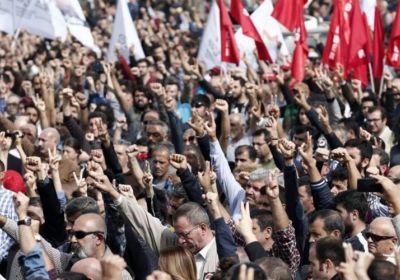
Turkish trade unions began a two-day general strike on October 12 in protest at the bombings two days earlier at a peace march in Ankara peace march that killed more than 125 people, Morning Star online reported.
-
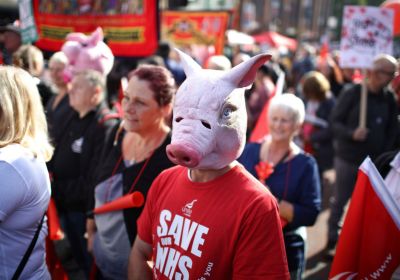 A desperate Conservative Party launched a vicious attack on Labour and the tens of thousands who have protested against its October 4-7 conference in Manchester — highlighting the government's fear of growing mass opposition. Wales Secretary Stephen Crabb accused protesters of spouting “venom and bile” because they dared to speak out against Tory cuts and oppose privatisation of public services and attacks on workers' rights.
 -
 Activists from France's Left Front. The Left Front is divided by strategic debates over how to confront Europe-wide austerity.
Five key figures of the European left have launched a new initiative “for a Plan B in Europe”.
Activists from France's Left Front. The Left Front is divided by strategic debates over how to confront Europe-wide austerity.
Five key figures of the European left have launched a new initiative “for a Plan B in Europe”.
-
 The United Nations Human Rights Council has unanimously adopted a resolution called “Promoting Reconciliation, Accountability and Human Rights in Sri Lanka”. This resolution, of which the United States was the main sponsor, welcomed a proposal by the Sri Lankan government to establish a “judicial mechanism” to investigate “abuses of human rights and violations of international humanitarian law”.
 -
 Photo: Jewish Voice for Peace Albuquerque Chapter.
For most of its existence since 1948, Israel has had the support of most Jews in the US. There have always, however, been some dissident voices, especially among Jewish members of socialist and communist groups.
Photo: Jewish Voice for Peace Albuquerque Chapter.
For most of its existence since 1948, Israel has had the support of most Jews in the US. There have always, however, been some dissident voices, especially among Jewish members of socialist and communist groups.
-
 Every year, the International Monetary Fund (IMF) sends a group of economists to Australia to survey the domestic economy, comment on the effects of government policy and make some suggestions as to what might best be done in the coming year. It is known as an “article IV consultation”. The IMF executive board’s latest report was publicly released in early October. After commending Australia’s economic performance during the past two decades, the report noted some challenges ahead. Chief among them is the prospect of “slow growth” in the coming year.