-
“WikiLeaks has had more scoops in three years than the Washington Post has had in 30.” — Clay Shirky It is for this reason that Wikileaks has become an incredibly important news source, with its commitment to provide the public with information that is deliberately withheld by governments and corporations, and to expose corruption. Its recent release of classified diplomatic cables revealing what our governments are really talking about behind closed doors has created a great divide in public opinion about just how much we, the people, really have a right to know. -
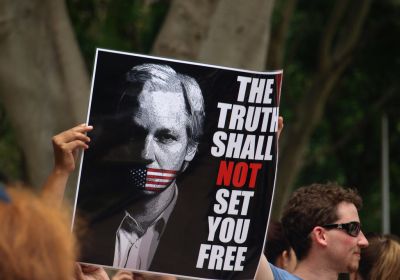
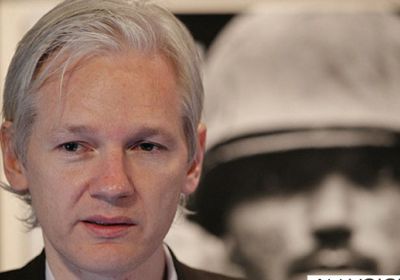
The significance of the whistle-blowing website Wikileaks can be measured by the hysterical and panicked response of the powerful to it. Wikileaks’ ongoing release of thousands of secret US government cables and other secret documents is being met with outrage, assassination threats, censorship, a corporate boycott and legal action. Much of this has centred on Wikileaks editor-in-chief Julian Assange. The allegations of sex crimes (for which no charges have yet been laid) have been used to hound him through the courts. -
When it comes to rape, the left “still doesn’t get it”, so says Katha Pollitt writing recently in the London Guardian on the defence of Wikileaks editor-in-chief Julian Assange, who is currently being held in Britain facing allegations of sex crimes in Sweden. -
December 14, 2010 -- Julian Assange, a man known only to a very few in the world some months ago, is demonstrating that the most powerful empire to have existed in history can be challenged. The daring challenge did not come from a rival superpower; from a state with more than 100 nuclear weapons; from a country with millions of inhabitants; from a group of nations with vast natural resources which the United States could not do without; or from a revolutionary doctrine capable of shaking to its foundations the empire based on plunder and exploitation of the world. -
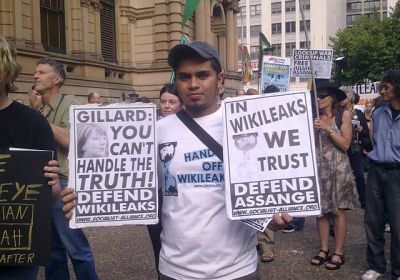
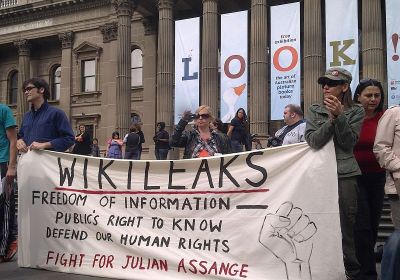
Supporters of whistleblowing website Wikileaks rallied in Sydney, Melbourne and Adelaide on December 14, as Wikileaks editor-in chief Julian Assange faced a bail hearing at Westminster magistrates court in London that day. Protesters opposed attempts by governments and corporations to shut down and harrass the site. About 800 people gathered in Sydney to call for Assange to be granted a fair trial and to defend Wikileaks. About 1000 marched in Melbourne and 300 in Adelaide.
-
Wikileaks is Democracy, a political and defense mobilization group that supports Julian Assange, WikiLeaks, democracy and transparency in government, is promoting an open letter printed below. The letter was started by Linda Schade and Kevin Zeese, past and current executive directors of Voters For Peace. -
In the US Army manual on counterinsurgency, the American commander General David Petraeus describes Afghanistan as a “war of perception... conducted continuously using the news media”. What really matters is not so much the day-to-day battles against the Taliban as the way the adventure is sold in America where “the media directly influence the attitude of key audiences”. Reading this, I was reminded of the Venezuelan general who led a coup against the democratic government in 2002. “We had a secret weapon,” he boasted. “We had the media, especially TV. You got to have the media.” -
More than 1000 people rallied at Sydney’s Town Hall at 1pm on December 10 to show their support for Wikileaks and its founder Julian Assange. Rallies also occurred in Brisbane, Melbourne, Hobart, Adelaide and Perth.
-
• A secret, US-backed operation had started to remove enriched uranium spent fuel from a Pakistani nuclear reactor research facility. • The US, Israel and several Middle East countries collaborated to isolate and threaten Iran, and several European countries were revealed to be holding US-owned nuclear weapons on their soil.
-
More than 250,000 confidential files from United States embassies and consulates around the world sit in the database of whistleblower website Wikileaks.