-
-
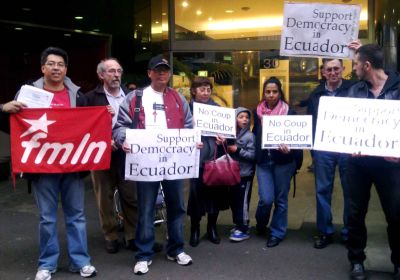
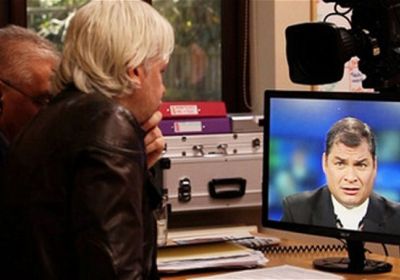
You can sign an online petition to the government of Ecuadorian president Rafael Correa in support of Julian Assange's extradition request. * * * To: Rafael Vicente Correa Delgado President of the Republic of Ecuador Ricardo Armando Patiño Aroca Minister of Foreign Relations, Republic of Ecuador CC: Raúl Gangotena Ambassador of the Republic of Ecuador in Australia Luis Felipe Valencia Consul General of the Republic of Ecuador in Australia -
Global Friends of WikiLeaks is an independent collective of WikiLeaks supporters. It is not affiliated with WikiLeaks. The letter below was originally posted here on June 20. You can sign an online petition to the government of Ecuadorian president Rafael Correa in support of Julian Assange's extradition request. * * *
-
Criticism of Latin America’s radical governments has become common currency among much of the international left. While none have been exempt, Ecuador’s government of President Rafael Correa has been a key target. But a problem with much of the criticism directed against Correa is that it lacks any solid foundation and misdirects fire away from the real enemy. Correa was elected president in 2006 after more than a decade of mostly indigenous-led rebellions against neoliberalism. -
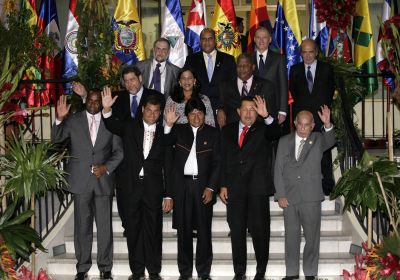
Member countries of Latin America’s alternative integration bloc, the Bolivarian Alliance for the Peoples of Our America (ALBA), met for its 11th summit in Caracas on February 4 and 5 to discuss advancing the organisation. ALBA is made up of the governments of Venezuela, Cuba, Bolivia, Ecuador, Nicaragua, Dominica, Saint Vincent and the Grenadines, and Antigua and Barbuda. Formed in 2004, ALBA seeks to develop trade on the basis of solidarity and cooperation.
-
Seven years after being launched by the Venezuelan and Cuban governments, the Bolivarian Alliance for the Peoples of Our Americas (ALBA) has become an important voice on the global stage willing to stand up and denounce capitalism. ALBA has grown to include eight Latin American and Caribbean countries (Venezuela, Cuba, Bolivia, Ecuador, Nicaragua, Antigua and Barbuda, Dominica, Saint Vincent and the Grenadines. -
An Ecuadorian court handed down a landmark verdict in an 18-year case against international oil-giant Chevron on February 14. The company was fined US$8.6 billion for polluting the Amazonian basin, and $900 million in costs. The case — perhaps the biggest environmental case in history — was filed on behalf of around 30,000 peasants, farmers, and indigenous Ecuadorians who have suffered the ill-effects of Chevron’s toxic legacy.
-
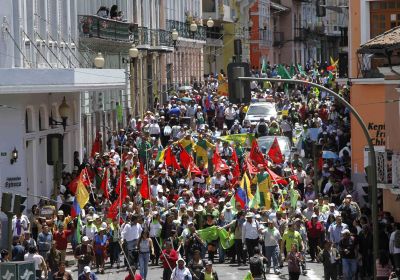
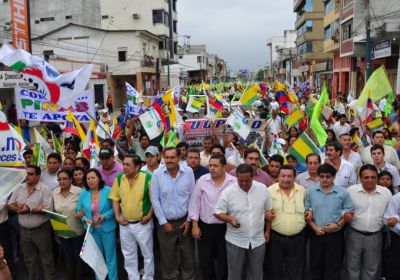
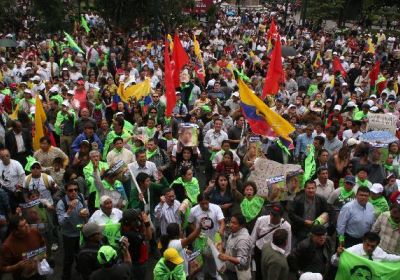
It is not difficult to see that the events in Ecuador on September 30 amounted to an attempted right-wing coup d’etat. Mass mobilisations in the streets of the capital, Quito, and other cities — together with action by sections of the armed forces loyal to the government — stopped the coup before the day was out. But those few hours highlighted, again, the deep dangers facing those fighting for progressive change in Latin America and the Caribbean. -
In the aftermath of a failed coup attempt on September 30, left-wing Ecuadorian President Rafael Correa has vowed to deepen his “citizen’s revolution” in the small Andean country. After the coup attempt by sections of the police and armed forces failed amid pro-government protests, Correa’s approval rate has surged to 75% in some polls. In response, Correa, said his government had not done enough to implement its pro-people program and would radicalise its project to build a “socialism of the 21st century”. -
The attempted coup d’etat in Ecuador on September 30 against the left-wing government of Rafael Correa was defeated by loyal troops and the mass mobilisation of Correa’s supporters. The event underscores the turbulent history of the small Andean nation. It also exposes some of the weaknesses of Ecuador’s revolutionary movement, which is part of a broader Latin American movement against US domination and for regional unity and social justice. -
On September 30, Ecuador descended into chaos as a protest by sections of the police force and army turned into a potentially bloody coup against left-wing President Rafael Correa. At about 8am, sections of the Ecuadorian Armed Forces and the national police went on strike, occupying police stations and barracks in the capital Quito, in Guayaquil and in at least four other cities. They set up road blocks with burning tyres, cutting off access to the capital. -
A coup attempt is underway against the government of President Rafael Correa. On Thursday morning, groups of police forces rebelled and took over key strategic sites in Quito, Ecuador’s capital.
Ecuador
Ecuador