-
British politics is being dominated by the June 23 referendum on whether Britain leaves the European Union (EU) — the so-called Brexit. This is a question that has, over recent decades, threatened to fatally divide the British right. But left forces also hold contradictory perspectives on the question. Labour Party leader Jeremy Corbyn, the Green Party of England and Wales and Left Unity are calling for a “yes” vote to remain in the European Union, but are demanding an alternative to the neoliberal EU. -
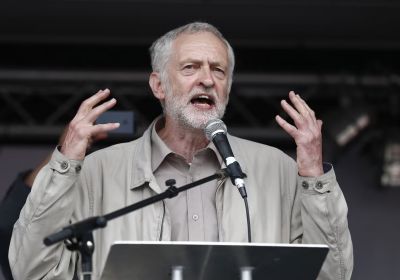
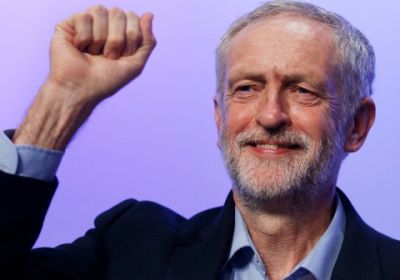
Jeremy Corbyn's election as Labour Party leader has already had a dramatic effect on British politics. All of us on the left in Britain need to ask how we can support him — and consider what the long term implications of his success may be.
-
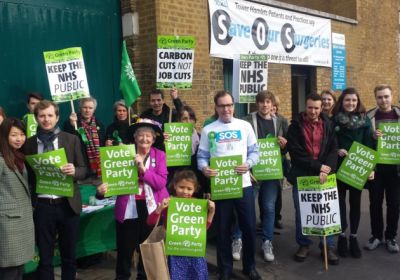
Britain's May 7 general elections, in which the Conservative Party won an outright majority, produced a couple of silver linings on a very large black cloud. One was the success of the Green Party of England and Wales. While the party did not sweep into Westminster, it made progress politically and in terms of votes.
-
A Green Surge has hit Britain. Thanks to an ongoing growth spurt, the Green Party of England and Wales has now hit 54,000 members, on top of nearly 10,000 members in the Scottish Green Party. Opinion polls put the party on the rise, frequently beating the Liberal Democrats, who are governing in coalition with the Conservatives. The Greens now have more members than the far-right anti-immigrant UK Independence Party (UKIP), whose growing support has generated much media attention. -
Beyond Capitalism? The Future of Radical Politics Luke Cooper & Simon Hardy Zero Books, 2013 Luke Cooper and Simon Hardy should be congratulated on producing a thoughtful contribution as to how we build a movement capable of defeating capitalism and creating a socialist society. From climate change to the financial crisis and austerity, the neo-liberal project has failed. Where it once promised prosperity, it can only deliver ashes.
-
With Italy being the latest European country to reject nuclear power in a June 12-13 referendum, a coalition of anti-nuclear groups in Britain has announced plans to hold a mass non-violent blockade of Hinkley Point nuclear power station on October 3. The plant, near Bridgwater in Somerset, is expected to be the site of the first new nuclear power station. Hundreds of campaigners are expected to take part in Gandhi-style civil disobedience, risking arrest by blockading the access road to the site in protest over the threat posed by nuclear power.
-
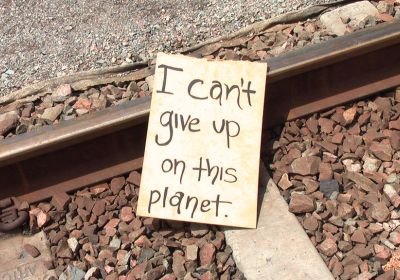
The recent figures on CO2 emissions are sobering. Despite the fact that the world has suffered a terrible recession, emissions are still rising. In essence, all the efforts to tackle climate change have simply slowed the rise a little rather than reverse it. The problem is that the solutions to climate change put forward at international conferences like Copenhagen and Cancun dare not deal with the real root cause of climate change — our current economic system. -
The historian William Cronon has been in the news recently in the US because of assaults on his civil liberties and academic freedom by the Wisconsin Republican Party. This story is likely to be of interest to Green Left Weekly readers because of the collision between university research and powerful corporate interests. However, Cronon's work as an environmental historian since the 1970s means that he deserves to be read by all those who take an interest in environmental issues and ecosocialist politics. -
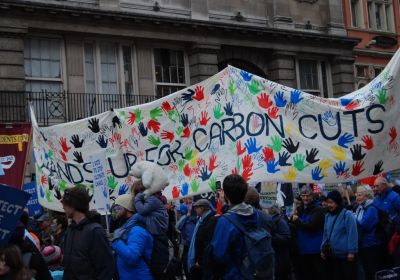
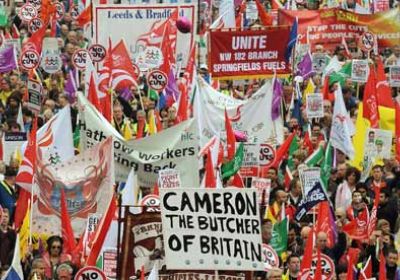
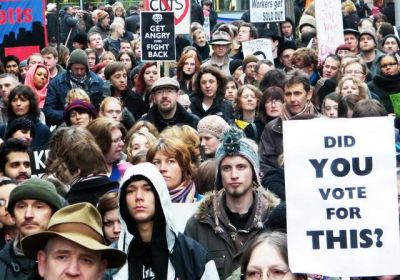
About 500,000 people marched in London on March 26 against the British government’s program of huge spending cuts. Called by the Trade Union Congress (TUC), the march drew people from every part of Britain — a splendid cross section of the country with numbers dominated by the working class.
-
A rebellion is developing across Britain in the face of huge spending cuts by the Conservative Party-Liberal Democrat coalition government. The scale of the cuts is huge. The government is seeking to privatise huge swathes of the economy and hundreds of thousands of public sector jobs are under threat. They have also cut corporation tax, but sharply increased the goods and services VAT tax from 17.5% to 20%, which hits those on lower incomes hardest. By changing the inflation measure used to determine benefits and pensions, the government is plunging more people into poverty. -
In 2009, more than a 100 activists were arrested in a swoop on a community centre in Nottingham in an operation involving hundreds of police. They were alleged to be planning to close down Ratcliffe-on-Soar power station. It was revealed that one of the organisers of the alleged protest, Mark Stone, was an undercover cop who had tipped off the police. Stone was unveiled after his partner found a passport in his real name of Mark Kennedy. He was confronted by Camp for Climate Action activists and confessed all. -
Ecology & Socialism By Chris Williams Haymarket, 2009 www.ecologyandsocialism.org United States activist Chris William’s new book, published by Haymarket Press, is an excellent introduction to ecology and socialism. It is well written and, despite being a long-time ecosocialist activist, I learnt a lot from it. Williams is a professor of physics and chemistry at Pace University, and chair of the science department at Packer Collegiate Institute. He is a green activist and a member of the International Socialist Organization.