
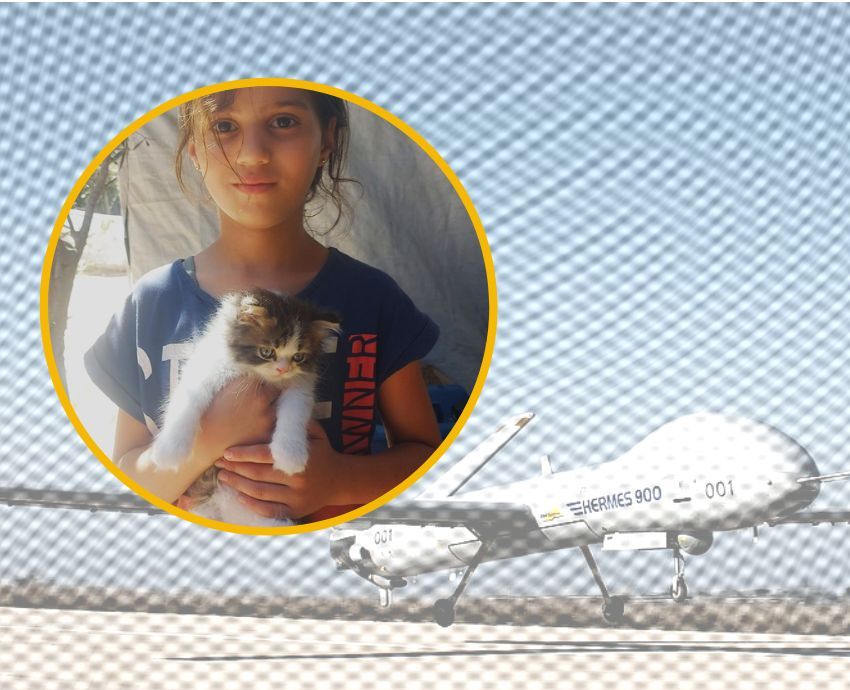
Nine-year-old Mira Hamad witnessed a bomb destroy her next-door neighbour. She now lives with the trauma. Green Left’s Jude Alexander spoke to Hamad, her father and NSW Greens Senator David Shoebridge about the bomb and Australia’s connection.
• • •
Hamad has been displaced 11 times and lives in a tent with her family.
She told me her favourite food is a shawarma kebab. “My favourite piece of clothing is a tracksuit and leggings, and I like playing hopscotch with my friends.” She also has a new kitten, which she loves. “She plays with me every morning and sleeps next to me at night.”
In August last year, the tent beside Hamad’s family was bombed. She saw her neighbours cut to pieces. It changed her life.
On the day of the bombing, Hamad’s father told me he was shocked to hear the distant sounds of the drones getting much closer. “The smell of gunpowder was distinct, amid the usual smell of the dust. Moments later, I heard people screaming and saw everyone rushing to the tent beside us.
“Mira was terrified by the sight of our neighbour Arbaba’s mangled corpse. The shock was clearly visible on her face; she said nothing. She did not sleep well, and suffered from bet-wetting for some time.”
Children should not have to deal with terrible things like this, which is why I asked Shoebridge about that particular bomb and the infrastructure behind it.
That bomb is the link between military equipment and the life of one child. I thought that reducing the overwhelming enormity of the genocide to just one bomb might reveal something about the methods of those responsible for it.
I asked Shoebridge, who holds the defence portfolio for the Australian Greens, about the bomb the Israeli Defense Force (IDF) dropped on the tent next to Hamad.
What he said was horrifying; nothing like what I was expecting. I’ve worked with the military, in an adjacent way. In my former work with a fire authority, I’ve worked on fires that burn for weeks through the summer.
Military operations are not so different to fire fighting.
My expectation was that for a bomb to have fallen on a tent, someone must have ordered the bomb; someone manufactured the firing pin and smelted the steel for the shell. There was a budget; someone paid the invoice; someone looked at a map and decided where the bomb would fall. Someone flew it out there.
I was wrong.
Shoebridge said the Israeli government, through a section of its military intelligence, called Unit 8200, is running an Artificial Intelligence program, called Lavender. That tent was bombed after data was aggregated from people’s mobile phones and from facial recognition software.
There would have been minimal to no human interaction. The choice to kill the people in the tent beside Mira’s would have been made by a computer.
Israeli intelligence
Unit 8200 is a part of the Israeli Intelligence Corps, considered its cyber arm; it is primarily responsible for electronic espionage.
The head of Israeli Microsoft recently stepped down after it was revealed that Unit 8200 had violated its terms of service, by using Microsoft’s Azure cloud platform to store phone calls from Gaza.
According to the Guardian, “Equipped with Azure’s near-limitless storage capacity and computing power, Unit 8200 built an indiscriminate system allowing its intelligence officers to collect, play back and analyse the content of millions of Palestinian cellular phone calls every day.”
When Mira grows up, she hopes to be a doctor. This will be difficult for her, but not impossible. She has now missed three years of primary school.
Lavender
Lavender, named after the sweet-smelling flower, used to identify military targets automatically for Israel.
Gaza has been subjected to a computerised slaughter. Using AI to identify targets is much faster than using human intelligence. The IDF used gravity bombs, called “dumb bombs” on lower-value targets, saving their expensive “smart bomb” munitions for best.
An Israeli intelligence officer interviewed by the Guardian in April 2025 said: “Because we usually carried out the attacks with dumb bombs, and that meant literally dropping the whole house on its occupants. But even if an attack is averted, you don’t care — you immediately move on to the next target. Because of the system, the targets never end. You have another 36,000 waiting.”
The bomb used on Hamad’s neighbour was probably a gravity bomb, because it was dropped from a drone.
Most people expect drones to be small things, but there are now fully-automated drones the size of passenger jets in regular use by the IDF.
Drone munitions made in Israel are free-falling and can reach the speed of sound. They fall in silence.
“I wish we could go back to school and buy our favourite toys, and stop hearing the sound of explosions,” Hamad said.
Shoebridge said systems like this comprise the frontier of modern warfare. Hamad, he said, is living on the front line of a dystopia.
Private companies involved in the bomb that fell next to Hamad and killed her neighbours are run by hard-right people, such as Alex Karp and Peter Thiel of Palantir. They see the West as being involved in a perpetual race war with everybody else.
Hamad’s dad has been looking to buy her a Barbie, but he cannot find one.
Australia complicit
Australia has worked to extend the range of guided bombs, which have tail fins to help them glide into the general area, and then be directed to strike once the target is identified.
Australian researchers built a long-range guided missile called JDAM. The Royal Australian Air Force put out a research request and the missiles were trialed in Woomera in 2013. This was probably not used on the missile that killed Hamad‘s neighbours, because those munitions are launched from planes.
But how many children have been killed by bombs guided by Australian-designed glide bomb conversion kits?
Australia has also been letting Palantir into its military systems.
According to Shoebridge, Palantir has also been engaged to map Australia’s defence industry capability. The Australian Defence Force (ADF) spent $7.6 million in February contracting Palantir for its targeting software.
Palantir staff is embedded in the ADF and the company has achieved “protected level” in the Australian Signals Directorate’s information security registered assessors’ program. Palantir has also been engaged to map Australia’s defence industry capability.
Shoebridge has been calling for contracts with Palantir to be cancelled. It should be easy, given the security risks associated with allowing a company with its own manifesto in to the most sensitive aspects of the defence system.
It is even more important given what we know about the damage these companies are already doing to children like Hamad.
If there are private companies run by people creating unethical AI systems directing unmanned drones to drop unguided missiles right next to and sometimes on to children who like orange blossoms and playing hopscotch. Is this something we are willing to live with?
[You can donate to Mira Hamad’s family here.]