
The trilateral meeting held in Port Moresby on December 3 between the Indonesian, Australian and Papua New Guinean defence ministers marked a significant moment in Indo-Pacific regional security alignment.
PNG’s Dr Billy Joseph, Australia’s Richard Marles and Indonesia’s Retired General Sjafrie Sjamsoeddin discussed strengthening cooperation on border management, maritime security, intelligence sharing, counter-smuggling and crisis preparedness.
On the surface, this trilateral framework appears to advance a pragmatic vision of collective security, particularly through reinforcing the PNG–Australia Mutual Defence Treaty (Pukpuk Treaty) and the Australia–Indonesia Treaty on Common Security.
In his opening remarks, Joseph said the trilateral meeting was a “significant moment” for the three nations, emphasising shared borders, maritime zones, cultural linkages and strategic interests.
However, beneath this diplomatic language lies a deeper contradiction: the trilateral security agenda operates in the shadow of the conflict, humanitarian and political crisis in West Papua.
This crisis is not mentioned directly in the joint communique, but it undeniably shapes the security landscape in which the three states operate. A critical analysis of the meeting therefore requires confronting the tensions between regional security cooperation, state-centric stability and the unresolved conflict at the heart of the Pacific.
Can regional stability genuinely be achieved when the West Papuan humanitarian realities remain structurally excluded from diplomatic and security processes? To what extent do defence pacts framed as instruments of regional stability enable and perpetuate cycles of violence?
These questions highlight a deeper theoretical tension: that security cooperation grounded solely in state-centric paradigms may fail to address, and may even exacerbate, the underlying political and humanitarian drivers of conflict.
Humanitarian situation in West Papua continues to deteriorate
Indonesian military forces reportedly used an armed drone in an operation that struck a civilian home in Yahukimo District on November 25, killing 17-year-old student Atin Sam and seriously injuring others.
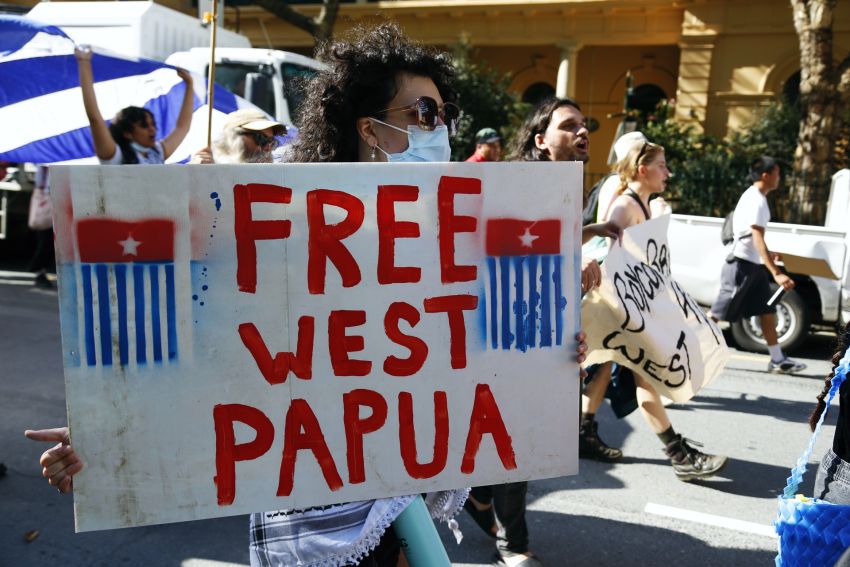
Just days before the Port Moresby meeting, West Papuans commemorated their symbolic Independence Day on December 1 by raising the Morning Star flag, staging peaceful protests, and participating in acts of cultural resistance across West Papua and Indonesia.
These events demonstrate the persistence of Papuan political identity and collective memory despite decades of repression. Meanwhile, Indonesian security forces intensified surveillance and arrests, reinforcing the pattern of securitised governance.
Militarisation and asymmetry in West Papua
Against the backdrop of colonial narratives emphasising development, stability and normalisation, independent reporting suggests a starkly different reality.
Project Multatuli, among other civil society sources, has reported that more than 80,000 Indonesian security personnel including soldiers, police and intelligence units are currently deployed across the Papuan provinces under the Prabowo Subianto administration.
Although Jakarta has not publicly confirmed these figures, the scale of the deployment would indicate one of the highest levels of militarisation in the Pacific. It also reinforces widespread perceptions that a large-scale, coordinated security operation is underway but not publicly acknowledged.
In striking contrast, various independent estimates indicate that the TPNPB — the military wing of the Papuan independence movement (OPM) and the primary armed resistance group — possesses fewer than 100 firearms and maintains roughly 1000 fighters, most of whom still rely on traditional weapons such as bows, arrows and spears.
The power imbalance is therefore extreme: the conflict is not between two symmetrical armed forces, but between a modern, heavily equipped state military and a lightly armed, territorially dispersed insurgency embedded in rural communities. This asymmetry carries profound implications for civilian safety, the nature of state coercion and the structural dynamics of the conflict.
Indonesia’s strategic silence and the politics of legitimacy
Indonesia’s engagement in the trilateral meeting must be understood within the framework of strategic legitimacy-building. By participating in high-level security dialogues, Indonesia enhances its international standing and reinforces the perception that the situation in West Papua is an internal matter fully under control.
By controlling the narrative, Indonesia can maintain the appearance of stability while deflecting scrutiny of its domestic security policies.
The West Papuan conflict is not a simple domestic security issue, as Indonesia often claims. It has deep international roots, beginning with the controversial Act of Free Choice in 1969, which was overseen and legitimised by the United Nations despite widespread criticism from scholars, human rights groups and West Papuans themselves. Because the UN facilitated this process, the conflict’s legitimacy and outcome remain part of an international dispute, not an internal matter.
The TPNPB positions itself as a liberation force fighting against colonial occupation. Its struggle is framed in the language of anti-colonialism, self-determination and international human rights law — principles recognised under the UN Charter.
Lesson from East Timor, Bougainville, Aceh
The trilateral meeting’s silence on West Papua stands in contrast with important regional precedents. These cases complicate assumptions about military dominance, conflict resolution and the long-term viability of territorial control.
A central tension that the UN, regional and sub-regional fora in the Pacific — including the recent trilateral defence meeting — often fail to acknowledge is that the largest ongoing armed conflict in both the Pacific and Indonesia is the protracted conflict in West Papua. Many West Papuans including armed factions such as the TPNPB explicitly describe the situation as liberation war.
While they continue to challenge Indonesia’s sovereignty over the region, external observers commonly assess that the TPNPB is unlikely to prevail militarily against the far more powerful Indonesian National Armed Forces (TNI).
Yet historical precedents complicate such assumptions of inevitability. For decades, the prospect of East Timorese independence likewise appeared impossible, until the political and military dynamics shifted dramatically in the late 1990s.
The example of Bougainville further demonstrates how protracted conflicts can produce unexpected political outcomes. PNG ultimately moved toward dialogue and political accommodation not out of strategic preference but because the PNG Defence Force failed to defeat the Bougainville Revolutionary Army (BRA), eventually withdrawing in disarray.
The long-term settlement has led toward an almost inevitable trajectory of Bougainvillean independence. This path, however, represents precisely the kind of outcome Indonesia seeks to avoid in West Papua, where any form of internationally mediated political process is perceived as a potential threat to territorial integrity.
The case of Aceh is often cited as a more positive and potentially transferable model, but the differences between Aceh and West Papua are substantial. The Aceh settlement was facilitated by strong international support, the role of the EU-led monitoring mission, the aftermath of the 2004 tsunami, and the presence of a comparatively sophisticated and well-armed movement (GAM) with external networks.
Building regional stability without addressing conflict resolution in West Papua is impossible, as the crisis constitutes one of the most severe and enduring humanitarian tragedies in the Pacific. Lasting stability cannot be built on silence or strategic avoidance; it requires confronting the unresolved conflict at the very heart of the region — West Papua.