
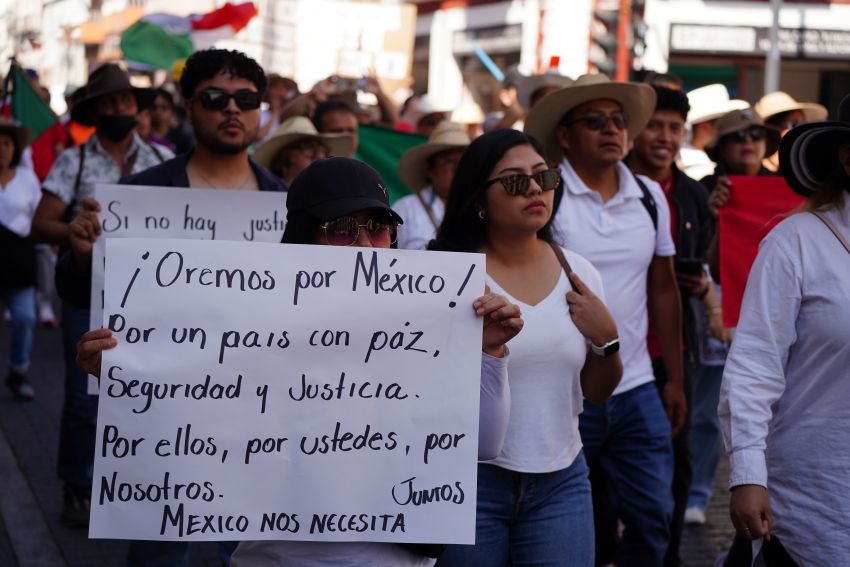
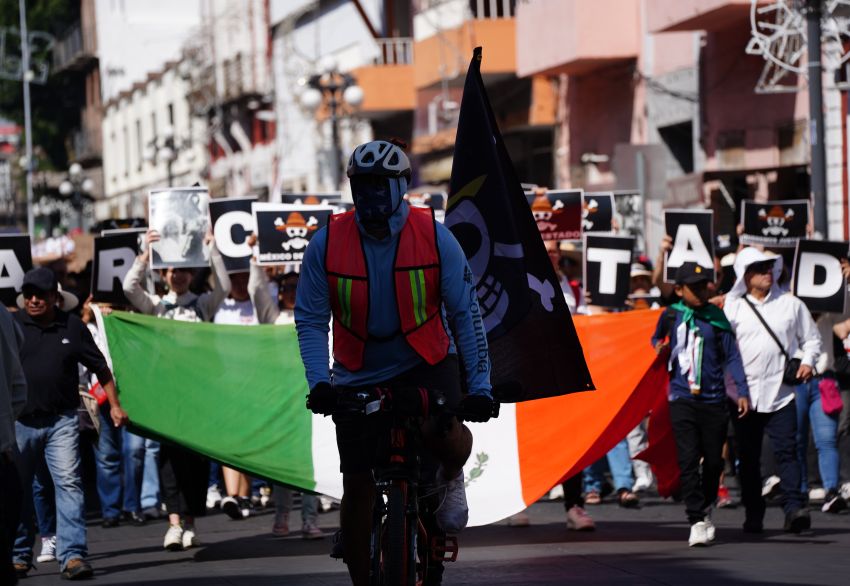
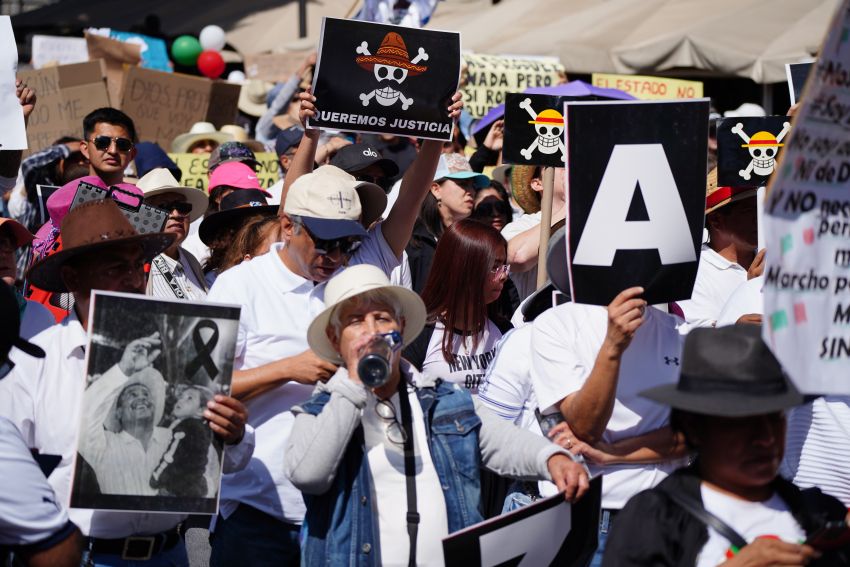
“Down with communism”, they chanted while also waving the One Piece pirate flag, meant to be a symbol of resistance to elitist excess, corruption and inequality. The right-wing march was meant to be a “Generation Z” protest, but most of the people I could see among the 1000 or so marching through the centre of Puebla, were of older generations; clearly the most loyal membership of Mexico’s right-wing parties, the Institutional Revolutionary Party and National Action Party.
Similar marches were held in various cities around the country on November 15. They were a bizarre attempt to copy-paste the recent uprisings and protests in Nepal, the Philippines and Indonesia, but they were built from the top down. Money was spent conjuring the protest from artificial intelligence (AI) campaigns, bots and influencers, rather than involving real social movements.
The main chants in the march were “Out Morena” (Mexico’s governing party) and “No more narco-state”. Meant to be organic, spontaneous anger at the government, crime and corruption, these marches’ vagueness and misuse of symbols left serious and experienced activists in the country amused, and a little annoyed.
As 51% of content is now AI-generated, it’s worth decoding how this protest was fabricated and the impact of its co-option of the symbols and phrases of more genuine causes. AI literacy and awareness of how videos and facts are manipulated for political and economic interests is becoming more important.
Social media
The Instagram account @somosgeneracionzmx (We are Generation Z Mexico) was among the first to publicly call for the November 15 protest.
Although describing itself as “anti-party”, “the disinterested generation” and “enough of the same old shit”, there are dozens of signs the account was not created by movement activists. The account does not follow, tag or interact with other longstanding movements, collectives or grassroots organisations, such as unions or community or alternative media.
The only groups it follows are bot-like replicas of itself that have each posted perhaps four times in total.
The account’s first posts were created exactly a month before the November 15 protest and got hundreds of engagements (likes and comments) straight off the bat: a sign the account holder either has funds to pay for significant boosting or that the posts were supported by bots.
Almost all the account’s content, including videos, is AI-generated.
Likewise, its sister account on Facebook. There are few real humans to be seen. But in Mexico, while people often cover their faces in public videos denouncing crimes and injustice due to fear of persecution, it is always important to show at least the eyes, or the full group of farmers on the land being attacked or the indigenous people meeting, women standing together and so on, to demonstrate that these communities are organising and speaking out.
The Generation Z Mexico accounts don’t have such visuals because they don’t actually meet, discuss and decide based on voting or consensus, hold speak-outs to build larger protests and other staples of real movements.
“Generation Z Mexico” doesn’t have real visuals of activists — and especially not young ones — because it is not led by actual activists or young people. In Mexico, there are strong women’s movements, movements for the forcibly disappeared, for water rights and more, but there is no movement here to revoke the president, so there are no photos of that to be used.
Instead, this group has resorted to AI-generated photos of protests such as this one. After the November 15 march, they will have photos they can use, though even those are being digitally edited to make their crowds look bigger.
Influencers for hire
Because this made-up movement doesn’t consist of real, committed activists, the people behind it instead throw money at influencers. One of the few real people seen on its Instagram account includes this influencer, who has 177,000 followers, and dedicates all her posts to fashion and to photos of herself posing. She openly advertises that she is available for paid promotions.
Another person featured on the account and who promoted the November 15 protest is this influencer, who also has never posted any political content until a week or two ago, when he suddenly went on a rant about “the left” or “communists” trying to delegitimise his “movement”.
Like all the content generated for the November 15 protest, he is vague about what it is he wants, talking about “a movement that seeks to represent us” and “dialogue” and “tolerance” (post since removed).
Influencer Carlos Bellow, who describes himself as a “man of god and business” and posts photos of himself in expensive suits, has also taken up the flag of the “protest”.
Another indication that this protest isn’t genuine is the support it has garnered from right-wing and commercial media. Media like TV Azteca for example, which usually demonises real movements and resistance, was among the first to promote the protest.
The head of TV Azteca, Ricardo Salinas Pliego, a billionaire recently investigated for money laundering and tax avoidance, posted about the November 15 protest various times and with slogans totally in line with the phrasing used by the “Generation Z Mexico” accounts, not to mention directly sharing their posts.
Finally, the content of the protest and those promoting it is muddy at best.
Screaming without substance
There were references to phrases brought up in other Gen Z protests in other countries, like “corruption” and “authoritarianism”, but without specifics.
There were no deep-dives into state power structures and collusion between organised crime, big business and the various levels of government.
There was no analysis of causes, no proposals, no named corrupt figures beyond the president.
Calling out the lack of safety as “bad” is so obvious that it is meaningless. Everyone here knows how harmful the proliferation of organised crime is — the key is in denouncing its origins — including the United States’ “War on Drugs” and rampant neoliberalism — and what should actually be done about it.
Empty, obvious phrases like “corruption is bad” and “crime is bad” are typical of battles for individual power, not of genuine movements. Only politicians or CEOs make cheap references to “safety” and “transparency” in order to get votes or financing, without wanting to dent a thing about the way the rigged system works in their favour.
To make it worse, one of the influencers mentioned above created this post for the “Generation Z” account, where she argues that Che Guevara and Donald Trump are the same kind of thing.
It’s a typical right-wing argument, not dissimilar to the wackiness of the right wing in Venezuela adopting Guy Fawkes masks.
Beyond the blatant disregard for ideological nuance, let alone the macro difference between an anti-imperialist revolutionary like Guevara and a racist blockhead, this conflating of “extremes” serves centrists and right-wingers as a way to dilute left-wing heroes of their impact, while seeking to appropriate symbols or methods such as diversity, dialogue, revolt and direct action into their own sphere of influence.
Portraying people, who want basic decent things like healthcare for all or unpolluted rivers, as “extreme” sidelines them to a bubble of irrationality, while the boring, polluting conservatives get to claim reasonableness for themselves.
Mexico needs protests, but not like this
Nevertheless, there are many steep horrors in Mexico worthy of mass, protracted protest, and this manipulated initiative likely drew some genuinely frustrated youth. But, Mexico is not Nepal or Indonesia.
Mexican President Claudia Sheinbaum is extremely popular here and abroad. She uses spin masterfully, vindicating important rights and oppressed identities, while in practice she and her party continue to put big business first. Morena is full to the brim with politicians who have migrated over from the traditional right-wing parties.
Here in Puebla, our human rights are violated constantly as our water is cut off for months so that Morena can roll out the red carpet to water-consuming transnationals like Google’s AI projects, Volkswagen, Audi, Walmart and more. Morena promised to de-privatise our water before former President Andrés Manuel López Obrador’s (AMLO) first term, and instead our rates have gone up.
There are a zillion more reasons to protest — and indeed people are — including the extreme femicide rates and the murder and criminalisation of land defenders. Organised crime is booming, taking over industries like avocados, permissions (to park, to set up a stall, to sell gum on the train) and tourism. There are 134,000 disappeared people.
We are intensely angry. But the pain, exhaustion, disillusion and trauma from being ignored and minimised, the concern for Mexican and Central America migrants and the rage at protection networks for rapists and the misogyny in healthcare goes back decades. The pain is, unfortunately, integrated into the rhythm of our lives, and so a sudden revolt led by faceless AI graphics and wealthy “whitexican” influencers was always unlikely to provoke an overnight rebellion.
What’s worse is that Sheinbaum, and AMLO before her, have dismissed many important and real movements, claiming they were orchestrated by the right.
AMLO has suggested that Mexico’s women’s marches — some of the biggest globally — were organised by the opposition. Sheinbaum has dismissed the important demands of feminist marches by accusing them of violence and criminalising them, and she said “there is always dialogue ... so one doesn’t understand why they protest’ in response to the CNTE (education workers) protests a few days ago and repressed by the government.
AMLO rejected journalist protests against the high rate of murders of journalists in the country (one of the highest globally) and called journalists “conservative”.
In that sense, an actual right-wing protest only adds fuel to the fire of those trying to delegitimise real movements.
The Latin American right
This is not the first time resources have been used to digitally promote disturbances aimed at overthrowing a Latin American government.
The account calling for the November 15 protest on X only has 209 posts (they seem to be regularly deleting more posts than they share — that figure has since dropped to 182 posts, at the time of writing). When the account was first created last year, its first posts were sharing posts in support of right-wing leaders and candidates in Venezuela.
In Latin America, the international right wing has repeatedly used AI and bot strategies to generate very vague anti-government discontent in countries like Cuba, Venezuela and Ecuador (under Rafael Correa).
I witnessed right-wing protests in Venezuela and Ecuador, saw the protesters parroting the online slogans (#SOS, or wearing gas masks to convey repression), and talking to them, noted how inarticulate they were. The participants in those protests, like November 15 in Mexico, were not people ever seen supporting other causes, like the sexual diversity marches, anti-racism, worker rights or standing up to mines.
The #SOS hashtag was used in Cuba, Venezuela and Ecuador as an attempt to convey that things were so desperate for people in the particular country that US intervention was necessary. That is not happening here in Mexico — the government here is barely centrist and never stands up to the US in practice, bar voting against the Cuban sanctions.
Although, it does seem that a few on the right are dreaming about it. There was one guy at a protest recently against the killing of a mayor, walking around with a sign in English welcoming the US army to the region, and an unofficial US security news account with 500,000 followers shared the One Piece flag and wrote: “It’s time for President Trump to order massive air strikes against all Narco Terrorist targets across Mexico” and “The People of Mexico are asking America to destroy the Cartels and end decades of violence, crime and corruption! Make Mexico Great Again!”
In the Cuban “SOS” movement, it was non-local accounts that kicked off the July 2021 protests (the first account to post about a COVID-19 crisis in the country was in Spain and that account would post over a thousand times in two days; July 10–11), with the support of mass amounts of bot accounts, then paid influencers, who, like the ones here, had previously never posted about political or social issues. More than 1500 accounts that used #SOSCuba were created during those two days.
These digital campaigns can cause long-lasting damage. Especially in the absence of AI and media literacy, they can cultivate distrust of the symbols and demands of genuine movements and causes. It can become a game of popularity based on who can pay for the most boosts — and movements of the oppressed tend to lose that game.
As AI and bot manipulation is used increasingly by the right and elites, reliable, on-the-ground, quality reporting becomes even more vital. It takes experienced, local reporters and activists to be able to distinguish between real movements and fabricated ones, to read between the lines of government spin, identify local actors and their alliances and interests, decipher the agendas behind the PR and know when Zapata is being evoked for the right reasons and when his memory is being used by groups with no understanding of his legacy — parading indigenous resistance for their own interests.
[Tamara Pearson is an Australian-Mexican journalist, editor, activist and literary fiction author. Her latest novel is The Eyes of the Earth, and she writes the Global South newsletter Excluded Headlines.]