-
About 40% of new Disability Support Pension (DSP) recipients may be ruled ineligible as the federal Labor government updates the tables for the assessment of work-related impairment for DSP. Community services minister Jenny Macklin said on July 30 that the revised impairment tables will be implemented from January 1 next year and will apply to new recipients only. This is the first review of the DSP impairment tables since 1993. -
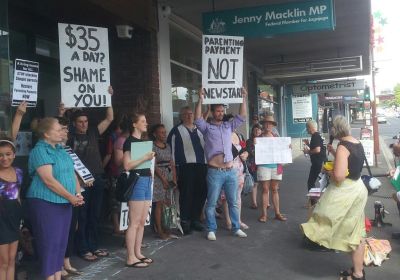
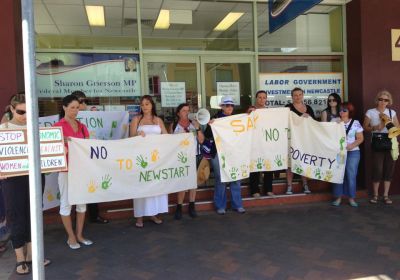
A coalition of groups in New South Wales came together in June to campaign against the federal government’s plan to introduce income management for welfare recipients in the Sydney suburb of Bankstown. The new coalition, called “Say no to government’s income management: not in Bankstown, not anywhere”, released the open letter below on July 27. * * * To ministers Tanya Plibersek and Jenny Macklin and to the local federal members for Banks, Blaxland and Watson. -
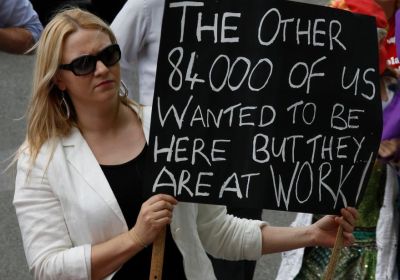
How do YOU suggest we cut Britain's deficit then? You'll be asked this if you ever oppose a cost-cutting scheme, such as merging the sewerage system with the library service or something. So here's one answer, we could pay a bit less to ATOS, a private company that receives £100 million a year from the British government for assessing who should be cut off from disability benefit.
-
The Republican-controlled House of Representatives threw down the gauntlet to President Barack Obama on July 19 by voting to cut federal spending by US$6 trillion and demand a constitutional balanced budget amendment in exchange for agreeing to raise the federal debt ceiling. The US must raise the debt ceiling by August 2 or default on its debts for the first time, potentially leaving the government unable to pay its employees and plunging the world into a second credit crunch. The bill is unlikely to pass into law.
-
As rocks fly and tear gas wafts through the streets of Athens, Greece’s Prime Minister George Papandreou has warned of a coming crackdown on protesters and striking workers. Meanwhile, a new bailout for the banks is being prepared in the halls of power in Europe. Papandreou was able to secure breathing room for the Greek government with another round of emergency loans that saved it from the immediate prospect of default — the state failing to pay back some or all of its debts. -
How is the government getting away with this idea that a public-sector pension is a “luxury”? Is it something that suave bachelors show off, saying: “Once I’ve taken you for a spin in my Aston Martin, how about I show you the mid-range forecast for my teacher’s pension over a bottle of Veuve Cliquot.” A pension is a necessity, so you might as well say we simply can’t go on enjoying the luxury of a sewerage system, given that the amount of waste we’re flushing is 35% higher than in 1996, so from 2015 we’ve got to throw it out the window otherwise we’ll end up like Greece.
-
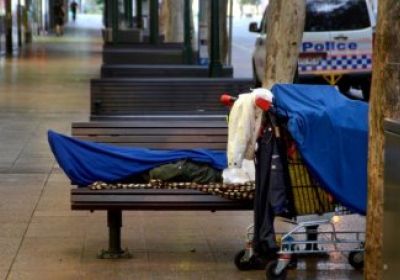
More than 60 people rallied outside parliament house on June 2 in support of rights for homeless people. This was the largest of three protests organised since the issue was raised in state parliament in April in relation to the upcoming Commonwealth Heads of Government Meeting (CHOGM).
-
Thirty people marched from the Stirling Gardens to parliament house on May 17 to protest the state governments plans to remove homeless people from the city centre for three days during the Commonwealth Heads of Government Meeting (CHOGM). Protesters were angry about the fact that $9 million dollars had been earmarked for the refurbishment of Frasers Restaurant in Kings Park for a CHOGM leaders social function. In addition, tens of millions of dollars have been allocated to refurbish ministerial offices. Meanwhile, 55,000 people are on the Homeswest waiting list for public housing. -
In its point-scoring endeavour to restore the budget to a surplus by 2012-13, Julia Gillard’s Labor government has decided to target the most vulnerable and needy in society. Instead of targeting the high end of town and the corporate elite a punitive approach was chosen. The budget deficit for 2011-12 is estimated to be $22.6 billion or 1.5% of gross domestic product. This compares with an estimated $49.4 billion deficit in this financial year, 2010-11. The budget is expected to return to surplus by $3.5 bilion in 2012-13. -
Despite some targeted increases in funding in the area of health and disability, the Labor government’s 2011 budget leaves Australians worse off. The increased funding for mental health has been widely welcomed and is a result of a long, concerted public campaign. Over five years, $2.2 billion in mental health spending was identified with a focus on early intervention programs, as well as social and employment participation strategies. Multicultural organisations, however, have criticised the absence of funding for the multicultural community. -
Twenty five people joined a demonstration organised by homeless people to protest plans by the Western Australian government to remove homeless people from the city during the Commonwealth Heads of Government Meeting (CHOGM) in October. on the street.” A parliamentary debate on April 7 revealed that homeless people would be directed away from CHOGM security areas in the city. Protesters were upset the government wanted to keep them out of sight during the CHOGM summit without doing anything to tackle homelessness.
-
Australia is one step closer towards embracing disability as part of human diversity. On February 28 the Australian Government Productivity Commission released a draft report on Disability Care and Support. If the general recommendations of the report were to be implemented, people with disability, their families and carers would achieve a much-needed improvement to their lives, albeit starting in 2014-15. The report recommends a doubling of funding to the disability support system based on 2009-2010 spending, financed from general revenue.