
“My plan is to demolish the ultra-right so that a true opposition arises, because I am ready to work with them,” Venezuelan socialist President Hugo Chavez told a mass rally of supporters of his re-election campaign in the Caracas neighbourhood of Charallave on September 9.
-
-
Green Left Report #5 has a focus on WikiLeaks, Ecuador and Julian Assange. It features interviews with Christine Assange, Latin American activist Federico Fuentes, plus features parts of the speeches from Julian Assange and Tariq Ali.
-
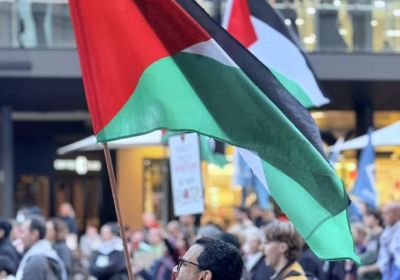
Adelaide protest organised by socialist youth group Resistance - part of a day of protest around Australia and Aotearoa/New Zealand.
-
 Although parliamentary elections are often billed as “historic”, and results hailed as “landslides” and “political earthquakes”, events usually turn out not to have been so dramatic once the dust settles. But the September 12 national election in the Netherlands really does seem to be living up to the rhetoric.
 -
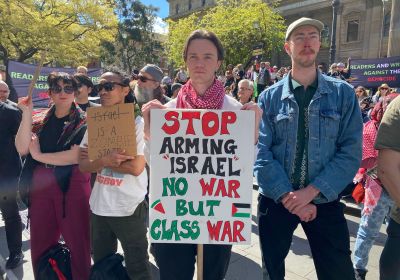
Feature interview with Chris Graham, managing editor of Tracker plus activist news on Aboriginal boxer Damien Hooper; refugee deportations; equal marriage rallies; Miranda Gibson's tree sit; the super trawler; Quebec's student uprising and from the Resistance conference. All rounded out with the return of Carlo Sands and his take on the ALP-Coalition refugee deal.
-
The 34,000 employees who work at the Polar Business food production conglomerate in Venezuela have denounced what they describe as a violation of their labour and social rights. The workers accused the company of trying to destabilise the country in the run up to the presidential elections on October 7. Polls show that President Hugo Chavez is far ahead of his right-wing rival, Henrique Capriles Radonski. Chavez is campaigning on a platform of deepening the socialist transformation of Venezuela.
-
 British-Pakistani author, journalist and activist Tariq Ali chaired a rally outside the Ecuadorean Embassy in London on August 19. The rally came before WikiLeaks editor-in-chief Julian Assange's widely publicised speech. Ali also gave two speeches. In the second, he spoke about why it was that Assange and WikiLeaks had found support in Ecuador and Latin America more generally — and highlighted the revolutionary movements that have swept the continent to challenge US corporate domination.
 -
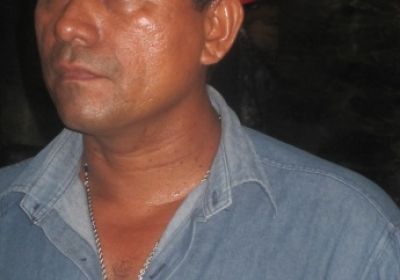 In May 2008, Venezuelan President Hugo Chavez endorsed Plan Socialist Guyana (PGS), drawn up by elected representatives from workers in Venezuela's heavy industry sector in Guyana. This plan calls for the introduction of workers' control across the state-owned industries grouped in the Guyana Venezuela Corporation(CGV), as well as a shift away from producing raw materials for multinationals towards Venezuela's development needs and taking the needs of communities and the environment into consideration.
 -
The Socialist Alliance NSW released the statement below on August 21. * * * “Parramatta City Council has a civic responsibility to respond urgently to the report from the Australian Council of Social Services (ACOSS) that the lack of affordable housing has reached crisis levels”, said Kerryn Williams, a Socialist Alliance candidate for the Woodville ward in the Parramatta council election.
-
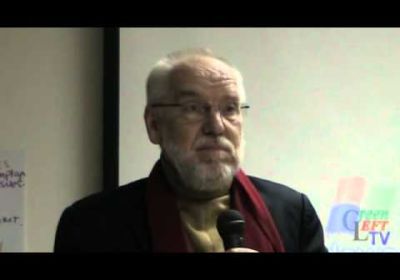
Carolus Wimmer is a widely respected Venezuelan political scientist, educator and writer, lecturer and columnist nationally and internationally. Elected to the Latin American Parliament in 2005 he served as Vice-President from 2008 to 2011.
-
Max Bound grew up during the Great Depression, and his view of the world was shaped in part by such experiences as seeing classmates being sent home from school because they were too hungry to stay conscious. He left school at the age of thirteen and as a teenager he started reading socialist theory. His experience working in a coalmine, as a cleaner, a tram conductor and as a builder's labourer gave him a thorough education in how the world worked.
-
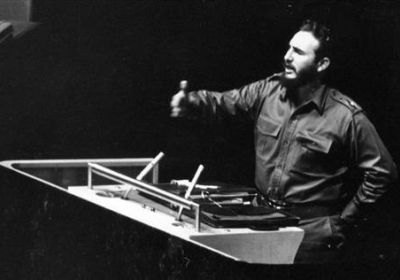 This isn’t an obituary. Every now and again those who hope and pray for his death spread yet another rumour, only to be disappointed by a photo or a commentary in that unmistakable style, confirming that Cuban revolutionary leader Fidel Castro is very much alive and making the most of his twilight years. When the inevitable does happen, the world, admirers and detractors alike, will pause for reflection. The corporate media will saturate our inner recesses with words and images that convey, for the most part, how the 1% appraise his life and legacy. Just imagine the gloating on Fox News.