New at LINKS International Journal of Socialist Renewal: 'People are capable of governing themselves', Marta Harnecker: From Allende to Chavez,
-
-
A Short History Of Social Democracy: From Socialist Origins To Neoliberal Theocracy By John Rainford Resistance Books $20, 184pp. The rise and then fall of social democracy as a movement for fundamental social change is a modern tragedy of Shakespearean proportions. It is one of the epic stories of the 19th and 20th centuries.
-
We live in a time of growing inequality between the rich and poor, when the environment is being destroyed to the point of threatening our very existence, because of a system that prioritises profit. Here are 10 reasons why socialism is the way forward to solve society’s problems. 1. THE DESTRUCTION OF CLASS DIVISION Under capitalism, people are divided on the basis of class. There are the 1%, who own the wealth and the means to produce wealth, and the rest of us, the 99%, who sell their labour to produce profit for the 1%. -
Meral Cicek (pictured) is the chair of Kurt Kadin Iliskiler Merkezi, the Kurdish Centre for Women's Affairs in Erbil, in the autonomous Kurdish Region in northern Iraq). Cicek spoke to the Rosa Luxemburg Foundation’s Florian Wilde during the World Social Forum (WSF) in Tunis last month. It has been translated by Leandros Fischer. * * * -
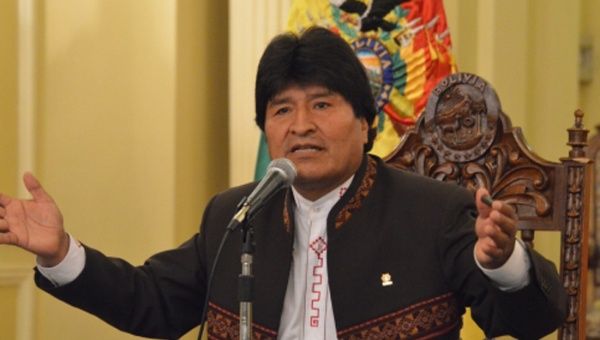
Up to 90% of the electorate voted in Bolivia’s “local” elections on March 29 for governors, mayors and departmental assembly and municipal council members throughout the country. The governing Movement for Socialism (MAS) of left-wing President Evo Morales once again emerged as the only party with national representation. It is by far the major political force in Bolivia, and far ahead of the opposition parties, none of which has a significant presence in all nine departments. -
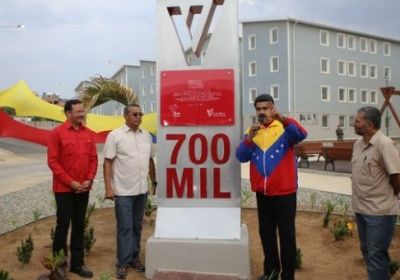
President Nicolas Maduro of Venezuela began his visit to Panama City for the Summit of the Americas with a visit to the impoverished neighbourhood of El Chorrillo to lay a wreath at the monument to those killed by the US bombing of the community during the 1989 US invasion of Panama.
The seventh Summit of the Americas, held in Panama City on April 10 and 11, was widely hailed as a victory for left-leaning and progressive forces in the region, particularly Venezuela and Cuba.
-
Ecuador has lifted 1.3 million people out of poverty in the past eight years, a new survey revealed on April 13, TeleSUR English said that day. The results of the first “Survey of Living Conditions in Ecuador” showed that poverty has fallen by one third. It also revealed that 900,000 individuals have been lifted out of extreme poverty, whilst the Gini coefficient, which measures wealth gaps, has dropped 4.8 points since 2006. -
The left-wing People's Democratic Party (PRD) held its eighth congress in Jakarta from March 24-26. This was the first time its congress was held openly. The open congress marks an important new stage of development for the party, which has a history of underground organising dating back to the era of the Suharto dictatorship that was overthrown in 1998. -
French politics further confirmed its rightward trajectory after the second round of departmental elections on March 29. There are 101 departments and 4108 councillor positions across the country. Departments are in charge of local roads, school buildings and buses, welfare allowances and various other local issues. But the elections also represent a barometer of the political situation in the country. The governing nominally centre-left Socialist Party (PS) suffered a humiliating defeat against a right-wing united front headed by the centre-right Union for a Popular Movement (UMP). -
The Portuguese tax-haven and tourist island of Madeira — a watering hole of Europe's super-rich — was the unlikely site of gains for the Left Bloc and the anti-corruption citizens’ movement Together for the People (JPP) in March 29 elections for the autonomous region’s legislative assembly. The JPP, whose lead candidate Elvio Sousa promised “a different way of doing politics … favouring the most victimised and the middle class”, won five seats (10.34%) in the 47-seat legislature. -
A group of Australian academics, unionists, politicians, and others have urged the US to “stop interfering in Venezuela’s domestic affairs”. More than 70 prominent Australian progressives issued an open letter to US President Barack Obama condemning US sanctions against Venezuela on April 9. The letter, initiated by the Venezuelan Solidarity Campaign in Melbourne, is printed below. The letter was handed to US consulates in Sydney and Melbourne on April 10. * * * No more coups! No more interventions! Repeal the Executive Order! Dear Mr President, -
Since US President Barack Obama's administration decided to impose new sanctions on Venezuela on March 9, many people, including journalists, have asked what motivated them to do this. Some are curious over the apparent inconsistency between this move and the White House decision in December to begin normalising relations with Cuba. Others are wondering why the Obama administration would do something that so obviously hurts the United States-backed opposition in Venezuela, at least in the short run.