A Senate inquiry into corporate tax avoidance last week revealed that BHP Billiton was funnelling profits from Australian minerals through a marketing arm based in Singapore as a way of dodging tax in Australia.
From 2006 to 2014, BHP was “selling” minerals mined in Australia to its Singaporean arm at well below market rates. The prices were then marked-up and sold on to third-party companies in Singapore, thereby attracting the infinitesimal Singaporean tax rate.
An irony of the sacking of SBS sports journalist Scott McIntyre for a series of tweets he made on Anzac Day is that the hysterical reaction from politicians and the media, and the consequences he has faced, has only served to prove his initial point.
Anzac Day is not about remembering history. To remember what actually happened at Gallipoli 100 years ago, and in Australia’s involvement in wars more generally, is not permissible. Whatever the Anzacs fought and died for, it was not free speech.
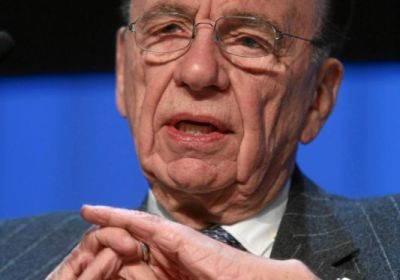
At a G20 meeting last October, Rupert Murdoch surprised some with a speech that criticised world leaders for, as it was described in his Australian newspaper, “their policies [that] have caused a ‘massive shift’ in societies to benefit the super-rich with a legacy of social polarisation”.
In particular, Murdoch criticised youth unemployment: “The unemployment rate for Americans under the age of 25 is 13%, which sounds awful until I remember that in the eurozone that number is 23%, and it is twice as high in places like Spain and Greece, and parts of France and Italy.
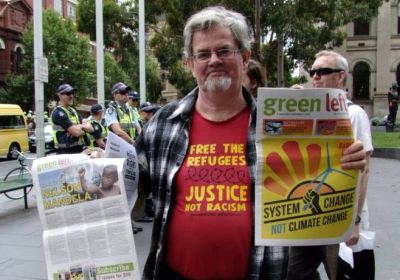
A couple of weeks ago I was campaigning with Green Left Weekly at our regular Friday afternoon Central station tunnel spot. It’s a pretty frenetic spot as hundreds of people bustle past every minute, eager to catch their trains and get home or out for the night.
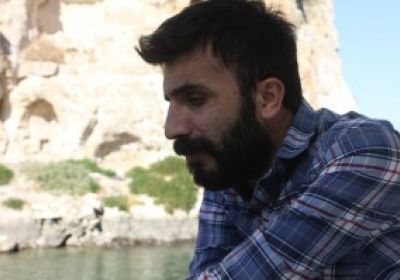
Kurdish journalist Ozgur Amed was sentenced on February 21 to three years in prison for political activism for the rights of the Kurdish people, Firat News Agency reported on February 25. The 7th Criminal High Court of Diyarbakir sentenced him under Turkish Penal Code Article 220/6 for “committing an illegal organisation crime while not being an illegal organisation member”.
The Telecommunications (Interception and Access) Amendment Bill 2014, also known as the “data retention” bill, if passed, will be the third installment of sweeping powers granted to Australian intelligence agencies.
It will mean that every move you make, every call you take, the government will be watching you.
How does data retention impede the role of investigative journalists, political reporters and whistleblowers?
1: METADATA THEFT
Citizenfour won the Oscar for best documentary on February 22, an award that its director Laura Poitras and journalist Glenn Greenwald collected, later joined on stage by Edward Snowden's partner Lindsay Mills.
“The disclosures of Edward Snowden don’t only expose a threat to our privacy but to our democracy itself,” said Poitras when receiving the Oscar.
“When the decisions that rule us are taken in secret we lose the power to control and govern ourselves.”
If Tony Abbott’s government has its way, new laws further empowering Australia's secret police to greatly expand their mass surveillance powers will be rammed through federal parliament by mid-March.
But it will succeed only if the Australian Labor Party backs the Telecommunications (Interception and Access) Amendment (Data Retention) Bill.
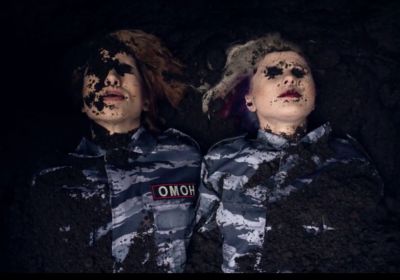
Two members of the Russian punk band Pussy Riot Nadya Tolokonnikova and Masha Alyokhina, who were jailed for songs criticising Russian President Vladimir Putin, have released a song and video titled "I Can't Breathe".
The video shows them being buried alive while wearing Russian riot police uniforms. The Guardian said on February 18 that the song is inspired by their recent trip to New York and the death of African American Eric Garner at the hands of an NYPD officer.
Zombie Economics: How Dead Ideas Still Walk Amongst Us
John Quiggin
Black Inc., 2012
265 pages, $26.95 (pb)
“Being already dead,” says John Quiggin of zombie ideas in economics, “they can absorb all kinds of damage and keep lumbering on.”
And so, despite severe reality checks such as the historical Great Depression and the more recent Global Financial Crisis (GFC), classical free market economics continues to lead its undead life in the neoliberal form Quiggin calls “market liberalism”.
When 22-year-old Omar Abdel Hamid El-Hussein murdered two people in Copenhagen on February 15, and was killed in a shoot-out with police, the media and politicians across the world did not hesitate to declare that an act of terrorism had taken place.
US President Barack Obama immediately phoned Danish Prime Minister Helle Thorning-Schmidt to offer condolences and invited Denmark to take part in a February 18 summit in Washington to counter violent extremism, Reuters reported on February 16.
Other Western leaders, including Australian Prime Minister Tony Abbott, responded similarly.