-
Pip Hinman, the Socialist Alliance candidate for the NSW seat of Marrickville, spoke at a March 14 election forum at St Peters Town Hall organised by Climate Action Newtown and Sydney Residents Against Coal Seam Gas. Hinman’s responses to the three questions put to her at the meeting appear below. * * * Will your party commit to not building any more coal or gas fired power stations in NSW? -
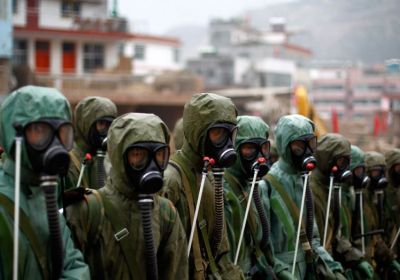
How have Australian scientists handled the difficult task of keeping us informed about the unfolding nuclear disaster in Japan? Only a few Australian scientists have featured repeatedly in the media.
-
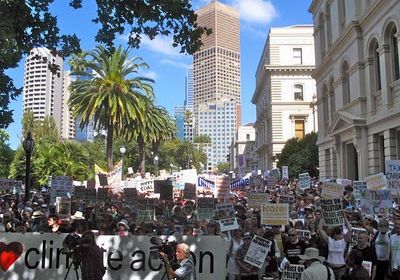
Facing public anger and concern over the nuclear meltdown unfolding in Japan, German Chancellor Angela Merkel announced temporary shutdown of several nuclear reactors. On March 12, more than 60,000 anti-nuclear protesters in the south-western state of Baden-Wuerttemberg formed a 45 kilometre human chain from Stuttgart to the Neckarwestheim 1 nuclear plant. Smaller protests took place in more than 450 towns and cities across Germany, anti-nuclear organisation Irradiated said. More protests are planned for March 26.
-
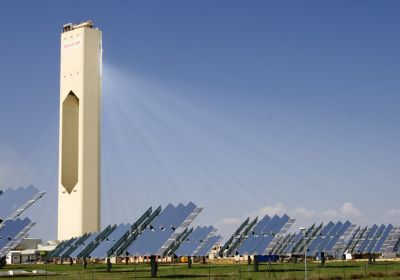
The NSW Greens announced their Solar Thermal Power Plant initiative on March 13: a policy to build three baseload solar thermal power plants in NSW and create new green jobs. At the official launch of the Greens' state election campaign at Balmain Town Hall, Greens MP and lead upper house candidate David Shoebridge announced: “The Greens will work in the next parliament to deliver three solar baseload thermal power stations with heat storage to be built in the state's central West, funded by green infrastructure bonds. -
More than 100 people attended a March 15 public forum in Hobart Town Hall about Tasmania’s logging moratorium. The forum was organised by The Wilderness Society (TWS) and the Huon Valley Environment Centre. TWS, the Australian Conservation Foundation and Environment Tasmania signed the forests “Statement of Principles” agreement with the Forest Industries Association of Tasmania, the Construction Forestry Mining Energy Union and Timber Communities Australia on October 14 last year. The groups have proclaimed the agreement as the beginning of the end of forest conflict in Tasmania. -
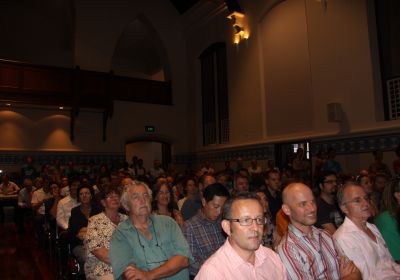
Beyond Zero Emissions (BZE) launched its award-winning Zero Carbon Australia 2020 Stationary Energy Plan to a packed meeting at Perth Town Hall on March 14. BZE executive director Matthew Wright outlined the Western Australian aspects of the plan, which was developed to show how Australia could reduce its stationary energy greenhouse gas emissions to zero by 2020, using a mix of commercially available renewable energy sources, primarily concentrating solar thermal and wind. -
The argument for a carbon tax in Australia boils down to two key points. The first is that a carbon tax puts a price on pollution. Pollution has been officially free for industry up until now.
-
Parramatta Climate Action Network hosted a presentation by Beyond Zero Emissions (BZE) at Parramatta Town Hall on March 14. About 30 people attended the forum. The presentation summarised the “Zero Carbon Australia 2020” stationary energy report, which details how Australia can transition to 100% renewable energy by 2020. In contrast to Australia, which has excellent renewable resources but is dominated by fossil fuel energy, Spain already has several large-scale solar thermal energy plants that provide baseload power.
-
On March 13, more than 100 people attended the first organising meeting of Stop CSG Illawarra, a residents’ group campaigning for a moratorium on coal seam gas mining (CSG).
-
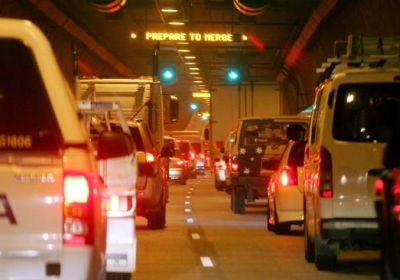
"We all knew that this was going to happen, but now many people are going to be saddled with this gigantic debt," David White, president of Community Action for Sustainable Transport (CART) told Green Left Weekly on March 11. He was commenting on the move to place the Clem7, Brisbane’s first and only cross-river road tunnel, into financial administration the previous week. -
The ability of real politics to focus debate is impressive. The climate movement has long debated what policy mechanisms can best combat climate change.
-
There's every likelihood that radioactive by-products of Australian uranium have spewed into the atmosphere from the nuclear reactor plant at Fukushima in Japan.