Springtime: The New Student Rebellions
Edited by Claire Solomon and Tania Palmieri
Verso 2011 283 pages,
paperback, £9.99
In years to come, when people look back at 2010-11 and try to identify the moment the fightback against the British Conservative-Liberal Democrat coalition really got under way, many will select the huge March 26 TUC-sponsored demonstration in London.
Magnificent and inspiring as March 26 was, however, November 10, 2010 has perhaps a greater claim to be recorded as the moment the fightback began in earnest.
-
-
Five revolutions in postwar Latin America have seen illiteracy as a neocolonial battleground. Salvador Allende’s Chile — birthplace of How to Read Donald Duck, an iconic attack on cultural imperialism — reduced illiteracy from 15.2% to 6.3% in under two years (1971-73), triple the rate of any regime before or since. In Nicaragua, the Sandinistas slashed the Somoza dictatorship legacy of 50% illiteracy to just 13% before the end of its first full year in power (1980), catapulting women to cultural and political prominence in the process. -
It can sometimes feel like we’re losing a race against time to avoid environmental catastrophe and social collapse. Climate change is already extinguishing species, destroying essential food production and forcing thousands of people to flee their island homes. People are directly affected by more wars than ever before in history. While the underlying causes of the recent global financial crisis remain, governments are imposing vicious austerity policies on the majority of people in the Global North and South to pay for the capitalists’ greed. -
To win socialism — a society democratically owned and run by and for the majority of people — we have to get rid of the capitalist system that stands in our way. But who is going to do this? The capitalists aren’t going to give up their privileges. It's those who are exploited and oppressed by the system that have an interest in changing it. Capitalism can't permanently satisfy the needs of the majority — the working class, farmers, women, ethnic and racial minorities and so on. -
A rebellion is developing across Britain in the face of huge spending cuts by the Conservative Party-Liberal Democrat coalition government. The scale of the cuts is huge. The government is seeking to privatise huge swathes of the economy and hundreds of thousands of public sector jobs are under threat. They have also cut corporation tax, but sharply increased the goods and services VAT tax from 17.5% to 20%, which hits those on lower incomes hardest. By changing the inflation measure used to determine benefits and pensions, the government is plunging more people into poverty. -
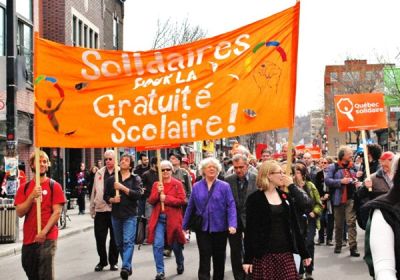
On November 10, tens of thousands of students marched through London against education cuts and fee hikes. This was an indication of the revival of a militant student movement in Britain. Clare Solomon, president of the University of London Union, told Green Left Weekly: “That demonstration was absolutely electric, especially when we occupied the Millbank Tory party headquarters. “There were thousands and thousands of 14, 15 and 16-year-old students, dancing, singing, hugging. It really was like a carnival of the oppressed.” -
During the Christmas/New Year holiday period, prior to the tragedy of floods and fires, Prime Minister Julia Gillard chose to feed out some media announcements about local school autonomy. Her proposal was to give schools the right to “hire and fire” teachers. The model would give school principals and local parent representatives control of staffing, replacing the current statewide system of appointments. Many states have a variation of this localised system to some extent. However, NSW and Queensland, which are still under state-based employment relations, do not. -
When the British Conservative-Liberal Democrat coalition government announced it would raise the maximum yearly tuition fee universities could charge students to £9000, thousands of students took to the streets of London in a series of protests. Highlights included occupying the Conservative Party headquarters in London and frightening Prince Charles. The tuition rise came after the release on October 12 of the Browne Review, a report into education funding chaired by former BP chief executive John Browne. The report recommended abolishing the cap on tuition fees. -
The NT government has failed to change its policy of "First Four Hours" of English in remote Aboriginal schools, despite the trial period expiring in January. The policy was introduced in January 2009, supposedly as a way to improve English literacy for Aboriginal students. The policy mandated that schools teach only in English for the first four hours — the most productive hours — of school, leaving teaching in local language to the last two, least productive, hours of the day. It effectively banned Aboriginal language in the classroom. -
Britain: Goldman Sachs gives huge bonuses “Bankers were accused of ‘sticking two fingers up to austerity Britain’,” the British Guardian reported on January 19, “after it was revealed that [Wall Street bank] Goldman Sachs had handed its staff a £10bn payday as new figures showed unemployment among Britain's young people had hit its highest level since modern records began”. The article said data from the Office for National Statistics showed that one in five people under 25 were out of work by the end of November last year — a total of 951,000 people.
-
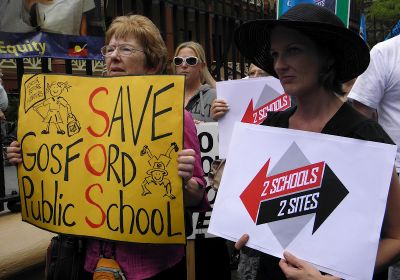
Fifty people attended the Public School Dreams forum, hosted by the Inner City Teachers Association (ICTA) on November 16. In attendance were students, parents, teachers and principals from 16 inner-city schools, Leichhardt Greens mayor Jamie Parker and NSW Greens upper house member John Kaye. Students from Darlington Public School opened the forum with two songs. School communities at the forum were encouraged to submit comments to the federal government’s Review of Funding for Schooling. -
The Venezuelan government has begun distributing the first of 350,000 portable Canaima laptop computers to be provided to public elementary school children by the end of the year, Venezuelanalysis.com said on November 17. Education minister Jennifer Gil said: “The Canaima Plan is a milestone and a technological innovation. It allows us to keep deepening our integral and massive education system that does not involve just students, but the entire family environment, parents, representatives and teachers.”