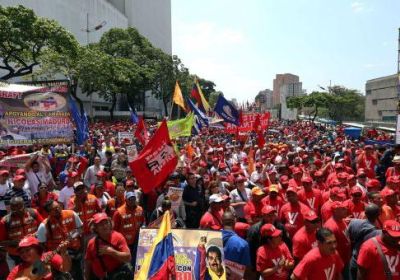
President Nicolas Maduro of Venezuela began his visit to Panama City for the Summit of the Americas with a visit to the impoverished neighbourhood of El Chorrillo to lay a wreath at the monument to those killed by the US bombing of the community during the 1989 US invasion of Panama.
The seventh Summit of the Americas, held in Panama City on April 10 and 11, was widely hailed as a victory for left-leaning and progressive forces in the region, particularly Venezuela and Cuba.
-
President Nicolas Maduro of Venezuela began his visit to Panama City for the Summit of the Americas with a visit to the impoverished neighbourhood of El Chorrillo to lay a wreath at the monument to those killed by the US bombing of the community during the 1989 US invasion of Panama.
The seventh Summit of the Americas, held in Panama City on April 10 and 11, was widely hailed as a victory for left-leaning and progressive forces in the region, particularly Venezuela and Cuba.
-
Ecuador has lifted 1.3 million people out of poverty in the past eight years, a new survey revealed on April 13, TeleSUR English said that day. The results of the first “Survey of Living Conditions in Ecuador” showed that poverty has fallen by one third. It also revealed that 900,000 individuals have been lifted out of extreme poverty, whilst the Gini coefficient, which measures wealth gaps, has dropped 4.8 points since 2006. -
The head of the Business Council of Australia (BCA), Catherine Livingstone, has called for a national “conversation” about what the federal government and the business community euphemistically call “economic reform”. Ever in thrall to trickle-down economics, they manage to talk in “doublespeak”, a close relative of the doublethink that George Orwell wrote about in his novel Nineteen Eighty-Four. -
Spain's left-wing Podemos party would win a general election if it were held today, a Metroscopa poll released on April 12 found. General elections are scheduled for December. Podemos, which was founded in January last year, came first with the support of 22.1% of those questioned. The opposition Spanish Socialist Workers Party (PSOE) regained lost ground to come second with 21.9% of the vote. The ruling conservative Popular Party (PP) would come third with 20.8% of the vote.
-
Günter Grass, who was one of Germany’s most important post-war novelists, died on April 13 at the age of 87 in the town of Lübeck, in northern Germany. Grass was perhaps most famous for his 1959 book The Tin Drum, a novel that embodied fantastical elements in its critique of Weimar and Nazi Germany. As such, his style bore resemblances to Latin America’s genre of magical realism. In 1979, the book was turned into an Academy Award winning film by Volker Schlöndorff, which won the Oscar for best foreign film. -
Internationally awarded Uruguayan author and journalist Eduardo Galeano died on April 13 of lung cancer at age 75 in Montevideo, the capital of Uruguay.
-
Jay Famiglietti, a senior water scientist at the NASA Jet Propulsion Laboratory in California, made a dire warning in March: there is only one year's worth of water left in the state's reservoir storage and river basins. Famiglietti said even nature's oldest water backup supply —groundwater — could be gone soon after the reservoirs dry up. About 38.8 million people live in California, which produces much of the United States' food. California's drought is throwing the ecology of the region into crisis, and ordinary people are scrambling for ways to help. -
French politics further confirmed its rightward trajectory after the second round of departmental elections on March 29. There are 101 departments and 4108 councillor positions across the country. Departments are in charge of local roads, school buildings and buses, welfare allowances and various other local issues. But the elections also represent a barometer of the political situation in the country. The governing nominally centre-left Socialist Party (PS) suffered a humiliating defeat against a right-wing united front headed by the centre-right Union for a Popular Movement (UMP). -
There is a tense stand-off right now between Greece's government and the so-called troika — the European Commission, the European Central Bank (ECB), and the International Monetary Fund (IMF). ECB President Mario Draghi recently went so far as to deny that his institution was trying to blackmail Greece's left-wing anti-austerity government. But blackmail is actually an understatement. It has become increasingly clear that the troika is trying to harm the Greek economy in order to raise pressure on the new Greek government to agree to its demands. -
A group of Australian academics, unionists, politicians, and others have urged the US to “stop interfering in Venezuela’s domestic affairs”. More than 70 prominent Australian progressives issued an open letter to US President Barack Obama condemning US sanctions against Venezuela on April 9. The letter, initiated by the Venezuelan Solidarity Campaign in Melbourne, is printed below. The letter was handed to US consulates in Sydney and Melbourne on April 10. * * * No more coups! No more interventions! Repeal the Executive Order! Dear Mr President, -
The Portuguese tax-haven and tourist island of Madeira — a watering hole of Europe's super-rich — was the unlikely site of gains for the Left Bloc and the anti-corruption citizens’ movement Together for the People (JPP) in March 29 elections for the autonomous region’s legislative assembly. The JPP, whose lead candidate Elvio Sousa promised “a different way of doing politics … favouring the most victimised and the middle class”, won five seats (10.34%) in the 47-seat legislature. -
The left-wing People's Democratic Party (PRD) held its eighth congress in Jakarta from March 24-26. This was the first time its congress was held openly. The open congress marks an important new stage of development for the party, which has a history of underground organising dating back to the era of the Suharto dictatorship that was overthrown in 1998.