-
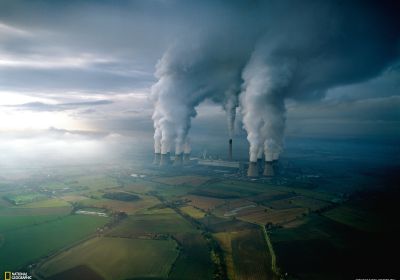
If modern industrial capitalism were a person, he or she would be on suicide watch. The system that has brought us quantum physics and reality television, modern medicine and the columns of Andrew Bolt is set on a course which, by all the best reckoning, points directly to its doing itself in. If capitalism goes on — everything goes. Climate, coastlines, most living species, food supplies, the great bulk of humanity. And certainly, the preconditions for advanced civilisation, perhaps forever. -
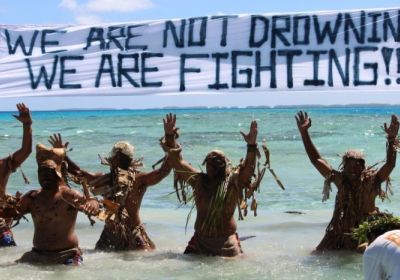
A meeting of the Cartagena Dialogue for Progressive Action took place in the Marshall Islands on April 1. The body is composed of 30 countries working towards a legally binding United Nations climate change convention before of an international summit next year. Delegates had a chance to witness first-hand the effects of climate change in the host country, a small atoll nation in the Pacific Ocean, where no land rises more than two metres above sea level. -
Thirty Venezuelan military officers, including several generals, have been arrested for alleged conspiracy to overthrow President Nicolas Maduro, a leading national newspaper has reported. The information, reported by Ultimas Noticias, was attributed to “high level sources” in Miraflores presidential palace. Most arrested were from the Venezuelan Air Force, however a few officers from the National Guard, Navy and Armed Forces were included.
-
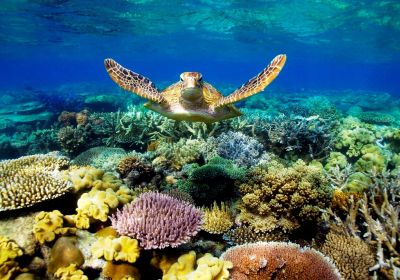
The Great Barrier Reef is almost certainly going to suffer permanent damage due to coral bleaching if countries do not act to reduce carbon emissions, the Fifth Assessment report by the Intergovernmental Panel on Climate Change (IPCC) said on March 31. A lead author of the report, Chris Field, told the ABC’s 7.30: “Warm water coral reefs are one of the world's ecosystems that's most threatened and especially threatened by the combination of a warming climate and acidification of the ocean waters.” -
“Ecological strain” and “economic stratification” could lead to the global fall of modern civilisation within decades, researchers warn in a disturbing new study sponsored by NASA's Goddard Space Flight Center. History shows that “complex, advanced civilizations” from the Roman to the Han empires are capable of collapse, note the authors, who hail from the Universities of Maryland and Minnesota.
-
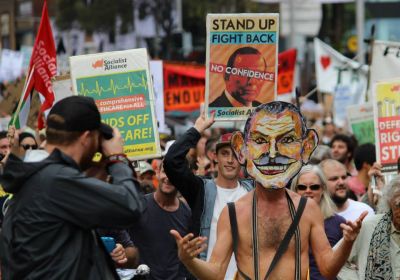
The March in March protests across Australia over March 15-17 were a resounding success – not just because of their size, focus and breadth. Just as significant is the fact that March in March tore apart the idea – seeded by the cynical rhetoric of John Howard's spin doctors in the wake of the invasion of Iraq – that protests don't work. This protest worked precisely because it brought between 80,000 and 110,000 people out of their homes and into the streets in a disparate yet united way against the Tony Abbott government's attacks. -
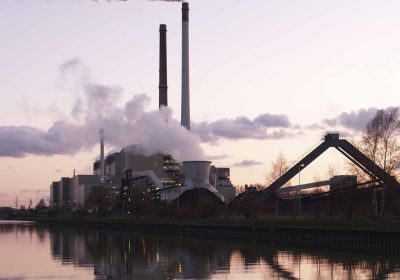
First there was climate denial. But the mocking laughter of the informed public – along with the indignation of the scientists – finally reached the energy-company boardrooms. So now instead we get the non sequitur. That’s Latin for “it doesn’t follow”. Rather than lying outright, the fossil-fuel chiefs make nakedly contradictory statements and count on us not to notice. -
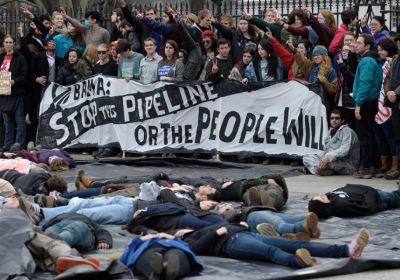
More than 350 climate activists were arrested March 2 in Washington, DC, after zip-tying themselves to the White House fence. The civil disobedience action was the highlight of two days of protest, dubbed XL Dissent by organisers, to demand that the Obama administration reject building the Keystone XL pipeline.
-
The Socialist Alliance Victoria released this statement on March 2.
-
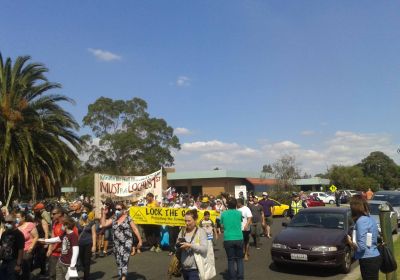
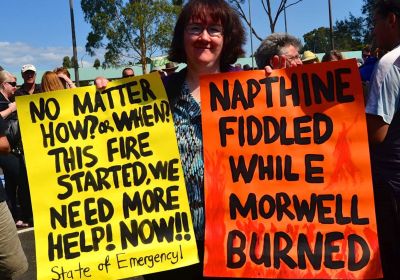
About 1000 Latrobe Valley residents gathered at Kernot Hall in Morwell on March 2 to protest against government and corporate mishandling of the fire in the Hazelwood coalmine. Residents directed their anger at government inaction and misinformation, and corporate negligence by GDF Suez, the multinational operator of the mine and power station. Fire Services Commissioner Craig Lapsley explained to the meeting the efforts and risks being taken by the firefighters. -
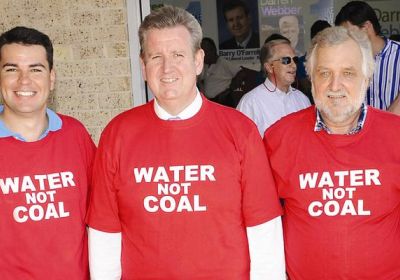
One of the most important initiatives that can be taken to revitalise manufacturing in NSW is to implement policies that will encourage the rapid development of renewable energy products. The one thing we should not be doing is developing new coalmines. -
The Climate Change Authority, the body responsible for setting Australia’s carbon emissions, has recommended that the target for emissions be increased from 5% to 19% below 2000 levels.