-
Students of the Australian National University have launched a campaign to raise awareness about the current situation in Rojava, in northern Syria. The campaign, “Stand With Kobane” aims to raise money to help rebuild the Kurdish city of Kobane. Kobane made headlines this year when it was the first Kurdish city to successfully break Islamic State's siege. A successful counter-attack resulted in the expulsion of all the IS fighters from the Kobane canton. -
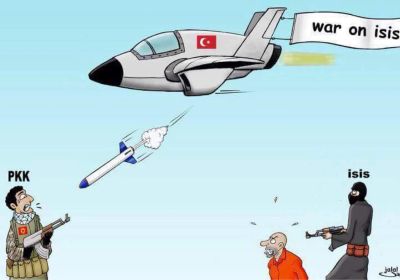
Turkey has “joined the war against ISIS”, according to US politicians and the corporate media after a July 23 deal between the US and the Turkish government. The deal gives US war planes and drones access to Turkey's Incirlik airbase from which to conduct air strikes in Syria and Iraq.
-
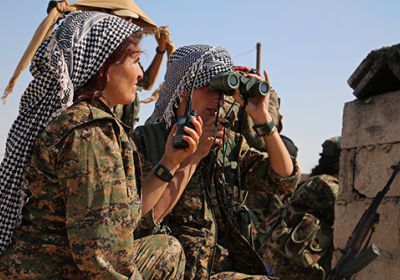
YPJ resistance fighter, Rojava. Picture: The Rojava Report.
-
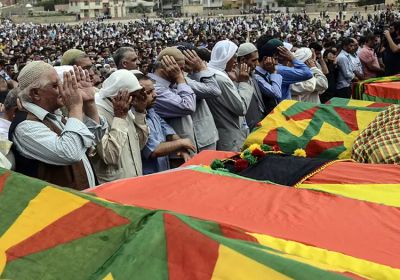
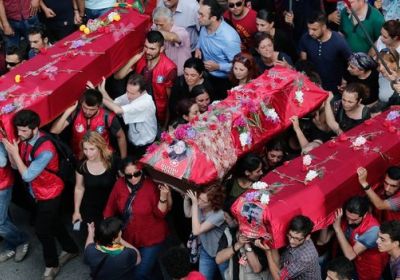
On July 20, 32 people were killed in a suicide bombing attack on a cultural centre in Suruç, a town in Turkish Kurdistan. More than 100 were injured. Suruç is located across the border from the Syrian Kurdish town of Kobanê, which was besieged by forces of the self-styled Islamic State terrorist group, also known as the Islamic State of Iraq and Syria (ISIS), between September and January. -
-
At least 30 people were killed and more than 100 injured on July 20, when ISIS suicide bomber from the self-styled Islamic State group attacked a cultural centre in the Kurdish town of Suruç, on the Turkish side of the border from Kobane.
-
Anti-war campaigners challenged British Defence Secretary Michael Fallon on July 2 after his call for more air strikes in Syria, warning that the action could fuel Islamic State recruitment. When the PM obtained Commons approval for the bombing of militant positions last year, he made it clear that this was limited to Iraq.
-
The “Islamic State” (IS) terror group attacks in Tunisia, Kuwait and France have grabbed global attention and condemnation. But the group's attack on Kobane in Rojava (Syrian Kurdistan) — and the fierce resistance — has been largely ignored.
-
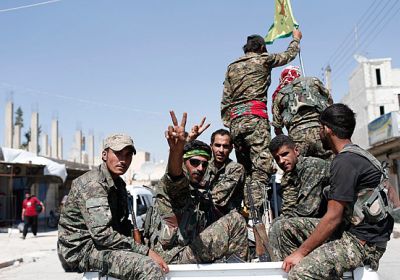
The Kurdish town of Kobane in northern Syria was attacked on June 25 by forces from the self-styled Islamic State (IS) terrorist group, which crossed from Turkey. This was the first significant IS attack on the town since a five-month siege was repulsed in January. The attack appears to be a Turkish-backed response to recent military gains made by the Kurdish-led forces of the Women's Defence Units (YPJ) and People's Defence Units (YPG). -
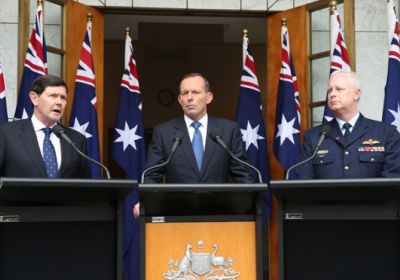
Prime Minister Tony Abbott has turned playing the national security card into a cliche in his desperate attempt to reverse his unpopularity by promising to protect Australians' lives from a serious threat of terrorism. On May 26, he again gave a press conference in front of half a dozen Australian flags, arguing that stopping Australians from being harmed by terrorists was his government's overriding priority and foreshadowing announcements in the coming parliamentary sitting week of a new round of legislation attacking fundamental civil liberties. -
When Prime Minister Tony Abbott used a March 3 press conference at Parliament House to announce the deployment of 300 more soldiers to Iraq, it was impossible to ignore the political theatre to serve a partisan domestic agenda. If you missed it in the content of his talk, you couldn't miss the no-less-than eight flags propped up behind him as he spoke. A combination of relentless attacks on the living standards of ordinary people and Abbott's incompetence has made his government one of the most unpopular in Australian history. -
US media reported on February 14 that more than 4000 ground combat troops are heading to Kuwait. Reports indicate it could be the US’ largest ground force in the region. The move comes as President Barack Obama is petitioning Congress for an Authorisation for the Use of Military Force (AUMF) against the Islamic State group. Obama sent Congress the AUMF petition denying plans for a ground war, however the troops in Kuwait are prepared for any “contingency,” a Pentagon military source said.