
Six US banks control 60% of GDP
“They are Goldman Sachs, Morgan Stanley, JPMorgan Chase, Citigroup, Bank of America, and Wells Fargo. They have assets equivalent to 60 percent of our gross national product.
“And to put this in perspective, in the mid-1990s, these six banks or their predecessors, since there have been a lot of mergers, had less than 20 percent. Their assets were less than 20 percent of the gross national product.”
-
-
A huge crowd of 50,000 people marched in Auckland on May 1 against the New Zealand government’s plans to allow mining in the country’s national parks. It was New Zealand’s biggest protest march in living memory. Greenpeace ambassador Robyn Malcolm said: “For nearly 50,000 Kiwis to turn out and be prepared to speak with one voice, must tell the government something ... Our land will always be more important to our identity than some extra dollars in the pockets of mining companies.”
-
 On April 29, more than 10,000 union members and others organised a protest on Wall Street in New York organised by the AFL-CIO union federation, Alternet.org said the next day. “The banners declared ‘Wall Street: Never Again’ and ‘Less Audis, More Audits’. Almost to a one, they echoed the clear policy demands of the day: regulatory reform, new taxes on banks and speculators, and a jobs bill.”
 -
 When setting a giant oil spill on fire is the least-worst option to limit environmental damage, you know you're in trouble. But that appeared to be the case as US authorities debated how to contain an spill caused by the failure in April of a deepwater oil rig — owned by the oil giant BP — about 80 kilometres off the US in the Gulf of Mexico. On May 2, the Times of London reported that Professor Ian MacDonald, an ocean specialist at Florida State University, said satellite data suggested the leak has already spread 9 million gallons of heavy crude oil.
 -
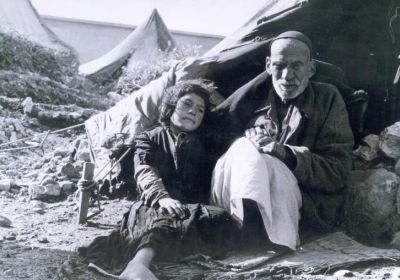 During April, 11 Palestinians, including two children, were killed by Israeli soldiers or settlers. For the world’s corporate media this was a quiet month. The deaths received little coverage in the Western media, unlike the two Israeli soldiers killed attacking the Gaza Strip on March 26.
 -
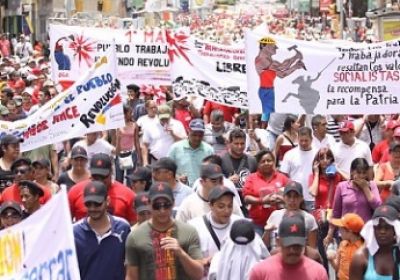 Venezuelans staged a big demonstration in Caracas on May one to mark the international workers’ day, Venezuelanalysis.com said. President Hugo Chavez also announced a 15% wage increase and broader social security entitlements. “While there were no official or police estimates, various participants in the march told Venezuelanalysis they estimated that ‘hundreds of thousands’ of people turned out, celebrating the achievements of the Bolivarian revolution and its promotion of ... better life conditions for the poor majority.”
 -
In Turkey’s capital of Istanbul, more than 200,000 people gathered at Taksim Square on May 1 in the first May Day demonstration allowed in the square in 33 years. May Day marches had been banned there since 37 people were murdered a 1977 May Day demonstration there. The government had violently repressed past attempts to celebrate May Day in Taksim Square. Marches carried banners reading: “Secure job and a humane life” and “Jobs, Bread, Freedom”.
-
“In a stunning demonstration all over the island”, Prensa Latina said on May 1, “Cubans showed the power of unity to face the media campaign launched against the country by United States and its European allies. “Millions of men, women and even children packed in the main squares, marched along central avenues all over the provinces and municipalities of the nation declaring their support to the revolutionary process they have freely chosen.”
-
As has become the tradition in recent years, Bolivian President Evo Morales celebrated May Day (May 1, the international workers’ day) by announcing the nationalisation of foreign-owned firms. Morales announced the state take-over of four power companies, as part of his government’s drive to strengthen the state sector to help reverse centuries of foreign exploitation of Bolivian resources.
-
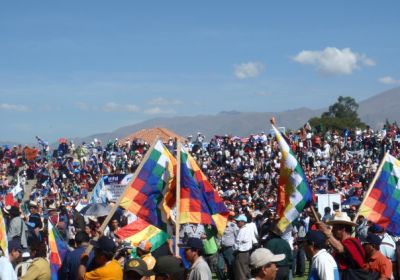 In the Cochabamba football stadium on April 22, diverse indigenous peoples paraded around the track, thousands of local peasants sat in the stands, and thousands more activists from around the globe waved flags and chanted on the field. A common sentiment flowed through the crowd: something historic had occurred over the previous three days during the April 19-22 World People’s Conference on Climate Change and the Rights of Mother Earth organised by the Bolivian government in Cochabamba.
 -
About 90,000 people marched in Yomitan, Okinawa on April 25 to call for the closure of US Marine Corps Air Station Futenma, an April 29 Counterfire.org article said. Protesters included the governor and all the mayors of Okinawa. Participants issued a statement calling for immediate closing and relocation of Futenma US Base outside Okinawa or the country. The rally recorded a record-high participation in Okinawa, expressing public opinion against the base. In 1995, 85,000 marched in protest at the rape of a schoolgirl by US servicemen.
-
A military coup, backed by the United States, ousted a democratically elected government in Honduras on June 28, 2009. It has arrested, without trial, thousands of democracy activists. More than 50 activists from the National Popular Resistance Front (FNRP) have been killed, and there are more than 100 other violent deaths related to the coup and curfews. The lesbian, gay, bi-sexual, trangender and intersex (LGBTI) community is being particularly targeted.