
“The time of big energy was supposed to have faded with the election of Barack Obama to the presidency”, Billy Wharton wrote in a May 12 www.counterpunch.org article.
“Then, a humble Coloradan, with a cowboy hat that seemed permanently affixed to his head, named Ken Salazar ambled to the microphone to accept Obama’s nomination to be the new Secretary of the Department of the Interior (DOI).”
-
-
 In further moves to strengthen the state’s role in the economy, Venezuelan President Chavez announced on May 11 the creation of a publicly owned import-export company as part of a broader plan to combat “the hegemony of the bourgeoisie”, speculation and inflation. Despite price controls and a fixed exchange rate, inflation reached 25.1% in 2009 — the highest in Latin America. Central bank figures reported inflation climbed 5.2% in April (double that of March), bringing accumulated inflation for 2010 up to 11.3%.
 -
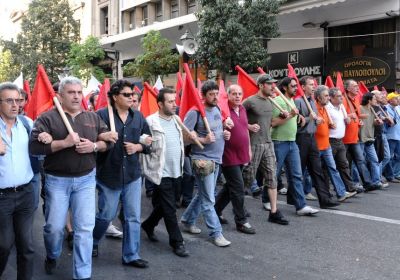 This statement was release by organisations in the Asia-Pacific region on May 13. If your organisation would like to sign on, please email [email protected]. * * * We, left and progressive organisations from the Asia-Pacific region, express our solidarity with the resistance of the Greek people against the harsh austerity being imposed upon them by the governments of the European Union (EU) and the International Monetary Fund (IMF).
 -
Photographer David Hoffman had his London home visited by British police on the day of the May 6 general elections. They forcibly removed a poster from his window featuring a photo of Conservative Party leader (and now prime minister) David Cameron and the word “wanker”, the British Guardian said on May 11. Hoffman said police threatened him with arrest and handcuffed him during the visit, claiming the poster was “offensive campaign material”. Hoffman said police “went completely over the top”, the Guardian reported.
-
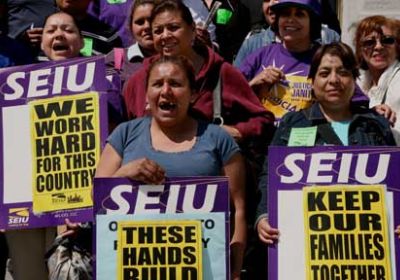 Federal immigration authorities have pressured one of San Francisco’s major building service companies, ABM, into firing hundreds of its own workers. Some 475 janitors have been told that unless they can show legal immigration status, they will lose their jobs in the near future. ABM has been a union company for decades, and many of the workers have been there for years. Olga Miranda, president of Service Employees International Union (SEIU) Local 87, said: “They’ve been working in the buildings downtown for 15, 20, some as many as 27 years.
 -
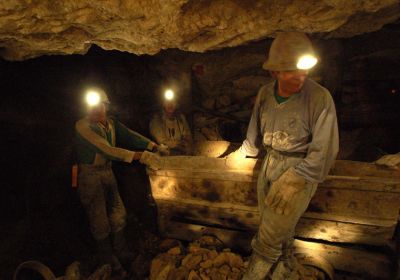
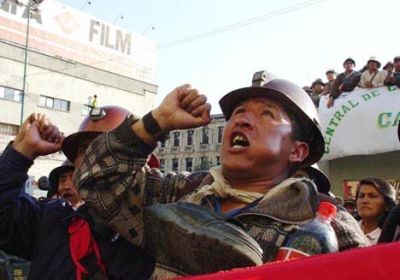 Perhaps no other sector better exemplifies the challenge the Bolivian government faces in lifting the country out of the poverty and dependency afflicting South America’s poorest nation than its all-important mining industry. Mining minister and former miners’ union leader Jose Pimentel told Green Left Weekly: “Bolivia has been a mining country for more than 500 years, ever since the Spanish came and discovered the legendary wealth [of the silver mines] of Potosi.”
 -
 Laws punishing women for wearing the burqa and the niqab in public were passed by the Belgian lower house of parliament on April 29. A similar law has been discussed by French President Nicholas Sarkozy, and the French National Assembly passed a non-binding resolution in favour of a ban on May 11. These laws have been pushed by right-wing governments on the basis of security needs and protecting national identity, but the laws have also been justified as promoting equality for women. On this basis, the laws have received support from sections of the left and the feminist movement.
 -
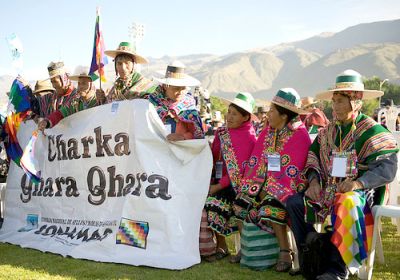 “There are two ways forward: Either save capitalism, or save Mother Earth”, Bolivian President Evo Morales said, stressing that this was the choice facing governments at a May 7 press conference in New York. There, he discussed the outcomes of the 35,000-strong World People’s Summit on Climate Change and the Rights of Mother Earth with United Nations Secretary-General Ban Ki-moon.
 -
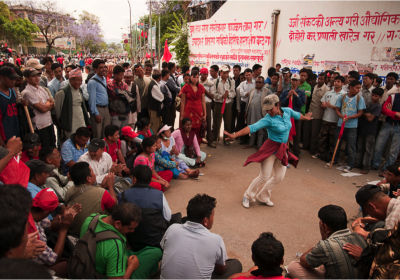
Jed Brandt, a member of US Kasama Project, is in Katmandu reporting on the ongoing struggle between Nepal’s poor majority, led by the Unified Communist Party of Nepal-Maoists (UCPN-M), and the US and Indian-backed elite that removed the UCPN-M-led government last year.
-
 The tremendous success of the April 19-22 World Peoples Summit on Climate Change and Mother Earth Rights held in Cochabamba, Bolivia, has confirmed the well-deserved role of its initiator — Bolivian President Evo Morales — as one of the world’s leading environmental advocates. Since being elected the country’s first indigenous president in 2005, Morales has continuously denounced the threat posed by the climate crisis and environmental destruction. Morales has pointed the figure at the real cause of the problem: the consumerist and profit-driven capitalist system.
 -
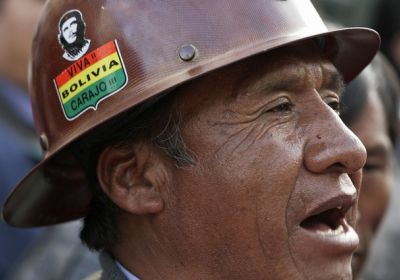 Under the new constitution approved in January 2009, the state now controls all minerals, metals, precious and semi-precious stones in the country. While respecting previously granted concessions to private companies, it has restricted new concessions to joint ventures with the state In 2007, the Bolivian government returned 100% control of the Huanuni tin mine to the state-owned Comibol. On May 3, the government nationalised the Glencore-owned antimony smelter, which has been out of operation for more than two years.
 -
The following statement was released by the United Front for Democracy against Dictatorship (UDD), the organisation of the “Red Shirts”, on May 6. It is abridged from wdpress.blog.co.uk. *** UDD leaders have again debunked speculation that the Red Shirt rally at Ratchaprasong will soon be packing up and the protesters returning home.