
“Ridiculous, counterproductive and stupid” is how one US official described the treatment of alleged WikiLeaks whistleblower Bradley Manning.
Manning, a private in the US army, has been held in solitary confinement for nine months at Quantico Marine Corps Brig while awaiting a pre-trial hearing.
Breaking government ranks, spokesperson for the US State Department PJ Crowley criticized on March 10 the reported mistreatment of Manning. This mistreatment has included Manning being forced to strip and remain naked in his cell.
-
-
“Pakistan has demanded an apology and explanation from the United States over a drone strike in a tribal region, which officials said killed 35 people,” ABC.net.au said on March 18. It said it was the seventh US drone strike in nine days. The article said it was the most lethal drone strike North Waziristan region since the US military escalated its bombing of Pakistani areas near the Afghan border in 2008. A Pakistani foreign ministry spokesperson Tehmina Janjua said: “The government of Pakistan strongly condemns the drone strike which has resulted in a large number of casualties …
-
After ousting former President Zine El Abidine Ben Ali and his supporters from office, the Tunisians have again hit the streets — this time, to demonstrate against the visit of US Secretary of State Hillary Clinton. About 300 people demonstrated at Tunis’ central Avenue Bourguiba against her visit on March 16, Reuters said. The next day, Clinton met with President Foued Mebazaa and Prime Minister Beji Caid Essebsi. About 100 people protested, in the face of dozens of riot police, two military helicopters and a water cannon, Al Jazeera said.
-
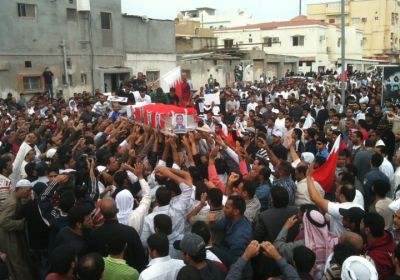
The government of Bahrain unleashed a brutal crackdown and invited in foreign troops on March 14 in an attempt to end pro-democracy protests that have lasted for more than a month.
-
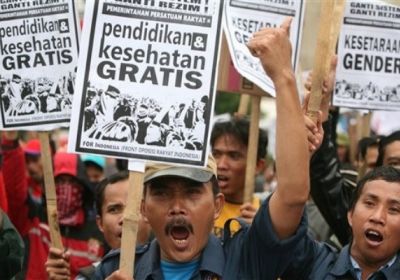 Progressive Indonesian website Berdikari Online said in a March 14 editorial that the recent US diplomatic cables published by WikiLeaks exposing the corruption of the Indonesian government confirmed what most Indonesians already knew. However, it said the leaks have further delegitimised the government of President Susilo Bambang Yudhoyono. In his two terms of government, the editorial said, Yudhoyono has imposed neoliberal policies and acted as a puppet of US imperialism.
 -
Facing public anger and concern over the nuclear meltdown unfolding in Japan, German Chancellor Angela Merkel announced temporary shutdown of several nuclear reactors. On March 12, more than 60,000 anti-nuclear protesters in the south-western state of Baden-Wuerttemberg formed a 45 kilometre human chain from Stuttgart to the Neckarwestheim 1 nuclear plant. Smaller protests took place in more than 450 towns and cities across Germany, anti-nuclear organisation Irradiated said. More protests are planned for March 26.
-
 On March 17, the United Nations Security Council (UNSC) “effectively authorized the use of force in Libya”, the UN News Center said that day. “Acting under Chapter VII of the UN Charter, which provides for the use of force if needed,” the report said, “the Council adopted a resolution by 10 votes to zero, with five abstentions, authorizing Member States ‘to take all necessary measures … to protect civilians and civilian populated areas under threat of attack in the Libyan Arab Jamhariya, including Benghazi, while excluding an occupation force.’”
 -
Six activists arrested in Harare, along with 39 others, were finally granted bail on March 16 after a month in jail. The activists were arrested for attending a video screening of footage from the people’s uprisings in Egypt and Tunisia. However, the six need to raise US$12,000 to pay their bail — far more than they can afford. An appeal is being launched internationally to raise the funds needed to pay the activists’ bail (see below for details). The bail conditions require the six to surrender passports and travelling documents. They must report three times a week to the police.
-
Legal action was launched on March 16 against Wisconsin’s Republican lawmakers in an attempt to repeal the anti-union bill that was signed into law on March 11. The law bans collective bargaining for most public sector workers in Wisconsin. Associated Press reported on March 16 that a legal challenge was mounted by Dane County district attorney Ismael Ozanne. AP said: “Democrats in the Wisconsin Assembly had alleged that Republican leaders did not give enough public notice that a committee planned to meet to amend the bill.”
-
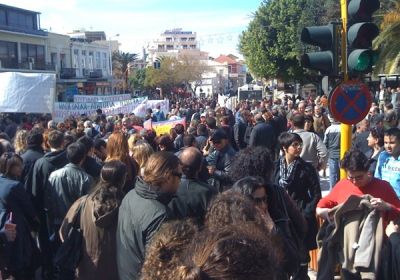 The standard of living for the people of Greece has dropped dramatically since the signing of the first “memorandum” — the agreement signed by the Panhellenic Socialist Movement (PASOK) government with the IMF and European Union (EU) representatives last May. The agreement has meant — among other things — unprecedented salary cuts, a rise in the allowed number of dismissals and a reduction in termination pay, and a cut in the minimum wage for those entering the workforce.
 -
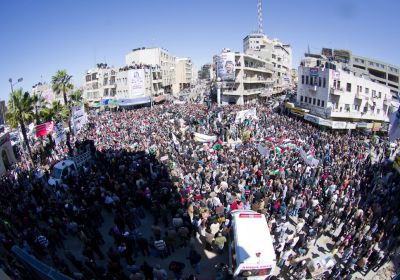 About 2000 mainly young Palestinians rallied in Gaza City on March 14. Waving Palestinian flags, they called on Palestinian factions Hamas and Fatah to end their divisions, for democratic elections for the Palestinian Authority (PA), and for the end to Israel’s occupation of the West Bank and siege on Gaza. Thousands more marching across Gaza the next day and 8000 people protested in Ramallah in the West Bank for the same demands.
 -
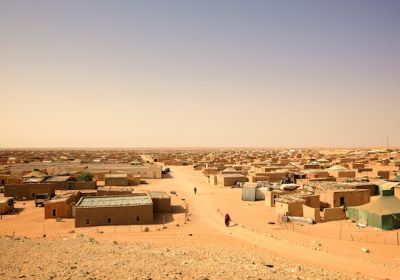 Western Sahara is the last country in Africa awaiting decolonisation. Invaded by Spain in the late 19th century, mass mobilisations in the early 1970s heralded the birth of the modern independence movement. In 1973, the Popular Front for the Liberation of Saguia el-Hamra and Rio de Oro (Polisario Front) was established to wage an armed independence struggle. By 1975, Polisario had fought Spain to a standstill. Rather than grant independence, Spain made an agreement with neighbouring countries Morocco and Mauritania to occupy Western Sahara.