
Europe’s biggest polluters have made billions out of the European Emissions Trading System (ETS). But a new briefing by Carbon Trade Watch (CTW) says the scheme will ensure industry will not have to cut its emissions until at least 2017.
The ETS sets a cap, or upper limit, on total emissions for 11,000 power stations and industrial plants in 30 European countries. Each company receives permits to pollute, which can be traded with other companies.
-
-
 Since January, tens of thousands of United Socialist Party of Venezuela (PSUV) militants, together with activists from other left parties and social movements, have been debating the future of Venezuela’s revolution. Their sights are set on the crucial 2012 presidential elections. This years’ pro-revolution May Day march will be the platform to officially launch Venezuelan President Hugo Chavez’s re-election bid. The US-funded right-wing opposition is yet to decide its candidate, but the election will be critical to the future of a country undergoing a profound process of change.
 -
 The US-led military operation in Libya has morphed from the initial imposition of a “no-fly zone” — ostensibly to prevent Muammar Gaddafi’s regime from carrying out a massacre — into an ongoing bombing campaign with no end in sight. And now there’s increasing talk of the use of ground forces until Gaddafi is overthrown and a new government, no doubt Western-approved, takes his place. Libya discussion Left wrong to oppose military intervention Two wars in Libya
 -
 Pablo Solon, Bolivia’s permanent representative to the United Nations, made the speech below at an April 20 session of the UN general assembly. * * * Victor Hugo, the author of Les Miserables, once wrote: “How sad to think that nature speaks and mankind doesn’t listen.” We are here today to attempt to have a dialogue not just among states, but also with nature. Although we often forget it, human beings are a force in nature.
 -
Only days before Peru’s general elections on April 10, three protesters were killed and dozens injured by firearm-wielding police near the southern city of Arequipa. The protesters were taking part in a community uprising against the Tia Maria copper mine proposed by Mexican-based, US-funded Southern Copper. The company has one of the worst environmental track records of any mining company active in Peru. Fearing that the mine would irredeemably contaminate local water, the residents of Islay took to the streets, despite realising it would put their lives at risk.
-
Two wars are being waged simultaneously in Libya. One has grown out of a revolutionary struggle for democracy. The other is an attempt by imperialism to strengthen its domination of the country. Both wars appear to share the goal of “regime change”, but they stand at opposite ends of the political spectrum. The regime change that the revolutionary struggle seeks to achieve is the overthrow of the Muammar Gaddafi dictatorship and the establishment of a system of democratic rule.
-
Richard Seymour (“Libya: Spring time for NATO”, GLW #876) has done an admirable job debunking justifications of “humanitarian” wars and its defenders. But his analysis of the internal dynamics of Libya leads him astray — so much so that bold assertions are taken as facts with nothing to back it up. He says the co-option of the Libyan revolution by NATO is a victory for reaction. Then he says it is no good hoping that the militias will shake themselves free of such constraints if they take power.
-
Pro-democracy protesters in Yemen have shown their determination for real change by rejecting a proposal that would allow hated President Ali Abdullah Saleh to leave power on his own terms and escape prosecution for his crimes. In the face of ongoing repression, the opposition rejected a proposal from the Gulf Cooperation Council (GCC) and maintained their demand that Saleh leave immediately, Al Jazeera said on April 11.
-
A federal budget containing the largest single-year spending cuts in US history was grudgingly passed by Congress on April 14. The cuts, amounting to US$38.5 billion, will be implemented until the end of the financial year on September 30, 2011. President Barack Obama hailed the budget agreement as a victory. He said: “This is an agreement to invest in our country’s future while making the largest annual spending cut in our history.”
-
“Bolivia is set to pass the world’s first laws granting all nature equal rights to humans,” the Guardian said on April 10. “The Law of Mother Earth, now agreed by politicians and grassroots social groups, redefines the country’s rich mineral deposits as ‘blessings’ and is expected to lead to radical new conservation and social measures to reduce pollution and control industry”, the article said.
-
The Venezuelan government has repeated its request to the United States government for the extradition of terrorist and ex-CIA agent Luis Posada Carriles. Posada Carriles was found not guilty by a Texas court on April 8 of charges of violating US immigration law. Posada Carriles is wanted by Venezuela for his role in blowing up a Cuban plane in 1976. The plane’s 73 passengers, all civilians, were killed. Posada Carriles escaped from a Venezuelan prison in 1985. Venezuela’s foreign ministry issued the statement abridged below on April 8. * * *
-
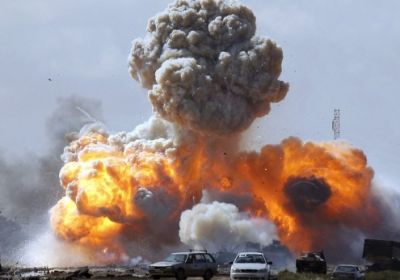 The Euro-US attack on Libya has nothing to do with protecting anyone; only the terminally naive believe such nonsense. It is the West’s response to popular uprisings in strategic, resource-rich regions of the world and the beginning of a war of attrition against the new imperial rival, China. US President Barack Obama’s historical distinction is now guaranteed. He is the US’s first black president to invade Africa.