-
In his May Day speech at a large rally in Caracas, President Nicolas Maduro announced the extension of social programs and benefits to workers and the population in general. The opposition held its own march to criticise the state of the economy. Some of Maduo's announcements to thousands of workers included: a new fund to protect and increase the value of workers’ social security savings, the extension of social programs to workplaces, and the introduction of free wifi in many public parks and urban spaces. -
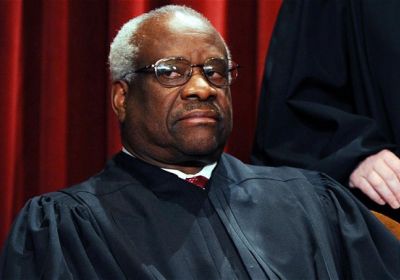
The United States Supreme Court ruled on April 22 that states can ban affirmative action in admissions to their public universities. At issue was a constitutional amendment passed in Michigan that banned consideration of race in admissions to the state’s education institutions. States that have banned affirmative action in higher education, such as Florida and California, as well as Michigan, have recorded a significant drop in the enrollment of Black and Latino students. -
Three years ago the Portuguese government, unable to raise funds on the capital markets, went for help to the infamous troika ― the combination of the International Monetary Fund, European Central Bank and European Union. In return for their bail-out, the troika imposed punitive conditions that have wrecked livelihoods. In Portugal last September, the negative impact was expressed for me in one biting comment: “They are draining the life blood from Portugal.” -
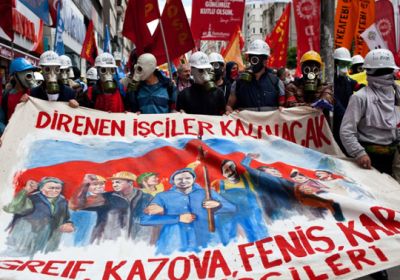
Millions of workers across the globe hit the streets on May 1 for mass rallies marking International Workers' Day. The day was chosen in 1889 as a global day to mark the struggle of the working class by representatives of socialist parties in the Second International. It was held to commemorate the Haymarket Martyrs, anarchists executed in Chicago for their role in the struggle for an eight-hour day in 1886. -
For a man who spent nearly four decades of his 76 years under the restrictive eye of the United States correctional system, few have ever touched as many lives as Rubin “Hurricane” Carter. The world-class boxer-turned-wrongfully accused prisoner-turned-advocate for the rights of the unjustly jailed succumbed to cancer on April 20. But his memory and work will endure as long as there are people outside and inside the prisons of the world fighting for justice.
-
On my wall in London is my favourite photograph from South Africa. Always thrilling to behold, it is Paul Weinberg's image of a lone woman standing between two armoured vehicles, the infamous “hippos”, as they rolled into Soweto. Her arms are raised, fists clenched, her thin body both beckoning and defiant of the enemy. -
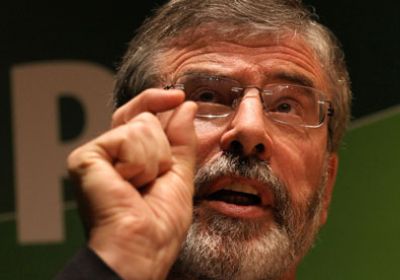
In a move denounced by Irish republicans as hypocritical and politically motived, Sinn Fein president and member of the Irish Dail (parliament) Gerry Adams was taken into custody by the Police Service of Northern Ireland (PSNI) on April 30.
-
Gaza's Ark, a Palestinian-built protest boat which was preparing to run Israel's naval blockade of the territory, was badly damaged in an explosion on April 29 that organisers blamed on Israel, Alarabiya.net said that day.
-
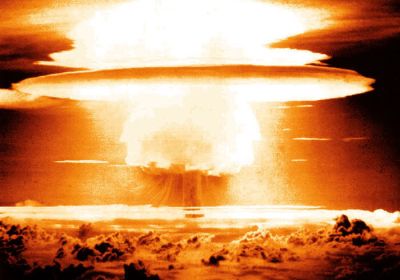
The tiny Pacific nation of the Marshall Islands began a legal battle today to demand the world’s nine nuclear-armed powers meet their disarmament obligations. It accused them of “flagrant violations” of international law. The island group, which was used for 67 US nuclear tests, filed a case with the International Court of Justice in the Hague. It claims the nine countries are modernising their nuclear arsenals instead of negotiating disarmament. The countries targeted include the US, Russia, Britain, France, China, Israel, India, Pakistan and North Korea.
-
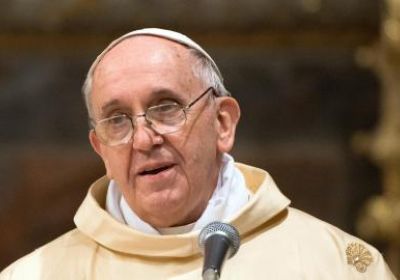
There is little doubt that the Catholic Church is in crisis as a result of deep internal problems. Alongside revelations that child abuse has been widespread within the Church, and that high ranking Church figures were involved in covering up these crimes, it has also been revealed that the Institute for Religious Work (IOR), better known as the “Vatican Bank”, was used for money laundering. -
Imagine trying to win public approval for the following scenario: detonate a hydrogen bomb in a remote region of the Pacific that has little contact with the outside world, in meteorological conditions guaranteed to spread radioactive contamination for hundreds of miles, then refuse to evacuate those affected for days finally taking the affected communities to research facilities for extensive and intrusive testing. -
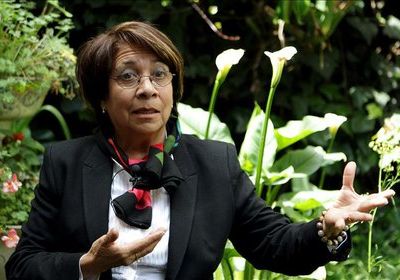
Since its founding in 1985, the Patriotic Union (UP), a Colombian leftist political party, has been victim of calculated violence from actors across the political spectrum. Colombia is the only country in the world that includes “political genocide” in its constitution. This is the label given to the violence suffered by the UP ― more than 5000 of whose members and supporters have been assassinated since 1985. This violence has meant that since 2002, the party has not had enough members to meet the threshold to legally qualify as an officially registered party.