
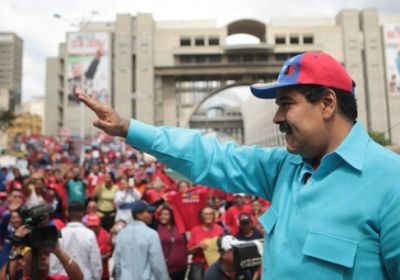
Venezuela's socialist president Nicolas Maduro told a crowd of supporters on May 15 that to increase productivity and help alleviate scarcity of basic products facing the South American nation, all businesses and factories closed down by their owners would be seized and handed over to their workers so production could be restarted. “A stopped factory [is] a factory turned over to the people,” Maduro said. “The moment to do it has come, I'm ready to do it to radicalise the Revolution.”

 On February 27, 1989, the poorest Venezuelans took over the streets in protest against price rises.
Thousands of Venezuelans took the streets in February 1989 in a wave of protests that highlighted the right-wing misrule in the South American country. The protests came to be known as the Caracazo — an uprising that began in the capital Caracas — and ultimately shaped the country's future.
On February 27, 1989, the poorest Venezuelans took over the streets in protest against price rises.
Thousands of Venezuelans took the streets in February 1989 in a wave of protests that highlighted the right-wing misrule in the South American country. The protests came to be known as the Caracazo — an uprising that began in the capital Caracas — and ultimately shaped the country's future.
 Statue of Guaicaipuro. Photo: Correo del Orinoco.
A statue of Caribe indigenous resistance hero Guaicaipuro was unveiled on October 12 by Venezuelan President Nicolas Maduro to commemorate the Day of Indigenous Resistance.
Guaicaipuro, an indigenous chief of the Caribes, led one of the most successful resistance campaigns against invading Spanish colonial forces throughout the 1560s and is revered by many of Venezuela’s grassroots movements.
Statue of Guaicaipuro. Photo: Correo del Orinoco.
A statue of Caribe indigenous resistance hero Guaicaipuro was unveiled on October 12 by Venezuelan President Nicolas Maduro to commemorate the Day of Indigenous Resistance.
Guaicaipuro, an indigenous chief of the Caribes, led one of the most successful resistance campaigns against invading Spanish colonial forces throughout the 1560s and is revered by many of Venezuela’s grassroots movements.
 Workers from Venezuela's 'housing mission', which is building large numbers of public housing, march on Venezuela's independence day, July 5. Photo from