-
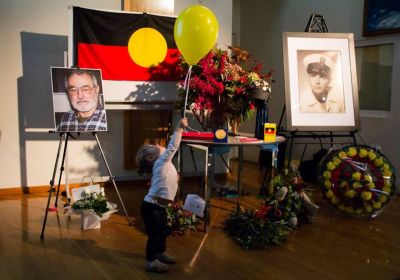
More than 300 people packed the Redfern Community Centre on May 1 to pay their respects to Wiradjuri warrior Ray Jackson, who passed away on April 23. Jackson was the president of the Indigenous Social Justice Association (ISJA) and spent decades campaigning against black deaths in custody. Jackson’s family gave moving messages of thanks to a loving, intelligent father. His granddaughter, Oki, moved the crowd when she said, crying: “I know that if I want to be like you I have to be confident.” -
Wiradjuri man Ray Jackson, socialist, and indefatigable fighter for a better world has fallen. At 73, he died peacefully in the evening on April 23. He had been in hospital for pneumonia a week before his death. Uncle Ray was stolen from his mother at the age of two, and placed with a white family when aged about three. -
Thousands of people took to the streets of Melbourne and Sydney on April 10 to protest against the forced closure of remote Aboriginal communities.
-
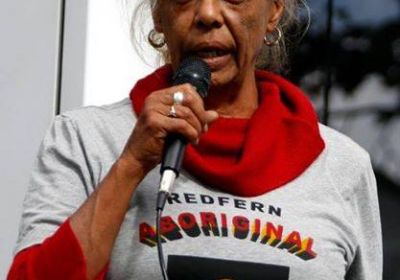
More than 150 people filled the Redfern Community Centre on March 20 to discuss a treaty for Australia’s first people. Organised by Stop the Intervention Collective Sydney (STICS), the event was hosted by veteran journalist Jeff McMullen and televised by National Indigenous TV. As coverage of female Aboriginal voices are rare among mainstream discourses, their retelling of their pasts and hopes for the future captivated the room. -
Student activists dropped a huge banner from Sydney University’s Fisher Library which read "No cuts, no fees, no dereg. Fightback now!" to raise the alarm about the federal government’s looming attempt to deregulate university fees. Six students also locked themselves to the Vice-Chancellor's office, to demonstrate their opposition, and called on all university Vice-Chancellors to oppose the bill. -
To date, Vice-Chancellor of University of Technology Sydney (UTS) Attila Brungs has supported Prime Minister Tony Abbott's fee deregulation legislation. Last year he said fee deregulation “could have some positive impacts” and result in “teaching quality going up”. Arguing that it is positive that students finish their course with $100,000 debt is a hard sell, and Brungs felt the heat as students at UTS signed petitions calling on him to oppose it.
-
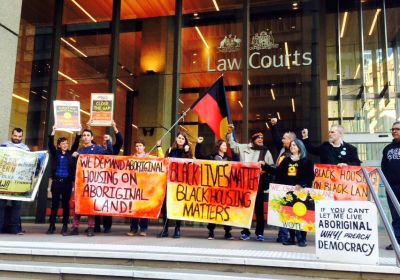
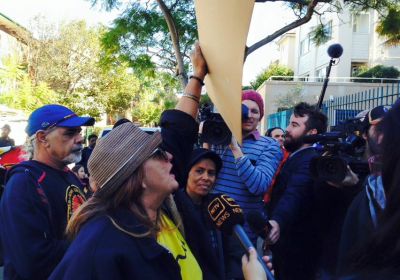
The Redfern Aboriginal Tent Embassy (RATE) is working hard to defend its right to stay at its current location following being served with an eviction notice from the Aboriginal Housing Company (AHC) on February 20. The eviction orders mobilised a number of supporters and media to defend the site during the past week. So far, AHC head Mick Mundine has not called in police to shut the embassy down. -
About 3000 people marched through Sydney's inner-west suburbs of Newtown and St Peters on February 1 to show their opposition to the $12 billion WestConnex motorway project.
-
The Redfern Aboriginal Tent Embassy (RATE) was established nine months ago. It is a site of resistance to a program to move Aboriginal people out of Redfern led by the Aboriginal Housing Corporation (AHC) and development company DeiCorp. The racist campaign of social cleansing is backed up by Redfern police. The Tent Embassy has been under sustained attack. RATE activists have suffered verbal and physical assaults and bail conditions imposed on victims that prevent access to the Embassy — all while the perpetrators have no restrictions on their movement. -
The planned forced deportation of Villawood detainee Wei Lin on December 19 was successfully stopped at Sydney apirport that day. A professional athlete in China, Wei Lin has already faced persecution and harassment in China after exposing the use of performance-enhancing drugs in Chinese sport in the late 1990s. Wei Lin, accompanied by four Serco guards, was handcuffed and masked, and driven to the back of the airport and onto the Air China plane on the afternoon of December 19. -
Activists tried to stop the transfer of asylum seekers from Villawood in Sydney to Yongah Hill in Western Australia on November 12 and 13. Activists heard that 65 asylum seekers would be transferred following on from the forcible transfer of at least 83 refugees from Villawood in April. Refugees oppose being transferred to remote detention centres because they have less access to support networks, such as friends and lawyers. The friendships they have made in detention can also be destroyed if people are sent to separate facilities. -
Sixty people, including activists from Papua New Guinea (PNG) and ABC radio presenter Julie McCrossin, protested outside the federal government's Asia-Pacific Rainforest Summit on November 12. The conference featured Liberal MPs Julie Bishop and Greg Hunt speaking to government ministers from the Asia Pacific region.