
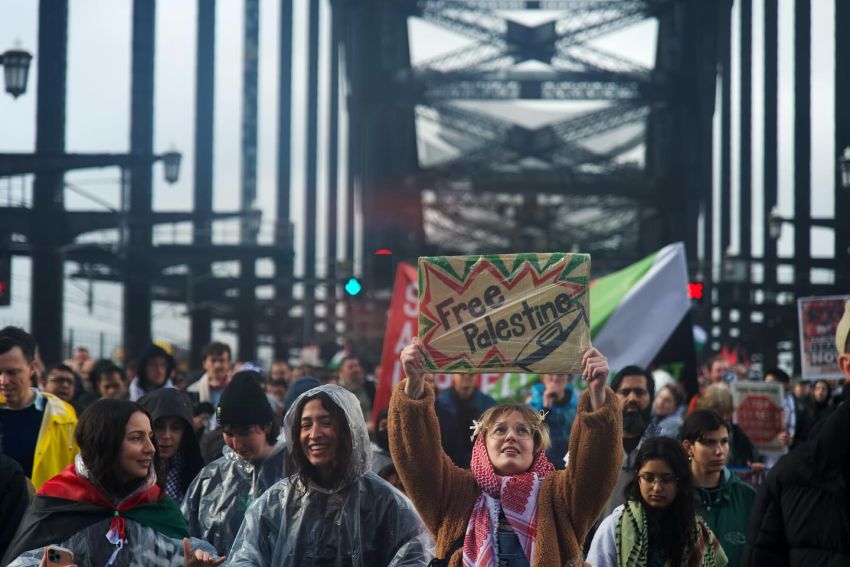
The Antisemitism in Australia: Findings of research commissioned by Australia’s Special Envoy to Combat Antisemitism (ASECA), published in November, purports to offer a baseline of racial prejudice. Instead, it delivers a masterclass in “evidence making”.
It is so methodologically flawed and ideologically driven that it is less a study of hatred and more a sophisticated instrument of propaganda — manufacturing the hatred it purports to condemn.
The report, commissioned by a government body explicitly tasked with combating antisemitism, relies on a circular logic that pathologises political literacy.
By defining opposition to Zionism as a form of bigotry, and then measuring the prevalence of that opposition, the researchers manufacture a “crisis of anti-Semitism”.
For institutions, this report is convenient because it justifies the censorship of pro-Palestine activism under the guise of “safety”. But from a social science perspective, it violates the basic tenets of empirical inquiry, exhibiting a colonial gaze more revealing of its authors’ prejudices than of the survey respondents’ views.
Measuring tool deception
The “Generalised Antisemitism Scale” (GAS), its primary measurement tool, is at the heart of the report’s deception. This psychometric instrument is more a political trap than a neutral thermometer of racial animus.
The report states that the GAS aggregates two distinct subscales — “Judeophobic Antisemitism” (hatred of Jews as a people) and “Antizionist Antisemitism” (political opposition to the Jewish state). It justifies this conflation by citing the controversial International Holocaust Remembrance Alliance (IHRA) working definition.
By melding these two categories into a single metric, the researchers ensure that any uptick in political outrage regarding Israeli war crimes is mathematically converted into a rise in hatred towards Jewish people.
The authors normalise a nationalist narrative, making any deviation an issue of mental health.
The report effectively treats the calling out of a state for committing genocide as a symptom of the same pathology as racial hatred. But the students are not the intoxicated ones. They have looked at the facts of the occupation without the comforting haze of colonial mythology. The report classifies this clarity as a defect, pathologising the refusal to consume state propaganda as a cognitive decline.
Interestingly, the data provided in the report betrays this conflation.
Among university students, the targeted demographic, there is a noticeable statistical divergence between the two subscales. Students score low on traditional Judeophobia but high on anti-Zionism.
In any rigorous sociological study, this variance would indicate evidence of their students’ ability to tell the two apart. It proves that young people are successfully distinguishing between Jewish people (whom they do not blame) and the State of Israel (which they fiercely oppose).
Interestingly, the report does not deny this: “Participants often presented over-simplified analogies, such as comparing the Israel-Palestinian conflict with Australia’s colonial history leading to reductive compassion to avoid a deeper engagement with the topic. Thus, many participants expressed support for Jewish communities while also criticising the actions of the Israeli state.”
Yet, it refuses to accept this as a valid distinction. Instead, it classifies students’ high anti-Zionist scores as evidence of a “knowledge gap” or “misinformation”, dismissing their political critique as a cognitive error and implying that universities are incubators of ignorance.
Racism built in
Perhaps its most egregious failure is its profound ethnocentrism, visible not only in what it asks but in what it omits.
The survey presented respondents with a list of “communities” — Jewish, Indian, First Nations, Chinese and Italian — asking them to rate them on descriptors, including “lazy”, “productive”, “cruel” and “coloniser”.
This is the textbook definition of racist thinking because it invites the respondent to attribute fixed, inherent qualities to entire peoples. Further, it collapses the distinction between political deeds and personal character, treating both as fixed properties of an ethnic group.
The researchers effectively incite respondents to trace everything back to a supposed underlying nature. It compels the respondent to engage in essentialist thinking, viewing complex political histories as the inevitable expression of an ethnicity.
The report uses the “stereotype content model” (SCM) method, yet it misinterprets the model’s most dangerous quadrant.
The authors celebrate the fact that students rated the Jewish community as “productive” (high competence), framing this as a “positive attribute” or “compliment”. However, scholarship on the SCM method explicitly warns that “competence” is context-dependent.
In a competitive context, the combination of high competence (“productive”) and low warmth (“coloniser”) places a group in the quadrant of “envious prejudice”. In this quadrant, competence is not viewed as a virtue but as efficiency in domination. When a student rates a perceived coloniser as “productive”, they are not expressing admiration for their work ethic; they are expressing fear of their military and bureaucratic efficiency. A “lazy” coloniser would be less dangerous.
By interpreting this threat assessment as a “compliment”, the researchers display an ignorance of social psychology.
The omission of “Anglo-Australian” or “White Australian” from this list is also a methodological scandal.
By excluding the dominant group, the survey treats “whiteness” as the neutral observer against which all “ethnic” others must be measured. This prevents the respondent from benchmarking their views against the actual colonial history of this country.
If asked “Is the Anglo-Australian community a coloniser?” any literate respondent would answer “Yes”. By removing this option, the survey frames “coloniser” not as a structural and historical description of a settler society, but as a stigmatising label applied selectively to minority groups for no other reason than “unexplainable ethnic hatred”.
Furthermore, asking respondents to rate ethnic communities on an axis of “productive” versus “lazy” resurrects essentialist typologies reminiscent of 19th century race science. These classic tropes are used to justify colonial exploitation.
To invite respondents to categorise First Nations people or Jewish people as “productive” or “lazy” forces a mindset of essentialist and racist judgement.
When students identify the Jewish community as “Coloniser” (giving it a score of 5.15), the report treats this as a slur (“Italians” are next at 5.48).
However, on the axis of “Cruel versus Kind”, the students assigned the Jewish community a score of 5.89 (a 0.05 difference from “Indians” at 5.94).
The statistical gap between these two scores, along with the comparison to other “ethnic communities” is telling: Students rate the Jewish community as “Colonisers” significantly more intensely than they rate them as “Cruel”. This confirms they are critiquing a structural position (settler-colonialism) rather than attributing an inherent moral defect (cruelty).
In reality, given the forced (racist) choices of the survey, the students are likely using the “Jewish community” slider as a proxy for the “State of Israel”. Without an option to rate “The Israeli state” separately from “the Jewish community” and without an option to compare this to “Anglo-Australia”, the respondents are trapped.
In fact, the data itself demonstrates that it is a proxy.
The report’s own figures reveal a critical divergence: students score low on traditional measures of anti-Jewish bigotry, yet high on the “coloniser” metric. This statistical gap confirms that the term is not being used as an ethnic slur, but that students are using the “Jewish community” category as a forced proxy to critique the political project of the State of Israel.
The authors are forcing us to see a factual truth (illegal occupation and dispossession) through a racialised survey instrument.
Empirical reality of genocide
The report repeatedly disparages young people’s use of the “settler-colonial framework”, attributing it to malign social media algorithms.
It claims that “misinformation” is behind students’ views that the war in Gaza is a colonial act or if they invoke the analogy of the Holocaust to describe the treatment of Palestinians.
The evidence however shows that students, not the researchers, are more aligned with international law on ruling against Israel’s de facto annexation, which violates the prohibition on the acquisition of territory by force, and humanitarian consensus.
When students describe Israel as a “coloniser”, they are using a legal description that has been validated by the International Court of Justice.
Moreover, the “genocide” framework dismissed by the special envoy’s report has been substantiated by United Nations Special Rapporteur Francesca Albanese’s Anatomy of a Genocide and Genocide as Colonial Erasure reports. The destruction of more than 80% of the Gaza Strip, the weaponisation of starvation and the systematic targeting of cultural and medical infrastructure are not matters of “opinion”; they are documented war crimes.
When 50% of the most educated cohort agree with the statement that “Israel treats the Palestinians like the Nazis treated the Jews”, social scientists should ask why. Instead, the researchers categorise this as “Holocaust inversion” — a trope of antisemitism.
Students have watched, in real time, the ghettoisation, starvation and industrial slaughter of a contained civilian population. The analogy is drawn from the mechanics of the violence, not from a desire to insult Jewish history. It functions in much the same way that anti-Nazism was a stand against political supremacy, not an expression of anti-German racism.
By pathologising this moral reflex as “hate speech”, the report demands we unsee the evidence over two years and effectively condone genocide — precisely the type of complicity that allowed the Holocaust to unfold.
Pathologising critical thought
The report rests on a lazy intellectual foundation, the “Deficit Model”, which presumes that if a population disagrees with a state-sanctioned narrative, it is because they suffer from a deficit of information.
Researchers repeatedly argue that student opposition to Zionism is due to “ignorance”, “social media algorithms” or a lack of historical awareness. They say that if students truly understood the history of the Middle East, they would support the state of Israel.
This claim flies in the face of decades of research. Studies by the Organization for Economic Cooperation and Development and the American Sociological Association demonstrate that higher education teaches students to interrogate power structures, analyse source material and question received wisdom.
When students apply these skills to the Israel-Palestine issue, the ASECA report dismisses their conclusions as “misinformation”. In a stunning act of intellectual arrogance, it dismisses students’ reliance on the “settler-colonial framework” as “misinformation” and “reductive compassion”.
When a state cannot win the moral argument, it targets the thinkers; when it cannot justify its violence, it tries to silence the campus. Students are doing exactly what the university was designed to teach them to do — look beyond the headlines and form independent ethical judgements.
By framing this intellectual labour as “radicalisation” or “ignorance”, the report engages in a form of gaslighting. It tells the most educated cohort in the country that their research is wrong because it led to a politically inconvenient conclusion.
The campus front
The practical danger of this report lies in its application. It provides the bureaucratic ammunition for a crackdown on academic freedoms. Universities Australia has increasingly signalled its willingness to adopt IHRA-like definitions of antisemitism, which conflates anti-Zionism with racism.
Academics for Palestine have pointed out that reports like this serve as a backdoor mechanism to enforce definitions that the sector previously rejected, using “student safety” as the lever to pry open the door for censorship.
The ASECA report, which frames universities as incubators of “radicalisation”, explicitly recommends “curiosity-based education” and “critical-thinking frameworks” to correct students’ “knowledge gaps”.
This is Orwellian doublespeak.
The students are engaging in critical thinking. The “education” proposed by ASECA is essentially a pedagogical intervention to align student views with Australia’s foreign policy interests that, apparently, rely on condoning genocide. ASECA’s “re-education” program amounts to authoritarian censure founded on prejudice.
It aligns with Universities Australia’s broader strategy of weaponising “cultural safety” to shut down political speech. If a lecture on the history of settler-colonialism in Palestine is deemed “unsafe” for Zionist students because it challenges their political outlook, the university must cease to be a place of inquiry.
The ASECA report, a resounding success as a piece of political theatre, creates the “evidence” needed to enforce this censorship, allowing university administrators to ban protests and discipline staff under the guise of “combating hate”.
The “gap” between the expertise of humanitarians and this report’s findings is not a difference of “opinion”. Students and young people have not “lost their way” or fallen prey to TikTok algorithms. They have looked at the rubble of Gaza, read the rulings of the ICJ and drawn the only ethical conclusion available.
That their government chooses to label this moral clarity as “antisemitism” says nothing about the students but speaks volumes about the moral bankruptcy of a state that would rather pathologise its youth than confront its own complicity.
[Gwenaël Velge is a member of Academics for Palestine WA, where a longer version of this article was first published.]