-
Regardless of the result of the latest round of negotiations between the SYRIZA-led government of Greece and the heads of the 28 members of the European Union, one thing is certain: in coming years, the Greek people are going to need all possible solidarity because their struggles and sufferings are bound to continue. The best imaginable deal with the EU will mean six years of Troika-imposed austerity grinding along to one degree or another. Forced Greek exit from the eurozone will drive the country deeper into recession, further contracting an economy that has shrunk by 25% since 2008. -
After Greece voted "no" by a large margin to more brutal austerity, Solidarity4All issued a call for assistance and solidarity on July 7, published below.
-
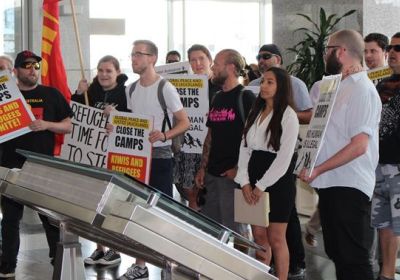
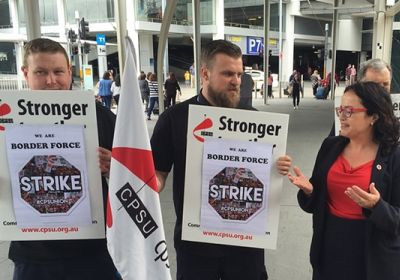
Staff of the Immigration and Border Force agency marked the first day of their newly merged federal department on July 1 by going on strike for the second time in a week. Two-hour stoppages and meetings took place at seaports, workplaces and international airports, including Sydney, Melbourne, Brisbane, Darwin, Perth and Adelaide. Significant disruption of services was reported. -
The Communication Workers Union (CWU) has called for Australia Post (AP) CEO Ahmed Fahour to be sacked over his plans for 1900 job losses from the government-owned postal service. The call follows Fahour's statement on June 26 that AP would spend up to $190 million slashing employment in the agency in response to a declining volume of letter deliveries. AP employs 36,000 staff, with about 23,000 working in the mail service. Fahour claims the cuts follow losses in the mail delivery section totalling more than $1.5 billion in the last five years. -
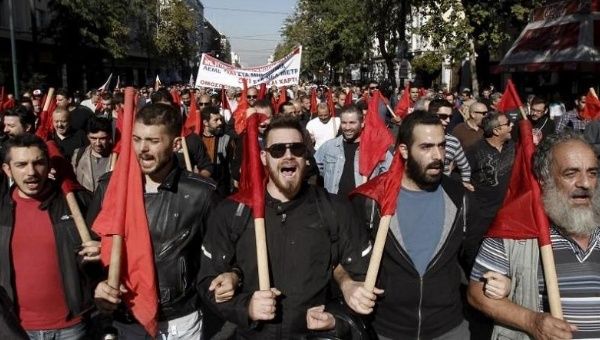
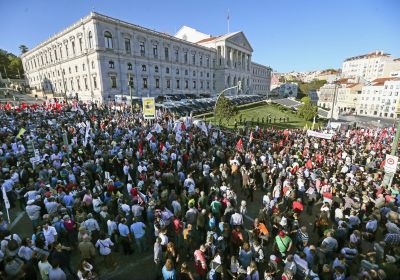
"The 'No' rally of this evening was quite simply the biggest political rally since the fall of the dictatorship," SYRIZA activist Stathis Kouvelakis said via Facebook on July 3 of the mass rally to back the SYRIZA government's call for a "No" vote in Greece's July 5 referendum on whether to accept the crippling austerity demanded by the nation's creditors.
-
Across Africa, western Asia and Latin America in the 1980s, the growth of per capita GDP was brought to a halt. This was not a recession, it was a severe depression. And its cause was reckless lending by banks in the ’70s.
-
Unions have slammed plans to axe more than 2700 jobs from the NSW power industry this year. Publicly owned electricity network companies Ausgrid, Endeavour Energy and Essential Energy have revealed plans to cut 2749 jobs from September, offering staff just one week to consult on the proposal. The announcement follows the recent passage of legislation by the NSW government to privatise the power "poles and wires" network. The proposed job cuts are part of preparations for the sale of long-term leases for the three public power companies. -
The ALBA bloc, comprised of 12 Latin American and Caribbean nations, expressed its support to Greece, as the Mediterranean country continues to renegotiate its debt with eurozone lenders. In a statement June 28, the bloc, which calls itself a “People’s Trade Treaty,” said it stands with the Greek people and the SYRIZA government against the "destructive consequences of neoliberal transnational capital," which regional organization said looks to subvert Greek democracy through financial measures. -
The message from the mainstream media and parties across Europe is Greece is to blame for its own predicament. But a growing grass-roots movement across the continent is pushing for an alternative approach that demands democracy, not austerity. In a speech to the Belgian parliament on June 10, conservative Belgian Prime Minister Charles Michel declared that “the end of the Greek holiday has sounded.” -
Sydney protest in solidarity with Greece, June 28. Photo by Peter Boyle Protests are being planned in the Australian cities of Melbourne, Sydney, Canberra, Armidale and Brisbane in coming days in support of the Greek people and its elected SYRIZA-led government.
-
Bolivia's President Evo Morales highlighted the importance of social movements in driving the changes and the economic growth experienced by the South American country in recent years.
-
Land rights activists in Honduras' north coast Aguan Valley have condemned what they call an ongoing “hunt” of campesinos (small farmers) in their communities. The activists are calling for freedom for political prisoners and an end to repression of campesino movements. Family members of jailed and persecuted rural workers have denounced the “dirty and malicious campaign” of criminalisation against campesino leaders and communities. They accuse the national police, and other state and private security forces, of operating as “a gang of hitmen”.