-
Venezuelan President has Nicolas Maduro announced a raft of new regulatory measures as part of his ongoing “offensive” to deal with the country’s economic problems. In a television interview on December 1, Maduro said the government’s economic policies were aimed at “stabilising” the economy in order to be able to develop a “productive” economic model. This year, Venezuela has experienced shortages in several basic food and household goods, a black market dollar worth ten times the government-set exchange rate, and annual inflation of 54%.
-
Supporters of the Venezuelan government celebrated their victory in the municipal elections held on December 8. Analysts have commented that results indicate President Nicolas Maduro has “reconnected” with the social base of the Chavista movement. The first results announced gave the governing United Socialist Party of Venezuela (PSUV) victory in 58% of the country’s municipalities. The PSUV and its allies gained more than 49% of the total vote share versus 43% for the opposition. -
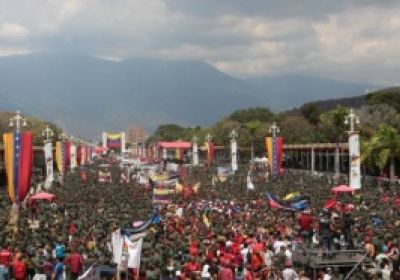
Hundreds of community activists gathered in downtown Caracas on November 16 and 17 to demonstrate their steadfast support for the socialist policies of Venezuelan President Nicolas Maduro. Maduro used the occasion to repeat: “Venezuela’s communes must be consolidated if we are to truly carry out the program elaborated by our leader, Hugo Chavez.” -
The National Electoral Council (CNE) has announced the first results of the Venezuelan municipal elections held on December 8. Mayors and local councilors were elected for the country’s 335 municipalities, as well as the metropolitan mayor of Caracas. CNE president Tibisay Lucena read out the results. Turnout was 58.92%, with 97% of votes counted so far. The results for 77% of mayoralties were announced, with the ruling United Socialist Party of Venezuela (PSUV) and its allies winning 196 so far, of the 257 mayoral position results that are so far irreversible.
-
While the governments of the United States, Britain and Israel provided support to South Africa's arpatheid regime, the Cuban Revolution helped the anti-apartheid forces, sending thousands of volunteers in the 1970s and '80s to help Angolan forces defeat the apartheid regime's war on their country. On his release from prison, Cuba was one of the first places Mandela visited to thank the Cuban people for their assistence. The article below is abridged from a piece originally published in Green Left Weekly #23 in 1991. * * * -
Below is a speech by Xiomara Castro, candidate for the left-wing LIBRE party who has claimed victory in Honduras' November 24 presidential election. The elections were marred by widespread fraud as the oligarch-controlled electoral council released results that placed the right-wing National Party candidate Juan Orlando Hernandez in a clear lead. It is taken from Honduras Resists!, which includes eyewitness accounts of the huge protest on November 30 against electoral fraud and for Castro as the legitimate president-elect.
-
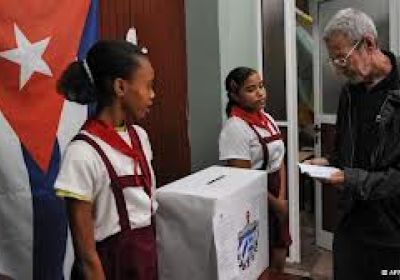
Local citizens voted to create 169 new communes on November 24, deepening efforts to create forms of communal organisation in the South American country. A recent national census found there are more that 40,000 active communal councils in Venezuela. These are local participatory bodies that develop their communities and can receive public funding. Communes are based on groups of communal councils, and can take on larger -scale projects and economic activities.
-
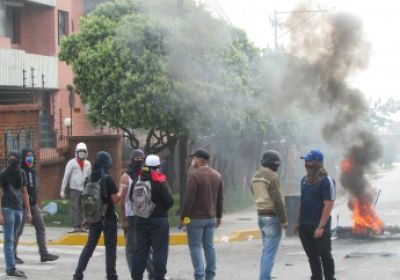
Over the past few months, plazas, airports and roads in Mexico City and several other cities across the country have been paralysed by teachers and their supporters. They have been protesting against neoliberal reforms to the public education system proposed by Mexican President Enrique Pena Nieto and recently approved by Congress. These so-called structural reforms to education coincide with other neoliberal attacks pushing the privatisation of education, oil and electricity industries. -
Large-scale electoral fraud affected every aspect of the November 24 general elections in the Central American country of Honduras. This has sparked a huge political crisis, which matches and possibly surpasses the crisis produced by the coup d’etat that overthrew president Manuel Zelaya in 2009.
-
Lurid articles about Venezuela have peppered the Western press in recent days and weeks. The latest event that has been widely reported is the use of the military to occupy stores, including the national electronics chain Daka, with a mandate to sell products at “just prices”. This is viewed by most media outlets as further evidence of the chaotic mismanagement of the economy by the government. However, while there are serious economic problems in Venezuela, this one-sided portrayal prevents an informed debate.
-
Venezuelan President Nicolas Maduro criticised US “intervention” in the internal affairs of Latin American countries, and in the Honduran elections, on November 25. Xiomara Castro, candidate for the LIBRE party formed by the resistance movement that opposed the 2009 US-backed coup, declared victory after the vote. However, so did her conservative opponent, National Party's Juan Hernandez , with the Electoral Supreme Court (TSE) declaring Hernandez clearly ahead. LIBRE rejected the TSE's count, alleging serious fraud.
-
Three of the main political parties contesting the November 24 election in Honduras are accusing the oligarchy-controlled Supreme Elections Tribunal of vote manipulation and fraud following a massive voter turnout on election day.
Latin America & the Caribbean