
The Sri Lankan army has demolished hundreds of houses inside its “high security zone” (HSZ) at Valikaamam on the Jaffna peninsula in the north of Sri Lanka, a February 11 Tamilnet report said.
The houses belonged to Tamils who had been driven from their homes 20 years ago when the HSZ was established.
-
-
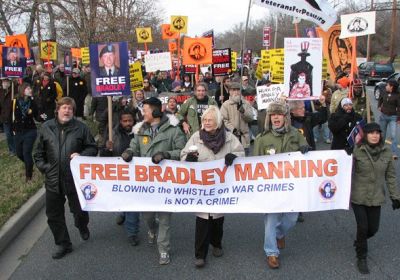 February 23 marks the 1000th day in which alleged WikiLeaks whistleblower, 24-year-old US Army intelligence officer Bradley Manning, has been jailed by US authorities without trial. A pre-trial hearing in January in the case of Manning, concluded that his defence would be restricted to arguing motive during his trial, scheduled for June 3. Manning has been accused of leaking thousands of classified documents to WikiLeaks, which revealed a wide range of US war crimes, as well as evidence of corruption and lying by a range of governments.
 -
As one who took part in demonstrations against the war in Vietnam, I could hardly believe it when the US “war machine” resurrected itself and began its march on Iraq. Appalled by what appeared to be happening, I was delighted to discover, following a rally in November 2002, that a local peace group had been created. I joined that group and began actively campaigning for peace which I continue to this day.
-
In a letter to the New York Times published on February 13, South African Nobel Peace Prize laureate Archbishop Desmond Tutu challenged the hypocrisy of the US and its citizens for accepting a killer drone program when it pertains to foreign suspects while demanding judicial review when those targets are American citizens.
-
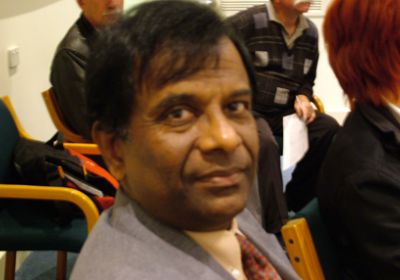 Lionel Bopage, 68, was jailed twice and tortured for his roll as a former leader of a mass liberation movement in Sri Lanka in the 1970s and 1980s, called the Janatha Vimukthi Peramuna (People's Liberation Front). He rose to the position of general secretary of the JVP but resigned from the group in 1984 over a number of differences, including his principled support for the right of national self-determination for the Tamil people. He was eventually forced into political exile together with his wife, Chitra.
 -
It started in Colombia in 2000, moved on to Mexico in 2008 and now rages in Central America. Since the beginning of the century, the US-backed “war on drugs” has progressively spread throughout the northern part of Latin America, leaving tens of thousands of lost lives in its wake. An in-depth investigative piece published by the Associated Press explains how this so-called “war” ― which relies on US funding, training, equipment and troops ― has grown in recent years to become “the most expensive initiative in Latin America since the Cold War”.
-
“I saw men, women and children die during that time,” former US drone pilot Brandon Bryant told the December 10 Der Spiegel. “I never thought I would kill that many people. In fact, I thought I couldn’t kill anyone at all.”
-
“France is in Mali for the long haul.” That was the headline of France’s daily newspaper Le Monde on February 4. The newspaper's front page, as well as pages 2 and 3, were devoted to a discussion over “what next” for France in Mali.
-
President Barack Obama's nomination of John Brennan to head the CIA underscores the administration's drive to assert absolute executive power in the “war on terrorism” without any outside constraints or possibility of review. Brennan was a public defender of the use of torture and "special rendition" under the Bush administration.
-
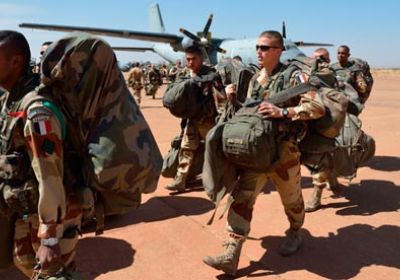 Statement on the military intervention in Mali by the Africa Network of the Committee for the Abolition of the Third World Debt (CADTM), January 29. * * *
 -
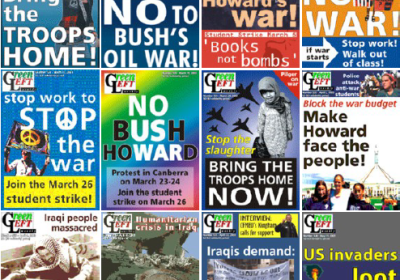 Ten years ago, the February 14-16, 2003 global protests against the looming US-led invasion of Iraq involved more than 12 million people in 700 cities around the world. A million people marched around Australia — 500,000 of them in a huge protest in Sydney that was so big that most participants could not move (let along march) from Hyde Park. It was the biggest globally coordinated protest ever — certainly the biggest global anti-war protest.
 -
The horrific murders of 20 children aged six and seven, along with six adults, at a school in Newtown, Connecticut, in December has ignited a debate about gun violence in the US. This was the latest in a series of such massacres to occur at schools, malls, religious institutions, theatres and similar places over the past few decades. In many of these instances, rapid-fire military-style weapons were used that sprayed big numbers of bullets in seconds, as was the case in Newtown.