-
In her previous books The Shock Doctrine: The Rise of Disaster Capitalism (2007) and No Logo: No Space, No Choice, No Jobs (2000), Canadian author and activist Naomi Klein took on topics like neoliberal “shock therapy,” consumerism, globalisation and “disaster capitalism”. Klein extensively documented the forces behind the dramatic rise in economic inequality and environmental degradation over the past 50 years. -
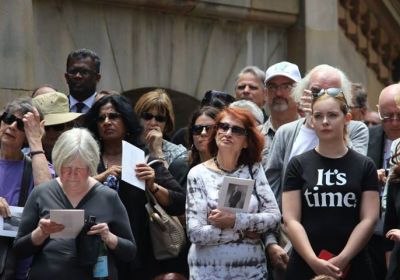
The summer sun beat down on August 21 as thousands of Palestinians set out on a silent march in al-Rama, a Palestinian town in the northern Galilee region of present-day Israel, honouring the recently deceased poet and activist Samih al-Qasim. The 76-year-old al-Qasim, who battled cancer for three years, died late on August 19. Placards bearing verses of al-Qasim’s poetry and Palestinian flags bobbed above the marching crowd, which eventually arrived at the town’s main amphitheater. Al-Qasim’s relatives, prominent religious figures and politicians all spoke. -
I am proud to join more than 250 Jewish holocaust survivors and descendants of survivors in condemning the massacre of Palestinians in Gaza and the ongoing genocide of the Palestinian people. Our statement of solidarity (published below) calls for "An immediate end to the siege against Gaza" and a"full economic, cultural and academic boycott of Israel". We believe that "never again", the often-repeated lesson of Hitler's holocaust, "must mean never again for anyone!" -- especially the Palestinians. -
We know it was the biggest protest in world history. We know that millions of people who'd never before felt like they could make their voices heard by taking action, marched in the streets of 800 cities to say “Not In Our Name”; that they dared hope for peace, but were committed by their governments to a bloody and illegal war.
-
Jan Woolf is the cultural coordinator of the No Glory in War campaign, a group that seeks to counter the celebratory narrative of the British government’s commemorations of World War I. She spoke to online radical cultural Red Wedge Magaize about the campaign’s use of art and media — both past and present — to communicate its message.
-
Jobbik, a far-right ultra-nationalist racist party established in 2007, made significant electoral gains in the Hungarian elections, garnering just over 20% of the national vote in the April poll. Under Hungary’s system of proportional representation, this result (up 5% from last showing) makes Jobbik Hungary’s second-strongest party. This assures it a significant agenda-setting presence in an already right-wing dominated parliament. -
The old rocker who owns the local music store has a t-shirt on display that reads: “When words fail ... music speaks.” One could also say that when speech fails, David Rovics sings. As Wally Brooker recently noted about the US folk singer: “What's striking about Rovics is his ability to bring first-hand reports of local struggles from around the world to each community that he visits.”
-
So here it is, the latest album from prolific radical songwriter David Rovics All The News That's Fit to Sing.
-
When you travel through France, there’s one name that appears most in public space ― on streets, schools and metro stations. Not Jeanne d’Arc, Napoleon, or even World War II resistance leader and later president Charles de Gaulle. No, the name you can pretty safely bet you’ll find on some sign in the next sleepy village is that of Jean Jaures. Jaures was France’s most famous socialist leader and deputy, a tenacious and passionate fighter for workers’ rights and against war, anti-Semitism, clericalism and colonialism. -
Les Miserables Now playing in Melbourne www.lesmis.com.au Les Miserables tells two stories: one of personal love, the other of revolutionary passion. It is no surprise that most Western adaptations of Victor Hugo's novel have, when deciding what to cut and what to leave in, favoured the clasped hands of romance over the clenched fist of insurrection. The story we all know -- the one that is left after adaptation pares away everything else -- is that of Jean Valjean, the ex-convict who redeems himself through acts of charity.
-
In the Shadow of Gallipoli By Robert Bollard NewSouth, Sydney 2013 On April 25, 1915, Australian troops landed at Gallipoli on Turkey’s coast. They were part of a British imperial force aiming to capture Constantinople (now called Istanbul) and the land alongside the narrow waterway linking the Mediterranean to the Black Sea. It was hoped this would enable British ships to enter the Black Sea and bring supplies to allied Russia. -
In the 18th and 19th century, scientists often used themselves as guinea pigs in the course of conducting experiments to determine the causes of disease and test the efficacy of new drugs. One of the earlier and more heroic examples comes from the Scottish physiologist and surgeon John Hunter (1728-93). Hunter was investigating syphilis, a disease surrounded by secrecy and shame whose origins were unlikely to be acknowledged at any level. The French called it the Italian disease and the Italians called it the French disease.