Britain's High Pay Commission has just published a report about the trend in salaries paid to the highest 0.1% of earners, and it seems that someone must have made a terrible mistake.
Because, in this time of unprecedented debt and sacrifice, the government's making daily statements such as "in order to keep old age pensions viable, we are insisting from now on that the elderly contribute towards their upkeep, by going on the game for just two days a week”.
-
-
The Occupy movement in the United States continues to gain strength, despite wide-scale repression. The article below is abridged from a US Socialist Worker editorial. * * * The raids, arrests and police violence against the Occupy movement that has been occurring across the United States are about trying to silence a movement giving voice to the accumulated discontent of the working-class majority. They're also about showing who's the boss ― the political and business establishment. -
The World Bank Out of Climate Finance coalition issued the statement below on December 1 from Durban, South Africa. * * * Today, 163 civil society organisations from 39 countries released a letter exposing an attempt led by the US, Britain and Japan to turn the Green Climate Fund into a “Greedy Corporate Fund” at UN climate talks in South Africa. The Green Climate Fund was created to support people in developing countries — people who are the most affected by the climate crisis but are the least responsible for it.
-
“There is money.” That was the major election campaign slogan of the Panhellenic Socialist Movement (PASOK) in October 2009.
-
The phrase “organise, don’t agonise” has become a bumper sticker, a popular slogan in the feminist movement, the title of many speeches, conferences and newsletters. African-American civil rights activist Florence Rae Kennedy coined the term. Gloria Steinem quoted her in Ms magazine in 1973. Since then, this powerful slogan has circumnavigated the world many times — used by many activists and movements. It has lasted because the slogan reasonates strongly with the condition of the oppressed, exploited and persecuted. -
As you read these words, disaster may be about to strike in the galloping crisis of the European financial system and the euro. Or it may not — yet. On November 30, the imminent threat of a banking system implosion stirred the European Central Bank (ECB), the US Federal Reserve, Bank of England and central banks of Japan, Canada and Switzerland, into taking the minimum action needed to prevent a “Lehman Brothers event” collapsing the European financial system. -
Prime Minister Julia Gillard’s imminent $90,000 pay rise is more than twice the estimated median wage of all Australian full-time or part-time employees, aged 15 years or over. More than half of all Australian workers have a yearly pay packet smaller than the PM’s expected pay rise. The $40,000 pay rise expected for backbenchers will also be more than the total wage of many Australian workers. -
Occupy began as a movement against the effects and causes of the global economic crisis and against the austerity measures pushed by governments for the benefit of the 1%. In Australia, many people were inspired by Occupy Wall Street in New York and the global movement it had sparked. When an international call for action on October 15 came out, we responded, and began our own occupations here. -
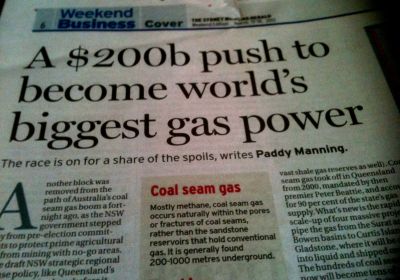
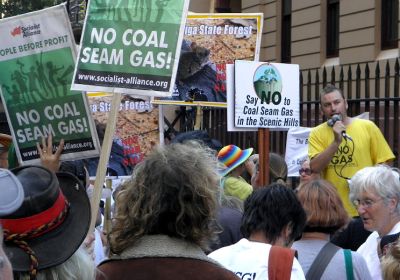
Australian energy company Santos has met determined resistance to its coal seam gas operations in Australia. It is less well known that Santos was one of the companies responsible for a monumental environmental catastrophe in Indonesia in 2006. The accident drowned villages in the Porong subdistrict of Sidoarjo in mud, and displaced up to 50,000 people. -
WikiLeaks releases The Spy Files - exposing uncontrolled mass spying.
The State of Surveillance | TBIJ
-
Green Left Weekly's Peter Boyle spoke to Greens Senator Lee Rhiannon outside Lynas Corporation's annual general meeting on November 30 about Lynas's plan to build a rare earths refinery in Malaysia.
-
Tory attempts to belittle public-sector industrial action rang pathetically hollow on November 30 as millions of workers joined the fight against government-imposed pension cuts for public servants. Services across England, Scotland and Wales ground to a halt in the strongest show of union strength in a generation. Schools, courts, museums and job centres were paralysed in the 24-hour strike which also brought extensive disruption to transport, hospitals and government departments.