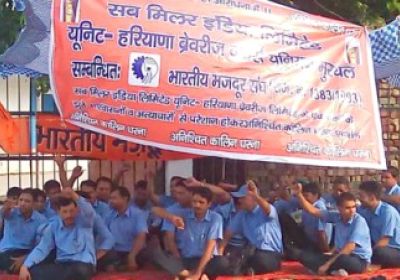
A march for jobs in Zimbabwe.
A national shutdown or 'stay away' in Zimbabwe this month paralysed the country. For the first time in years the country's ruling party, ZANU-PF, and the tenure of 92 year old president Robert Mugabe, were seriously rattled. Young people, workers and traders – who survive by hawking food, cheap imported goods in cities and towns – engaged in pitch battles with the police and army, in many cases outnumbering the security forces.
-
A march for jobs in Zimbabwe.
A national shutdown or 'stay away' in Zimbabwe this month paralysed the country. For the first time in years the country's ruling party, ZANU-PF, and the tenure of 92 year old president Robert Mugabe, were seriously rattled. Young people, workers and traders – who survive by hawking food, cheap imported goods in cities and towns – engaged in pitch battles with the police and army, in many cases outnumbering the security forces.
-
Members of the Merida communal council distributing food. Photo by Tamara Pearson.
It's been three years now of food shortages, inflation, and queues in Venezuela, and the millions of people involved in community and movement organizing have been the most affected. But they've also defied right-wing and general expectations, and even perhaps the expectations of the Maduro government, and have become stronger and better organized as a result of the hardships.
-
General strike to protest mass layoffs under President Mauricio Macri. Buenos Aires, February 24. Photo: EFE.
-
Declaring "We have abolished the case for austerity", left-wing Labour leader Jeremy Corbyn officially launched his campaign for re-election in London on July 21. He used the occasion to make a strong putting a case for a clearly anti-austerity Labour Party to oppose the Tories and a rise in racism.
-
The Australian government released its National Strategy on International Students 2025 in April. At its heart lies a strategy for exploiting international students and increasing the commercialisation of the education sector. It aims to swindle hundreds of thousands of international students and normalise the neoliberal idea that students are consumers and that education and learning are commodities. -
Two Aboriginal elders were arrested at a protest against multinational mining company Rio Tinto blasting at the Mount Thorley-Warkworth coalmine in the Hunter Valley on July 18. Wonnarua elders Kevin Taggart and his sister Pat Hannson were arrested after telling police they would not move from the side of Putty Road. Residents of the village of Bulga are protesting against the expansion of the Mount Thorley-Warkworth mine, the closure of Wallaby Scrub Road and the destruction of Aboriginal and European cultural heritage. -
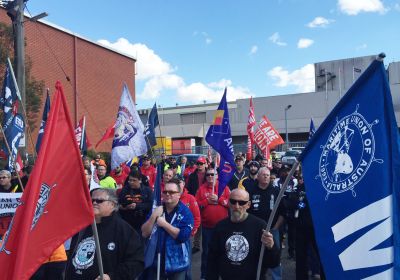
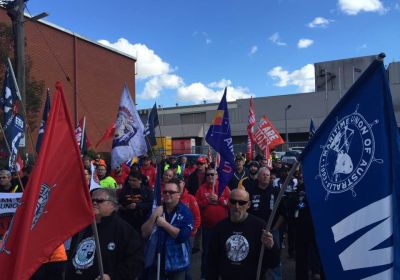
The industrial action by Carlton & United Breweries (CUB) maintenance workers in Abbotsford has entered its seventh week. The company is refusing to back down from its decision to sack the workers and then offer to rehire them with a 65% pay cut.
-
The chances of Australia achieving its 2030 emissions reduction target have been further weakened by Australia’s poor performance on an international scorecard for energy efficiency Australia ranked 16th overall on the American Council for Energy Efficiency’s international scorecard released on July 20, which ranks the top 23 biggest energy-consuming countries on their energy efficiency across a range of areas. Australia was ranked in the bottom three countries for industry and transport. -
Pauline Hanson came across a racist and incoherent cartoon character on the ABC's Q&A program on July 18. But it would be a mistake to think that Hanson, and the more than half a million people who voted for her in the July 2 federal election, can simply be laughed away. They represent, in a distorted way, the deepening contradictions in our society that have to be addressed at their root. The myth of the egalitarianism of Australia is cracking up after 50 years of Coalition and Labor Party governments helping the super rich get even richer at the expense of the rest. -
Bill Gates was set to deliver the July 17 annual Mandela Lecture in Johannesburg, justifying his philosophy of market-oriented, technology-centric philanthropy. Last year, French economist Thomas Piketty’s speech on inequality attracted healthy debate — with even business notables endorsing his concerns — given South Africa’s intense social conflict. To illustrate, South Africa’s Gini Coefficient measuring inequality is the world’s highest (at 0.77 on a scale of 0 to 1, in terms of income inequality from employment). Since 2000, social protests have numbered on average 11 per day. -
Jeremy Corbyn addresses supporters in London.
“Jeremy Corbyn has touched parts of the electorate Labour hasn’t reached in a long time.” That is the judgement of Laura Kuenssberg, the Tory propagandist who delivers most of the BBC’s political coverage on Labour’s socialist leader.
-
The streets in Buenos Aires and other Argentine cities have been filled with protesters in a “Cacerolazo” (pot-banging protest) against President Mauricio Macri’s major hikes in utility prices. The hike includes a 700% rise in electricity prices, more than 2000% rise in gas prices in some places and a 350% rise in water prices. Consumer protection associations and left-wing groups called the march against the hikes, which are “affecting people very seriously,” said Osvaldo Bassano, head of the Association for the Defense of Users and Consumers.