-
-
Workers in retail and fast-food outlets, including Woolworths, Hungry Jack's and KFC, are being underpaid more than $300 million a year, in a national wages scandal centred on deals struck with the socially conservative Shop, Distributive & Allied Employees Association (SDA). Fairfax Media has uncovered evidence that some of Australia's biggest employers are paying their employees less than the award in a longstanding and cosy partnership between big retail and fast-food employers and the union. -
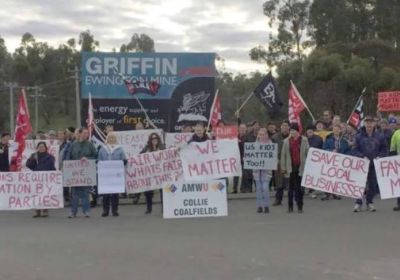
Maintenance workers at Griffin Coal and their supporters held a protest outside the Fair Work Commission (FWC) in Perth's CBD on July 5. They called for a stay on the commission's decision to terminate the recent enterprise bargaining agreement between the Australian Manufacturing Workers Union (AMWU) and the company, citing the latter's alleged unprofitability. Griffin Coal claims to be surviving only due to financial support from its parent company, Lanco Infratech. The 70 workers, who work at Collie in WA's south-west, face a 43% pay cut if the FWC's decision were to stand. -
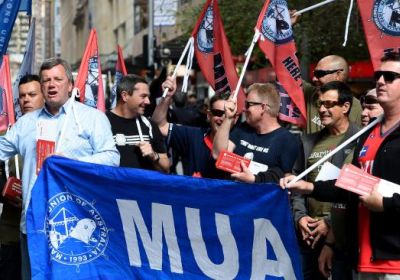
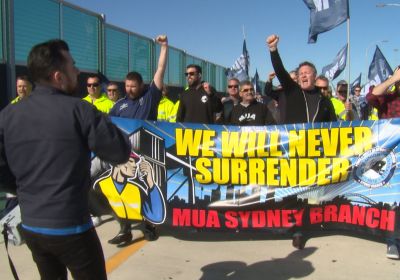
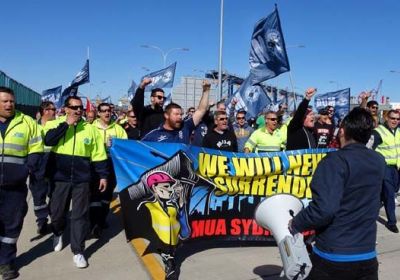
Maritime Union of Australia (MUA) members at Patrick Stevedores terminals struck for 24 hours on January 18 at the ports of Sydney, Melbourne, Brisbane and Fremantle to demand job security and an improved enterprise agreement. The strike followed the imposition of work bans at the Port Botany site in Sydney from January 4. -
“We're all very happy and proud of our efforts in this dispute: 106 days ago we didn't have a job and now we are going back inside,” a waterfront worker at the Hutchison Port Botany community assembly told Green Left Weekly on November 19. He was commenting on the settlement agreed between Hutchison management and the Maritime Union of Australia (MUA) to bring to an end conclusion the long-running industrial battle over the jobs of 97 workers sacked by text and email on the night of August 6. -
Waterfront workers at Hutchison Ports in Sydney and Brisbane are set for a crucial vote on a new enterprise bargaining agreement (EBA) on November 16. The vote takes place after 100 days of community assemblies at Port Botany and Port of Brisbane, following the controversial sacking by text and email of 97 workers at the two ports on August 6. -
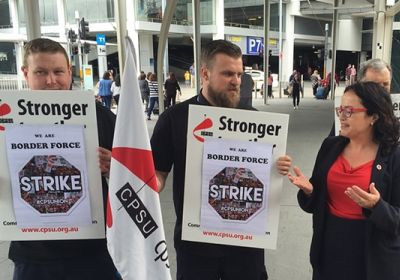
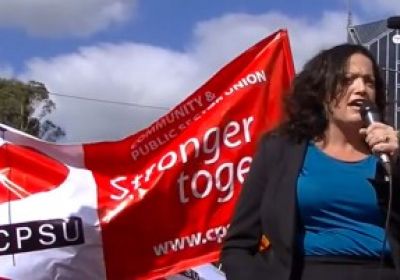
The Community and Public Sector Union (CPSU) is calling on the Turnbull government to improve its bargaining policy to allow federal agencies to make acceptable enterprise bargaining agreement (EBA) offers to public sector workers. Despite a small increase in the government's pay guideline from 1.5 to 2%, union members are insisting on a minimum rise of at least 2.5 to 3%. -
Border Force staff, who imposed work bans in support of their campaign for a new enterprise bargaining agreement on November 4, were stood down without pay by the Department of Immigration and Border Protection (DIBP), despite the industrial action being authorised by the Fair Work Commission. The Community and Public Sector Union (CPSU) condemned the department's action as a heavy-handed escalation of the long-running dispute. -
Talks are continuing in the Fair Work Commission between the Maritime Union of Australia (MUA) and Hutchison Ports over the sacking of 97 waterside workers on August 6. Meanwhile, community assemblies are being maintained outside the gates of Hutchison terminals at Port Botany and the Port of Brisbane. The company has said it is seeking a new enterprise agreement with the union, and has agreed to pay wages to the sacked workers until at least mid-November. -
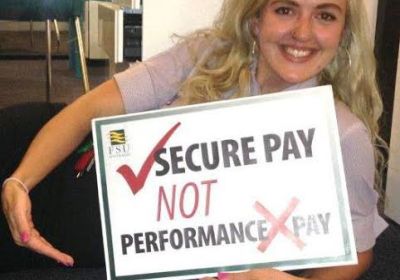
Westpac workers have managed to break the link between targets and annual salary in the recent Enterprise Agreement (EA) negotiations between Westpac and the Finance Sector Union (FSU). After two months of negotiations, including a petition signed by workers across the Westpac Group, FSU negotiators reached an “in principle” agreement effective from 2016. The link between targets and annual salary increases has been broken, with staff only required to meet minimum behaviour standards and complete compulsory compliance training — which 98% of staff achieved in the last two years. -
The Community and Public Sector Union (CPSU) has launched another round of industrial action, starting with half-day strikes in many Canberra-based public service agencies on September 15. This is an escalation of its long-running bargaining campaign against the Abbott government. Staff from the Canberra offices of Human Services, the Tax Office, Immigration and Border Protection and Employment will hold a lunch-time rally and half-day walk-outs. -
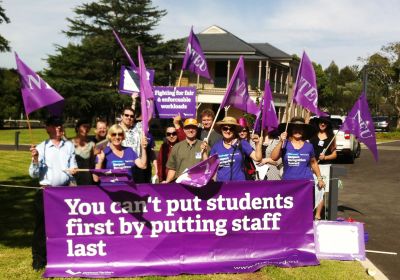
Casuals now make up about half of the academic workforce in Australia’s universities. For most of them it is precarious work at its worst. Those lucky enough to get two 13-week sessional contracts a year are unemployed academics for the other half of the year, forced to then compete with a growing precariat for temporary employment elsewhere while still at the call of their part-time employer. And the 13 weeks are not necessarily standard 35-hour weeks, they can be for as little as one hour a week.
Enterprise Agreement (EB, EBA)