
Cochabamba is a city with a history of struggle. In April 2000 the people stood up against the privatisation of their water supply, threw out the multinational Bechtel and retook control of the local water company. In October 2003 they joined the thousands of people on the street in El Alto, La Paz and other cities to defend the right of the people to nationalise the countrys gas reserves, effectively forcing, then president and champion of the neoliberal economic model Gonzales Sanchez de Lozada to flee the country.
-
-
On January 15, Ecuador’s new president, Rafael Correa Delgado, was sworn in, promising to build “socialism of the 21st century” to overcome the poverty and instability of the small Andean country.
-
On December 29, 2006, the 176-member standing committee of the National Peoples Congress (NPC Chinas law-making body) lent its support to the draft of the proposed Property Law. Many fear this controversial law will help launder the enormous state wealth already appropriated illegitimately by corrupt Communist Party officials and their hangers-on, as well as encourage more such activities.
-
Testifying to a January 12 US Senate hearing on President George Bush’s new Iraq war strategy, Secretary of State Condoleezza Rice warned Nuri al Maliki, Washington’s puppet Iraqi prime minister, that he was “living on borrowed time”.
-
When supporters of Venezuelan President Hugo Chavez rallied in the Teresa Carrena theatre in Caracas on December 15 to celebrate their presidential election victory, “there were cheers in the back half of the theatre”, wrote Caracas-based Marxist writer Michael Lebowitz in Venezuelanalysis.com, “but few in the high-priced seats”.
-
After months of pressure following the debacle of the July-August war in Lebanon, Israeli defence chief Lieutenant General Dan Halutz announced his resignation on January 16, prompting thousands of Lebanese to take to Beiruts streets in celebration.
-
The Bush administration’s decision to send more troops to Iraq in the face of rising opposition among ruling-class politicians and pundits, and against the wishes of the overwhelming majority of the US people, represents a desperate gamble.
-
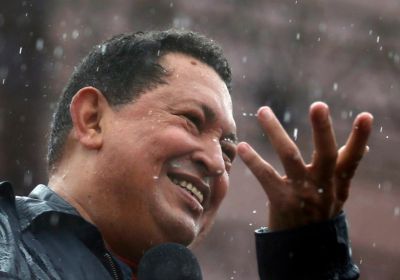 Venezuelas Leap Backwards was the headline verdict of the January 10 Washington Post editorial, which attempted to throw doubt on the legitimacy of the December 3 presidential election in Venezuela that returned socialist President Hugo Chavez to office with a record 7.3 million votes (63% of the total vote cast)."Venezuela's Leap Backwards" was the headline verdict of the January 10 Washington Post editorial, which attempted to throw doubt on the legitimacy of the December 3 presidential election in Venezuela that returned socialist President Hugo Chavez to
 -
Late last year, Green Left Weekly’s Kerryn Williams spoke to the assistant secretary of the Sudanese Communist Party (SCP), Suleman Hamid El Haj, in Khartoum about political developments in Sudan since the January 2005 signing of the Comprehensive Peace Agreement (CPA). The CPA ended the two-decade-long war between Sudan’s central government in Khartoum and the south.
-
Around 200 pick-up trucks and cars comprised the long snake of a protest caravan making its way along Jakarta’s main thoroughfare, Jalan Thamrin, after a rally outside the Presidential Palace, where speakers called on the people to “withdraw the mandate” of President Susilo Bambang Yudhoyono. The occasion for the protest was the anniversary of the mass protests and riots against the Suharto government that took place on January 15, 1974.
-
Parliamentarians from the Scottish Socialist Party (SSP), the Dutch Socialist Party, the Greens and the Welsh nationalist Plaid Cymru party were arrested on January 8 following a protest at the Faslane nuclear submarine base on the River Clyde. The protest was organised by Faslane 365, which is promoting a year-round blockade of the base.
-
Mision Vuelvan Caras, literally about-face, is a social project or mission launched by the revolutionary government of Venezuela in 2004 to train and offer employment to thousands of people. It is changing the lives of a large number of the countrys citizens, many of whom previously had no formal education or jobs to rely on.