-
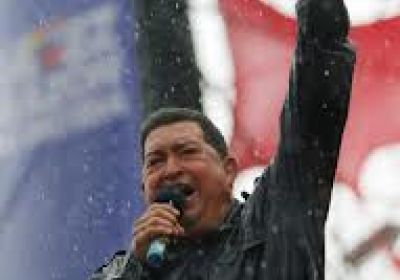
The illness of Venezuelan President Hugo Chavez has created uncertainty over the future direction of his government, and specifically its commitment to revolutionary change and socialism. Throughout the 14 years of his presidency, the key to Chavez’s political success was the constant deepening of the process of change, which invigorated the rank-and-file of his movement.
-
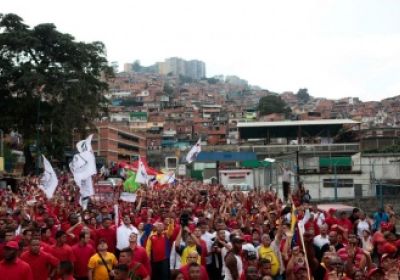
Venezuela's Vice-President Nicolas Maduro and government ministers marched with up to one million people on January 23 to defend the Bolivarian revolution, which has signficantly reduced poverty and promoted new forms of participatory democracy, on the country's Democracy Day. The right-wing opposition march turned out to be a small rally. Further, sectors of the far right have called on the armed forces to resist what they referred to as the “invasion” of “Castro-communism” in Venezuela.
-
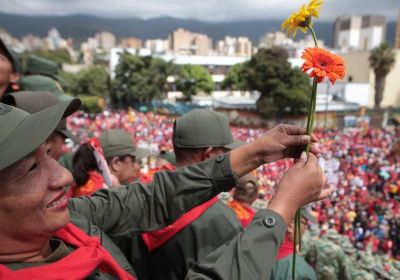
Tens of thousands of supporters gathered in Caracas today for a huge rally in support of Venezuela's ill President Hugo Chavez. The gathering was in response to the controversy surrounding his absence on January 10, the date set for his inauguration day after he was re-elected for a new six-year term in October. -
The Venezuelan government has responded to opposition and private media accusations that it is being “mysterious” regarding information on Chavez’s health situation, and has called such statements as well as rumours being spread on social networks “psychological warfare”. -
President Hugo Chavez announced on public television on the night of December 8 that he would return to Cuba to receive surgery for new malignant cells, and that vice-president Nicolas Maduro will be in charge during his absence. Chavez said Cuban doctors informed him that the area where he has previously been affected will need to be operated on again, as new malignant cells have appeared. He also said that “there are always risks in processes like this” and that “if anything happens to me that hinders me [from performing as president]”, Maduro was his preference to replace him.
-
Despite securing a comfortable victory in October's presidential elections, the United Socialist Party of Venezuela (PSUV) is set for a harder struggle in crucial regional elections on December 16. However, even opposition polls show PSUV is likely to keepcontrol of most governorships. The issue is whether the opposition Democratic Unity Roundtable (MUD) can win or hold key seats, or the PSUV can build on the momentum from the presidential vote and important social gains. -
If the mainstream Western media is to be believed, the world witnessed a shining example of true democracy in action in the United States on November 6. In the Washington Post, Dan Balz described the US presidential race as a “contest of competing visions”. Apparently, democracy is epitomised by a race between two representatives of the 1% fighting to impose “competing” agendas that ― with differences of nuance ― bear more similarities to each other than to public opinion. -
I have been reminded lately of that line from that famous song: “How many polls must an anti-capitalist win, before we call him a democrat?” -
This episode focuses on feminism's resurgence and Venezuela's unfolding revolution. It includes activist news on Stop CSG protests, Global Noise protests, plus Carlo Sands on the European Union's Nobel Peace prize win, and a performance by 1000 eyes at Occupy.
-
Venezuelan President Hugo Chavez’s re-election on October 7 with more than 55% of the vote was vital for two reasons. First, the Venezuelan people blocked the return to power of the neoliberal right. Had they won, these US-backed forces would have worked to roll back important advances for the poor majority won since Chavez was first elected in 1998. -
This episode features Beyond Zero Emissions' Terry McBride plus footage of the campaign for big solar in Port Augusta, South Australia.
-
“Venezuela Elections 'Free, But Not Fair'”, was Germany’s Spiegel Online headline on a piece about Venezuela's October 7 presidential poll, won by socialist President Hugo Chavez by more than 55% of the vote. “Chavismo wins, Venezuela loses”, was The Wall Street Journal's take. Compared with such headlines, the Sydney Morning Herald’s reprint of a New York Times article “Socialist Chavez hangs onto Power in Venezuela” by William Neuman might seem a reasonably balanced report. It is not.
Hugo Chávez
Hugo Chávez