-
-
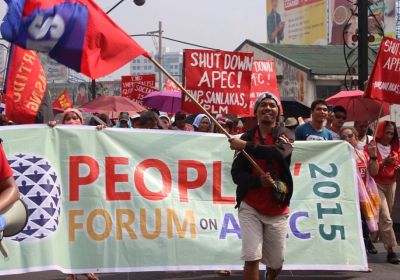 Thousands marched in protest during the APEC Summit held in Manila on November 18-19. US President Barack Obama turned up with a "gift" of two warships to the summit perversely themed of this APEC Summit is "Building Inclusive Growth". More than a quarter of Filipinos are struggling to survive on less than US$1.25 per day but Obama does not come with food, clothing, housing or anything urgently needed by these millions in extreme poverty, but with two warships to underline Washington's latest military build up against China.
 -
 Protest at Kentex factory, Valenzuela City, Metro Manila, May 15. Photo: Partido Lakas ng Masa/Facebook.
Revelations have continued emerging over safety and labour abuses at the Philippines factory where 72 people died in a fire on May 13.
Protest at Kentex factory, Valenzuela City, Metro Manila, May 15. Photo: Partido Lakas ng Masa/Facebook.
Revelations have continued emerging over safety and labour abuses at the Philippines factory where 72 people died in a fire on May 13.
-
On September 24, one day after the United Nations climate summit in New York once more failed to come up with any form of serious action to confront the climate crisis, Filipino socialist group Party of the Labouring Masses released the statement below. * * * Philippines President Benigno Aquino concluded his United Nations speech in New York on September 23 by posing the question: What more can we do? The question is rhetorical, even hypocritical, as the president well knows what needs to be done: to address the demands of the mass movements, which he has heard, but not heeded.
-
 When I was travelling from Manila to Australia, I bought a copy of a book to read on the plane. It was Dan Brown’s novel Inferno. Actually, when this book first hit the bookshops, the Philippines went crazy about a small part of the novel that referred to Manila as the “gate of hell”.
 -
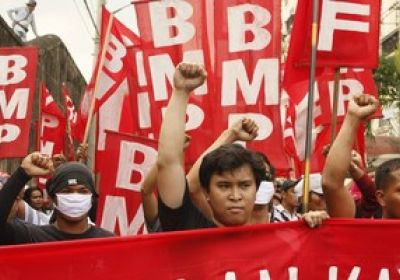 Sonny Melencio is chairperson of the Filipino Party of the Labouring Masses (PLM) and a former council member of Solidarity of Filipino Workers (BMP). Melencio is also involved in a new coalition against the established “political dynasties” in the Philippines, called Alliance for Truth, Integrity and Nationalism (ATIN).
 -
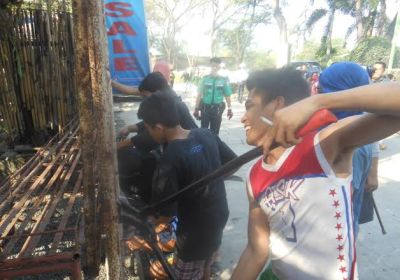 The Manila Seedling Bank, a seven hectare area of small market gardens and big and small shops selling plants, was a rare green space among the traffic jams, shopping malls and slums on the intersection of Quezon and Edsa Avenues in Quezon City, Metro Manila. It was also home to a community of hundreds of smallholding horticulturalists and their families. That was until January 20.
 -
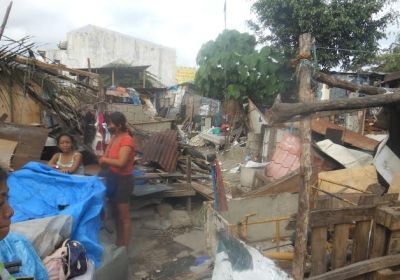 Residents in the urban poor settlement of San Dionisio in Barangay Cupang, Muntinlupa in Metro Manila, were woken on January 15 by a heavily armed police SWAT team. Brandishing a local government order that referred to an address in a different barangay (neighbourhood), authorities overrode objections of residents and started tearing down their homes.
 -
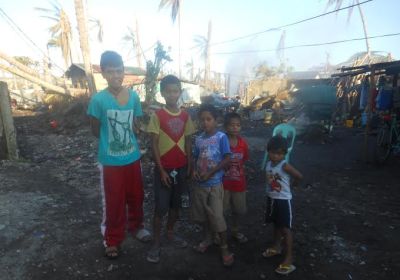 “When we went out, it was like a Zombieland,” Zoreen Agustin, a student at the University of the Philippines’ (UP) Tacloban campus told me on December 2. “A lot of people were walking around, some with no shoes and their clothes all torn, a lot of people were covered in cuts.” She was referring to what she saw after Tacloban, and much of the Eastern Visayas region, were demolished by Super Typhoon Yolanda (known as Typhoon Haiyan outside the Philippines) on November 8. The storm, one of the strongest on record to hit land, killed anywhere between 5000 and 10,000 people.
 -
After the storm, the “shock doctrine”. This is what awaits the Philippines after the devastation wrought by Typhoon Haiyan. The familiar cycle of “disaster capitalism” allows wealthy and politically connected First World corporations to profit obscenely from the suffering of acutely vulnerable disaster-affected communities. Disaster profiteering is a parasitic tendency deeply embedded in the structures of the neoliberal global economy. It will degrade and corrupt the international “relief effort” under way in the Philippines.
-
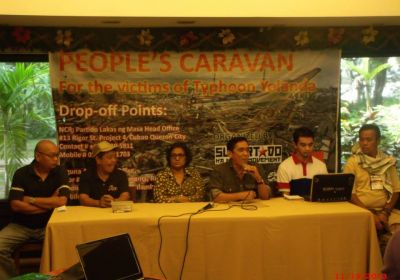
The People's Caravan is a grassroots relief effort initiated by the Party of the Labouring Masses, a Filipino party of the marginalised and poor.
-
A revealing story about the lawsuit against the United Nations over a cholera outbreak in Haiti was broadcast on the Canadian Broadcasting Corporation’s The World At Six on November 13. The report began: “The United Nations is among those leading the effort to get aid to the Philippines. But even as it helps out with this natural disaster, it is haunted by the ghosts of another.”
Philippines
Philippines