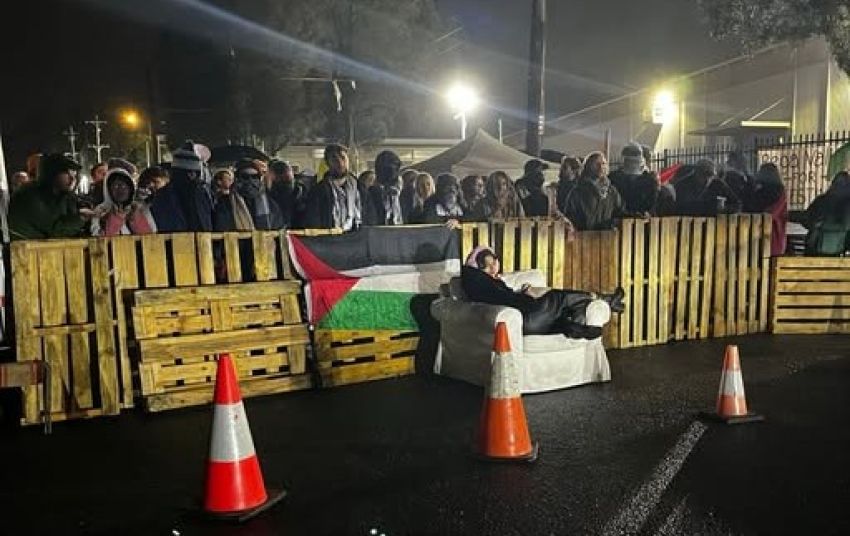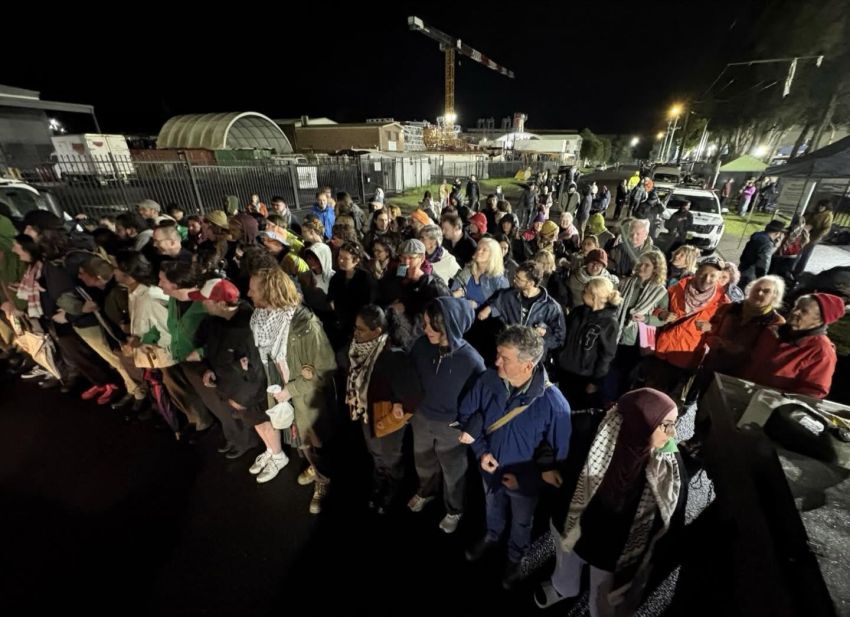
Community group Wollongong Friends of Palestine (WFOP) set up a 300-strong community picket at Bisalloy Steel on June 14. Two shifts have been successfully blocked and the picket is holding strong.
WFOP plan to stop work at the factory for 72 hours. However, 50 NSW Police, including riot police, tried to break it up at 6am on June 15. One person was arrested and they remain in police custody at the time of writing.
About 10 pickets have been organised over 24 months, since 2023, with the last successful 48-hour picket in February.
Bisalloy Steel sells products to Israeli armoured vehicle manufacturers Rafael Advanced Defense Systems. Rafael is a government-owned corporation, founded by the Israeli Ministry of Defence, which primarily supplies the Israeli Occupation Forces (IOF). Bisalloy Steel products are part of the supply chain of IOF Merkava tanks, which are being used to destroy homes and villages in Palestine and Lebanon.
WFOP spokesperson Rawda Alshroof said Bisalloy Steel has not said it will “reconsider” its commercial arrangements with Israel, or Israeli companies. Up to 1.9% of its product is exported to Israeli stakeholders.
German arms manufacturer Rheinmetall, a Bisalloy partner, is also a key part of the supply chain for F-35 warplanes and Merkava tanks.
Michael West Media reported that Bisalloy’s exports to Israel contravene the UN Arms Trade Treaty, of which Australia is a signatory. It also violates the International Court of Justice’s preliminary determination against Israel’s plausible genocide in Gaza.
David Balkin, Bisalloy chairperson and managing director, has said the company is “very proud” of its two-decades-long relationship with several leading Israeli companies.
Bisalloy is also developing hulls for the SSN-AUKUS submarines. There is significant and growing opposition to the AUKUS deal and the possibility of a nuclear submarine base being set up at Port Kembla.
Safaa Rayan, social worker and WFOP spokesperson, said that after 2.5 years of genocide and ethnic cleansing in Gaza, the West Bank and Lebanon, the company’s owners and investors “are well aware of where their products are going”.
“It is telling that Bisalloy will do anything to hold onto this 1.9% of their business; this relationship seems more ideological than financially driven,” Rayan said. “The community are happy to see Bisalloy lose working days and profits if it continues to support the genocidal regime in Israel.”