
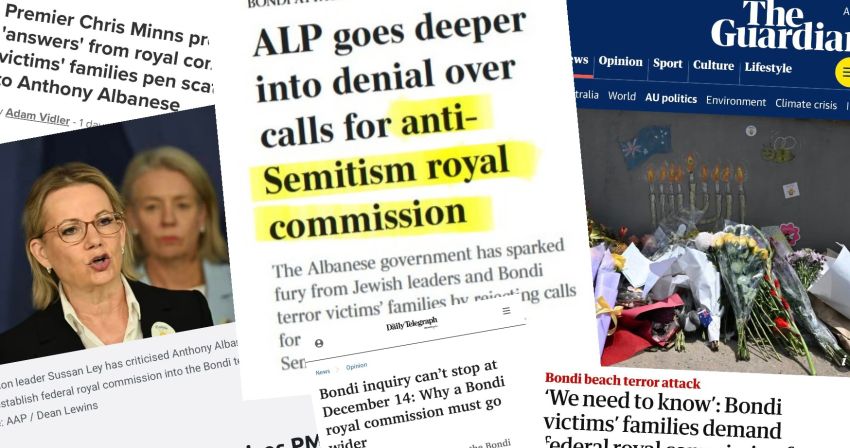
The most insistent calls for a royal commission into the Bondi shooting are emerging from a convergence of actors: opposition politicians, peak Zionist organisations, and sections of the media already invested in a narrative that closely links antisemitism to criticism of Israel and advocacy for Palestine — those who define the attack as religiously motivated and point to Islam.
Victims’ families are frequently cited — sometimes sincerely, sometimes instrumentally — but they do not appear to be driving the broader political momentum behind the demand
The push for a royal commission is not primarily about fact-finding or resolving outstanding evidentiary questions but meaning-making. It is about shaping understanding of the event and how it is ultimately memorialised in Australia’s public life.
A royal commission is uniquely powerful because it does not merely investigate; it authoritatively frames what happened, why, and the lessons to be drawn.
Those advocating for a royal commission appear to seek an outcome in which Bondi is fixed in the public record as an antisemitic and religiously motivated attack, rather than as an act of identity-motivated violence arising from a wider set of social, political, and institutional factors — including intelligence failures and the broader global context in which extreme violence against civilians, including children, has increasingly been disregarded and normalised.
If a royal commission were established, there would be no need to influence findings overtly. Shaping the outcome occurs earlier: through carefully drafted terms of reference, the sequencing of expert testimony, and the privileging of particular analytical frameworks.
Antisemitism would be positioned as the central question to be examined, while alternative explanations and contributing factors would be treated as contextual, marginal, or ignored.
Within such a structure, even weak or ambiguous evidence can acquire disproportionate weight. A familiar conclusion follows: “Motivation cannot be definitively established, but antisemitism cannot be ruled out and must therefore be treated as a serious and growing threat”.
That formulation alone may be sufficient to justify the criminalisation of criticising Israel, curtailments of civil rights, and erosion of academic freedom, media independence, and legitimate political speech — particularly criticism of Israel’s genocide and unlawful occupation, and advocacy for Palestinians’ right to exist—in peace and security, and with dignity.
In this sense, the demand for a royal commission arises less from what the existing evidence compels than from what the process itself can deliver—the cannonising of a politically and ideologically-motivated interpretation of Bondi in the national memory, marginalising competing explanations, and shifting responsibility for the attack onto Islam, Muslims, and Australians in general who publicly defend Palestinian human rights and reject antisemitism but rightly want Israel held accountable for its crimes.
A royal commission might therefore risk transforming a national tragedy into a powerful deflection — away from a widespread public demand that killers face justice —that Israel end its unlawful occupation and genocide, and toward the official reclassification of legitimate moral and legal criticism of a state’s actions as antisemitism.
In doing so, responsibility for the erosion of moral consensus around the sanctity of life, rule of law, and accountability would be displaced from those undermining these principles onto those seeking to uphold them.
[Halim Rane is a leading Australian scholar of Islam, sociologist of religion and a professor at Griffith University.]