
The Venezuelan government has strongly denounced the “Human Rights Report” published by the US State Department on May 24.
Venezuela's Attorney-General Luisa Ortega Diaz said the US lacks the moral authority to issue human rights reports on other countries.
“How can they be issuing reports if the United States is the world’s leading military power and the protagonist of the principle wars that shake the planet?” she said on Venezuelan state channel VTV.
-
-
Some years ago, travelling on the presidential plane of Venezulea's left-wing President Hugo Chavez of with a French friend from Le Monde Diplomatique, we were asked what we thought was happening in Europe. Was there any chance of a move to the left? We replied in the depressed and pessimistic tones typical of the early years of the 21st century. Neither in Britain nor France, nor anywhere in the eurozone, did we see much chance of a political breakthrough. Then maybe, said Chavez with a twinkle, they could come to our assistance.
-
 Much of the world’s population continues to pay for the global financial crisis with their jobs, homes, education and health. Bankers continue to award themselves millions of dollars in bonuses, such as the British bank Barclay’s chief executive, who last year earned US$26.9 million. The Venezuelan government, however, has raised the percentage of net profits banks must grant in credit to national social programs. In doing so, it is demonstrating to the rest of the world what a regulated and socially oriented banking system could look like.
 -
On more than one occasion, I have referred to the infamous agreement which the United States imposed on Latin American and Caribbean countries when the Organisation of American States was founded in Bogota on April 30, 1948. Just by sheer coincidence I happened to be there on that date, helping to organise a Latin American students’ congress with the objective of struggling against European colonialism and the bloody tyranny imposed by the United States in this hemisphere.
-
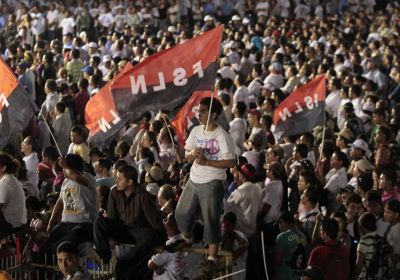 Nicaragua's President Daniel Ortega and a crowd of more than 100,000 people gathered on the night of May 2 in Managua's Plaza de la Fe to pay tribute to Tomas Borge. Borge, who died on April 30 aged 81, was the last surviving member of the group that founded the Sandinista National Liberation Front (FSLN) more than 50 years ago. Borge has always been and remains a symbol of the Nicaraguan Revolution in Latin America and beyond.
 -
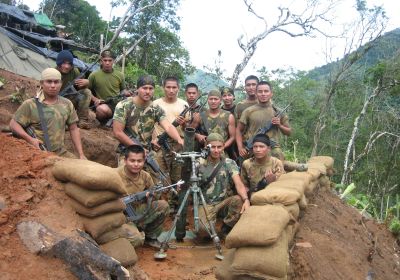 After a hostage crisis in which one of armed group Shining Path's (Sendero Luminoso – SL) factions abducted gas workers employed by a major multinational, a counter-insurgency operation was launched in the Apurimac-Ene River Valley (VRAE). The stand-off was reported by the international media. But what has been largely ignored are the human rights abuses against VRAE civilian communities are being committed by the Peruvian military.
 -
Argentine President Cristina Kirchner announced the nationalisation of Federal Petroleum Deposits (YPF), the country's largest oil extractor and refiner, on April 16. Altogether, 51% of Spanish oil multinational Repsol's 57% stake in YPF has been claimed by the Argentine government. The move shook the markets, with YPF shares falling 30% on the New York stock exchange. The nationalisation has drawn condemnation from Spain, the European Union and the United States ― as well as US regional allies Chile, Colombia and Mexico. In contrast, it was applauded by Venezuela and Bolivia.
-
 Environmentalists seem to realise that they have some stake in a fight such as the Ecuador-Chevron lawsuit. That case, which Chevron has recently moved to an international arbitration panel to try to avoid a multibillion-dollar penalty handed down by Ecuadorian courts, is about whether a multinational oil corporation will have to pay damages for pollution, for which it is responsible. Most environmentalists figure that would be a good thing.
 -
“April 13, the great day of victory 10 years ago, opened the way to the independence and unity of our Latin America and the Caribbean,” Venezuela's socialist President Hugo Chavez said on April 13. He was speaking during a commemoration of the uprising that toppled a short-lived military coup that aimed to crush the Chavez presidency . “We showed that a people united will never be defeated.”
-
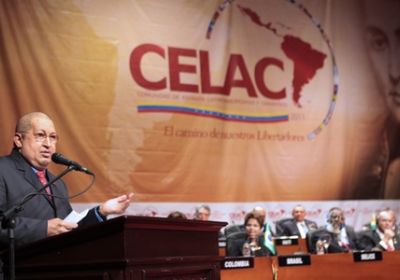 At the insistence of the United States and Canada, Cuba was excluded from the Sixth Summit of the Americas, an intergovernmental conference held in Cartagena, Colombia, over April 14-15. As a result of opposition from many Latin American nations over Cuba's exclusion, as well as Argentina's claim to sovereignty over the Malvinas (Falklands) islands, the summit ended with no final declaration signed. The summit, involving all nations in the Americas except Cuba, is ostensibly designed to facilitate dialogue, understanding and cooperation between nations of the region.
 -
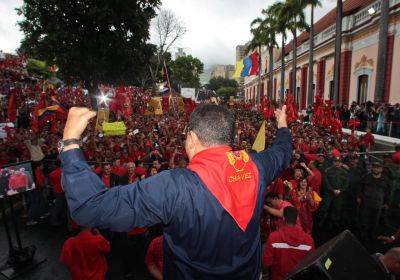 Ever since the US-supported coup attempt against President Hugo Chavez in Venezuela failed in April 2002, Washington has been pursuing a variety of strategies to remove the overwhelmingly popular South American head of state from power.
 -
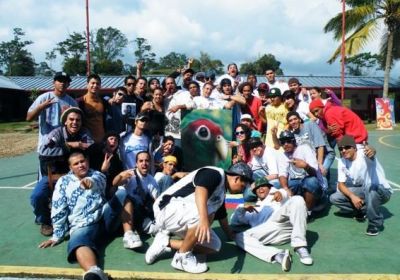
The oil-rich South American nation of Venezuela is in the midst of a complicated and contradictory process of social transformation. The revolutionary movement, headed by President Hugo Chavez, is redistributing wealth, bringing key industries under state ownership and promoting experiments in direct, participatory democracy. The aim of the Bolivarian revolution is to build a “socialism for the 21st century”.