-
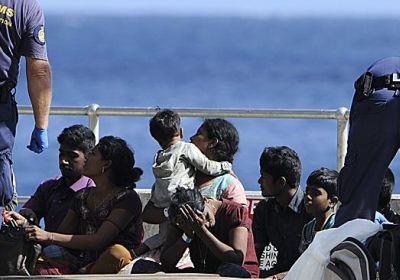
It was almost a simple formality. Rejecting any attempt by the Greens to introduce rudimentary protections, the Australian Senate voted on May 16 to excise the entire country from the migration zone. It will most likely be given approval by the lower house soon. If implemented, it will mean that for all asylum seekers who arrive by boat, Australia -- and by proxy the Refugee Convention -- will legally not exist. -
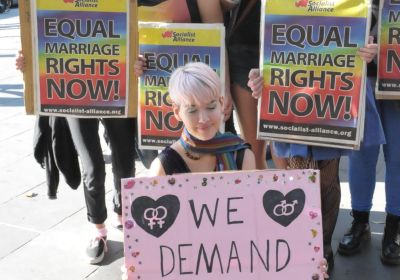
The fight against homophobia is arguably the civil rights issue of our times. It is increasingly unacceptable that, in 2013, society continues to discriminate against people based on their sexuality. This is most obviously demonstrated by the continued refusal to grant equal marriage rights to lesbian, gay, bisexual, transgender and intersex (LBGTI) people. -
The other day, I stood outside the strangely silent building where I began life as a journalist. It is no longer the human warren that was Consolidated Press in Sydney, though ghosts still drink at the King's Head pub nearby. As a cadet reporter, I might have walked on to the set of Lewis Milestone's The Front Page. Men in red braces did shout, "Hold the front page", and tilt back their felt hats and talk rapidly with a roll-your-own attached indefinitely to their lower lip. You could feel the presses rumbling beneath and smell the ink. -
Over the last eight months at least seven political activists around Australia have been approached by federal or state intelligence agents for information about other activists. Green Left Weekly spoke to human rights lawyer and researcher Dale Mills who explains what rights activists have — and what they should do — if they are approached for information by the Australian Security Intelligence Organisation (ASIO) or other political police.
-
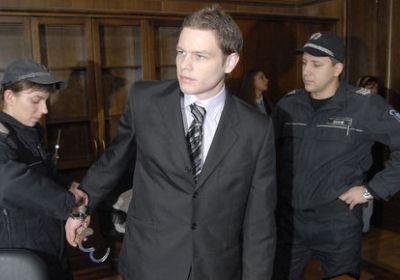
“I’m in Villawood!” Jock Palfreeman exclaimed, with the cheerful exuberance he displayed throughout an interview conducted through glass and wire-mesh partitions in the gloomy surroundings of the visiting room of Sofia central prison. He told Green Left Weekly that it was the plight of refugees detained in Sydney's Villawood detention centre that first radicalised him. His first protest, as a high school student in Sydney, was a blockade of the offices of Villawood’s then operator Australasian Correctional Management on May Day in 2002. -
What do a conservative leader and a radical feminist have in common? More than we would have guessed, it seems. Recently an Islamic group held an event at the University of Melbourne. The seating was arranged according to gender, as is common with such events. A reporter from the Australian newspaper decided to go along and search for controversies; the promise of discussing jihad at the event must have lured the newspaper into seeing an easy opportunity to vilify Muslims. This has become a lucrative industry nowadays. -
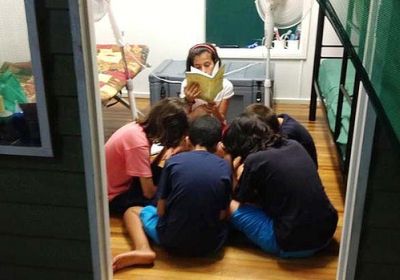
The federal Labor government is desperate for you to believe that its “no advantage” refugee policy is working. And from offshore detention to impoverished “living in the community”, children and teenagers will be no exception to its increasingly cruel measures.
-
Ten years ago, then Australian Prime Minister John Howard sent 2000 Australian soldiers to join the US-led invasion of Iraq. Like US President George Bush and British Prime Minister Tony Blair, Howard lied about Iraq possessing weapons of mass destruction (WMD) to justify an illegal war of aggression. The Labor Party hoped to gain political advantage by opposing the unpopular war, but did so only on a technicality: the lack of United Nations Security Council (UNSC) authorisation for the invasion. -
In the aftermath of the bombing of the Boston Marathon, the Obama administration is broadening its definition of “terrorism” to include fighters for Black rights in the US. Washington has already used the term so indiscriminately against enemies internationally that it has become virtually meaningless. For example, every act of resistance to US occupation in Iraq and Afghanistan is labeled “terrorism”. By that definition, George Washington and the other American revolutionists were “terrorists” for resisting British rule. -
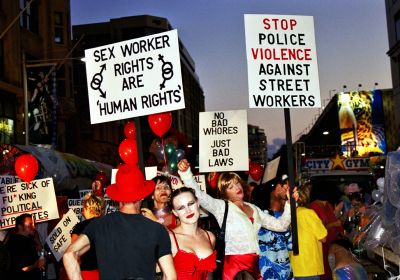
Liberal Premier Colin Barnett has proposed reforms to license and register some forms of sex work. And again people are referring to the bill as “legalisation” and “partial decriminalisation” when it is not. It’s deeply concerning when big party politicians and mainstream journalists do not understand the proposed sex-work laws, and describe them as the opposite of what they are. Most Western Australians seem unaware that Barnett’s proposed bill is unnecessary, perpetuates stigma towards sex workers and will result in worse working conditions.
-
Finally, we have a reason to get excited about elections. Yes, billionaire mining magnate Clive Palmer has formed a political party and is determined to become Australia’s next prime minister. For the first time in god knows how long, we have a real alternative to the tweedledum-tweedledee politics of the big parties. Palmer's bid for PM poses a crucial question: why shouldn’t those who own this country, run it too? -
University students across Australia will take to the streets on May 14 to protest the federal Labor government’s $2.8 billion cuts to higher education. The call by the National Union of Students (NUS) for a “student strike against education cuts” has not only received support from students, but also the National Tertiary Education Union (NTEU), which covers university staff. On a number of campuses, NTEU members have been resisting cuts that university administrations claim are necessary due to lack of government funding.