-
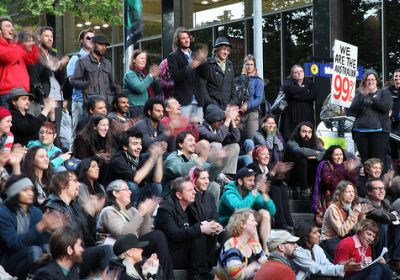
Green Left Weekly’s Chris Peterson spoke to Melanie Sluyter, an environmental activist from the United States who took part in Occupy Wall Street and is visiting Melbourne. * * * How did you get involved in the Occupy movement? -
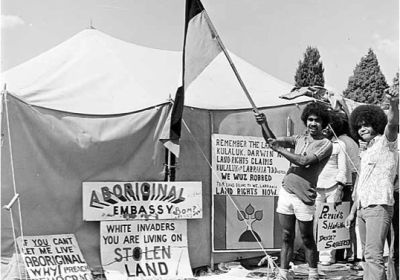
Few Australian political protests can claim to have made an impact as great or as lasting as the Aboriginal Tent Embassy in Canberra. First set up on the lawns of Old Parliament House in January 1972, the embassy has been a focal point for the struggle for Aboriginal rights. Four Aboriginal men, Michael Anderson, Billie Craigie, Tony Koorie and Bertie Williams, launched the embassy in response to then-prime minister Billy McMahon’s refusal to grant Aboriginal land rights. Instead, McMahon had offered to lease stolen land back to Aboriginal people.
-
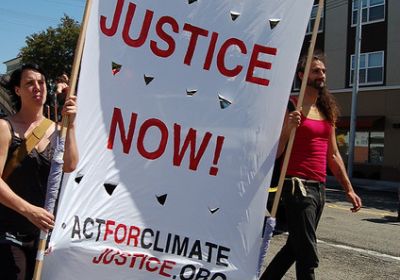
If you are an activist peacefully campaigning for a clean energy future, the federal Labor government believes you are a legitimate target for secret surveillance. Fairfax News’ Phillip Dorling reported on January 7 that resources and energy minister Martin Ferguson had asked for federal police help to spy on anti-coal campaigners. Even worse, documents released to Fairfax after a Freedom of Information request showed Ferguson acted after urging from coal industry lobbyists. -
A Perth educator, author and long-time activist, Mary (Mairi) McKenzie, died on New Year's Eve at the age of 94. Mary discovered early what life was like in a society with little welfare and few rights for workers and the unemployed. At the age of 10, she lost her mother to tuberculosis, making her effectively the mother figure for her seven younger siblings. At the age of 13 she left school to undertake their full-time care. -
The global economic meltdown is yet to hit Australia hard, but 2011 was still a busy year of struggle in this relatively sheltered, wealthy country. The year began with an Australian citizen on the global centre stage. WikiLeaks cables embarrassed governments worldwide, revealing war crimes and treachery, and WikiLeaks founder Julian Assange was arrested without charge. He was detained for all of last year. His supporters fear he will be extradited to the US, where conservatives have openly called for his assassination. -
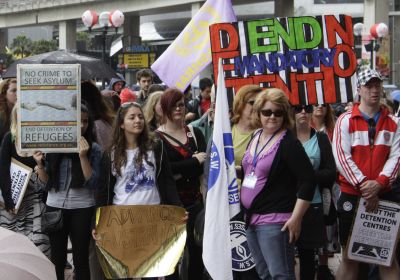
Rohingya refugee Harun had been in Australian detention for more than two years when he was told by letter that he would never be a free man in Australia. Despite being a recognised refugee under the United Nations High Commissioner for Refugees and the Australian immigration system, Australia’s secret security organisation had decided he was a “threat” and should not be given a protection visa. -
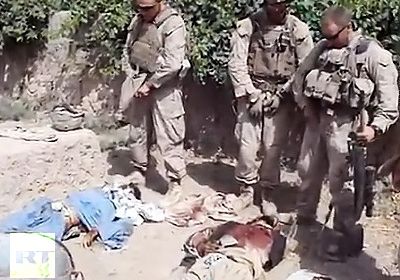
It wasn't long into 2012 before fresh evidence emerged of a democratic, free West's civilising mission, providing a sterling example to backward barbarians as the march towards global liberation continues apace. -
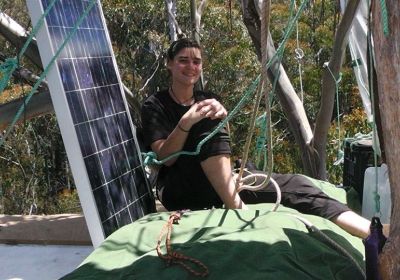
This is a story of broken promises from the Australian and Tasmanian governments, private companies profiting from the destruction of the environment with taxpayer-funded subsidies, threatened species under threat despite being “wholly protected,” one woman sitting in a tree to stand up for the forests and a local and international community who are standing behind her in the fight to save an irreplaceable ecosystem. Almost two years ago the forest round table talks began, bringing together groups that were once seen as opponents in the long running battle over the forests in Tasmania.

-
After a year of ferocious debate, the New South Wales Greens decided on December 4 to retreat from supporting the global pro-Palestine Boycott, Divestment and Sanctions (BDS) campaign. It does not mean the NSW Green Party has abandoned all support for the Palestinian struggle for justice, but it marks a setback for the left inside the Greens and the pro-Palestine movement in Australia. -
A task of the United Nations Framework Convention on Climate Change, now under way in Durban, South Africa, is to extend earlier policy decisions that were limited in scope and only partially implemented. These decisions trace back to the U.N. Convention of 1992 and the Kyoto Protocol of 1997, which the U.S. refused to join. The Kyoto Protocol’s first commitment period ends in 2012. A fairly general pre-conference mood was captured by a New York Times headline: “Urgent Issues but Low Expectations.” -
Rev Dr Djiniyini Gondarra responds to the 'second intervention' otherwise known as 'Stronger Futures in the NT', a new Commonwealth Government initiative which will maintain key powers introduced through the NT Intervention.
-
Despite a significant, if partial, win for the marriage equality movement, the right-ward shift of the Australian Labor Party (ALP) continued apace at its recently concluded national conference.