-
During the Christmas/New Year holiday period, prior to the tragedy of floods and fires, Prime Minister Julia Gillard chose to feed out some media announcements about local school autonomy. Her proposal was to give schools the right to “hire and fire” teachers. The model would give school principals and local parent representatives control of staffing, replacing the current statewide system of appointments. Many states have a variation of this localised system to some extent. However, NSW and Queensland, which are still under state-based employment relations, do not. -

Members of the National Tertiary Education Union (NTEU) at the University of New South Wales (UNSW) voted on January 13 to lift their ban on the transmission of student results. More than 40 staff members who took part in the lawful industrial action had been stood down without pay for nearly eight weeks. The decision to lift the ban followed concerns over attempts by university management to release unauthorised student results. -
Several hundred people from the Egyptian community in Sydney and supporters staged a protest against the Mubarak dictatorship and in support of the people power revolution in Egypt.
-
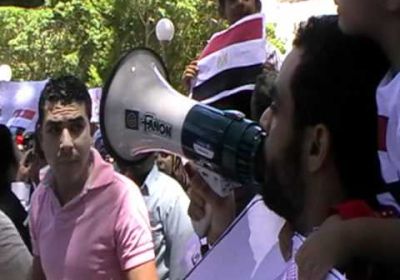
"Mubarak out now!", "Freedom for Egypt!", "Mubarak no! Gamal no! Suleiman no!", "No to the car tire and no to the spare!" - these were some of the slogans chanted by a lively crowd in the 6th rally in Sydney rally in a week to show solidarity with the Egyptian Revolution.
-
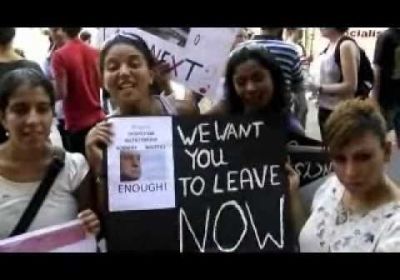
Heavy-handed policing in Sydney over the past few months may indicate a heightened, anti-protester attitude of NSW police. States and territories across Australia have either a “permit” or “notice” procedure for holding protests. NSW law has the “notice” procedure, which is very favourable for those organising protests. The completion of a simple form, given to the police with seven days’ notice, protects activists from arrest for offences like obstructing traffic. This favourable legal situation no doubt frustrates police, who are using more aggressive means to curb protests. -
As momentous events in Egypt demonstrate, much of the world is calling to account an “old order”. These are exciting times for the possibilities of real change in the way our societies are run. One of the catalysts of the “people power” we see on our TV screens is the extraordinary disclosure of secret information that tells us how wars begin and governments manipulate and deceive in our name.
-
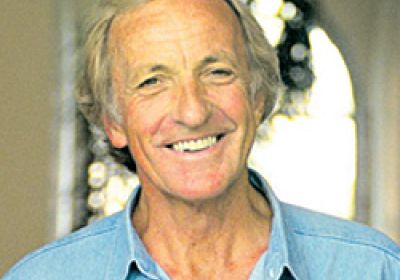
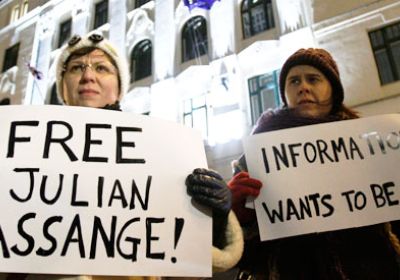
The Sydney Peace Foundation awarded its “gold medal for peace with justice” to WikiLeaks editor-in-chief Julian Assange on February 2 in recognition of his “exceptional courage and initiative in pursuit of human rights”. This award is different from the foundation’s annual Sydney Peace Prize. The foundation has awarded the gold medal on only three previous occasions: the Dalai Lama in 1998; Nelson Mandela in 2000 and Japanese lay Buddhist leader Daisaku Ikeda in 2009. -
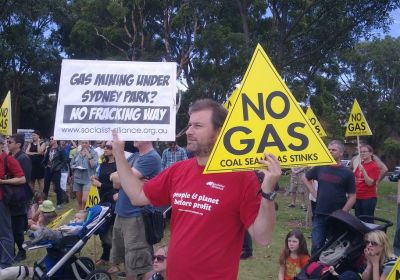
About 300 people turned out for a free outdoor film screening of the award-winning US documentary Gasland in Sydney Park on February 5. The screening was supported by the City of Sydney and Palace Cinemas, and was organised by Sydney Residents Against Coal Seam Gas, a community group established to oppose plans for exploratory gas drilling in the inner-west suburb of St Peters. -
About 300 members of the Egyptian community in Sydney and their supporters held a rally in Hyde Park North on January 30.
-
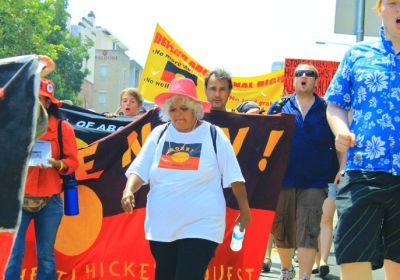
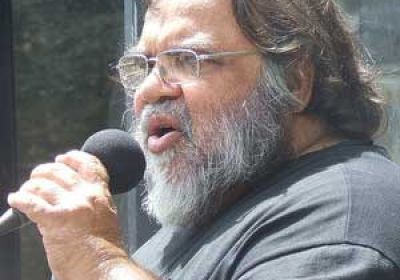
About 250 protesters gathered outside Redfern Community Centre on January 26 to listen to Aboriginal leaders speak out against the Northern Territory intervention and ongoing attacks on Aboriginal self-determination. The event was organised by the Stop the Intervention Collective Sydney (STICS). Speakers included Valerie Martin Napaljarra, based in Kalkaringi in the Northern Territory; Greens councillor Irene Doutney; and Graham Merritt of STICS. -
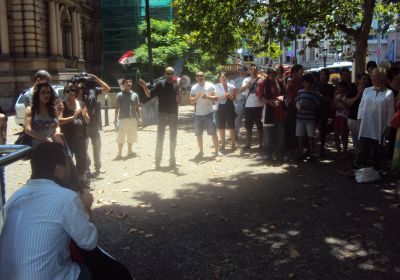
"As we speak, Egypt is on fire," Arab community activist Omar Mostafa told about 50 people who attended a snap protest rally in support of the recent democracy protests in Egypt at Town Hall Square on January 29.
-
The Australian Museum hosted a debate on January 23 on the topic: “Is the 26th of January the most appropriate date to celebrate our national identity?” Sixty people attended the debate, which pitted historian and educator Nigel Parbury against Brisbane indigenous leader and Socialist Alliance member Sam Watson. Parbury put the affirmative case and said that Australia Day had changed over the decades to better reflect the country's multicultural community. But he conceded that much more change was needed in future.