Indonesia

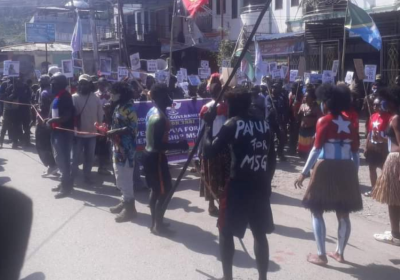
Papua New Guinea marked its independence from Australia — achieved in 1975 — on September 16. But West Papua, a province on the same island, continues its struggle for self-determination in one of the world’s least publicised and longest-running independence struggles.

West Papuans won their independence from Dutch colonialism in 1963, but the country was invaded by Indonesia and officially annexed in 1969 after a controversial referendum in which just over 1000 people voted.

Suspected leftists held by the military during the mass killings that followed the Western-backed 1965 Indonesian military coup. East Timor’s decision to take Australia to the Hague over Australia’s refusal to obey international law — and grant East Timor its legitimate share of oil and gas resources — comes just weeks after a tribunal at the Hague found Australia was complicit in the murders in Indonesia in 1965.

British Labour Party leader Jeremy Corbyn publicly criticised human rights abuses in Indonesian-occupied West Papua and backed Papuan demands for self-determination, in a May 3 meeting at Britain’s House of Commons. The meeting was a “historic step on the road to freedom for West Papua”, International Parliamentarians for West Papua (IPWP) said. At the meeting, a new declaration was signed calling for an internationally supervised vote on the independence of West Papua.
Secret documents found in the Australian National Archives provide a glimpse of how one of the greatest crimes of the 20th century was executed and covered up. They also help us understand how and for whom the world is run. The documents refer to East Timor, now known as Timor-Leste, and were written by diplomats in the Australian embassy in Jakarta. The date was November 1976, less than a year after the Indonesian dictator General Suharto seized the then-Portuguese colony on the island of Timor.
October marked 50 years since the start of the campaign of mass killing of Indonesian Communist Party (PKI) members and sympathisers in Indonesia. It is estimated as many as 1 million people were killed or jailed during 1965-1966, carried out as part of Suharto's Western-backed military coup.
The following statement was issued in Jakarta, Indonesia, on October 24, 2015): Indonesia's freedom of expression and critical thinking are under attack. Series of repressive and violent acts by the authorities against attempts to critically revisit and review the 1965 communist purge for the betterment of the nation and its people are a strong proof that the totalitarian legacy from the New Order Regime is still alive and kicking.
The United Nation's Intergovernmental Panel on Climate Change estimated in 2011 that carbon dioxide emissions had to be limited to 1000 gigatons to have a two-thirds chance of keeping global warming below 2°C. By mid-October, there were more than 100,000 fires raging in the Indonesian provinces of Sumatra and Kalimantan that had released an estimated 995 million metric tons of carbon dioxide into the atmosphere over the past four months. This is just short of 1 gigaton.
Indonesian police shot two senior high school students in Gorong Gorong, Timika, West Papua on September 28, the Institute for Papuan Advocacy and Human Rights (IPAHR) said the next day. The IPAHR said 17-year-old Kaleb Bogau was shot in the chest and died on the scene. Efrando Sabarofek, also 17, was shot in the chest and leg and is in a critical condition in the Timika hospital.
Demonstration in solidarity with West Papua. Honiara, Solomon Islands. Indonesian police beat two West Papuan students in Yahukimo, Papua Province, on September 16 for handing out leaflets about the Pacific Islands Forum.

Pages

Subscribe to Indonesia