
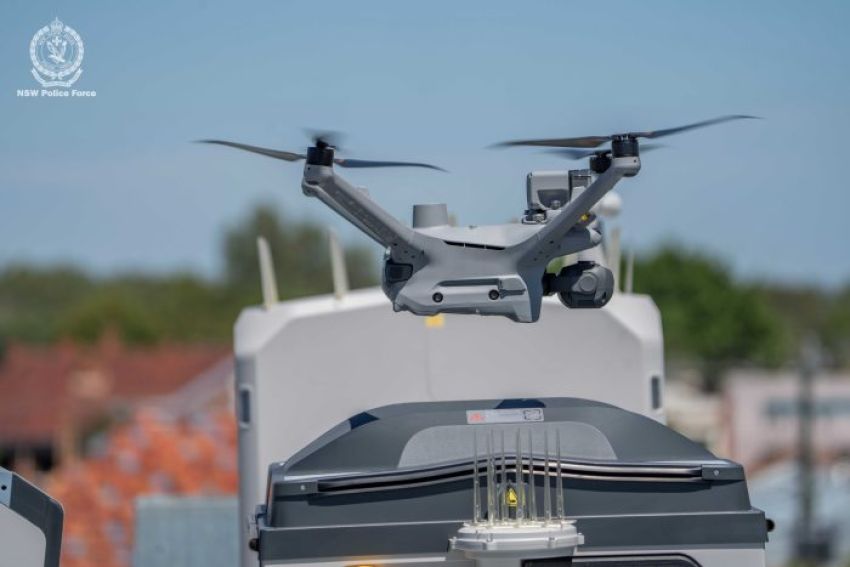
The Chris Minns Labor government is allowing the NSW Police to continue drone surveillance on Gomeroi Country in Moree for two more years, despite having done no assessment about how effective the drones have been in preventing crime.
NSW Police want the “PolAir Remote” program expanded to other regional areas, with no assessment yet to be filed about how effective the drones have been.
NSW authorities announced a six-month trial of the “world class, modern technology” police drones in January. There was no prior warning or public consultation.
Police Minister Yasmin Catley’s August 27 announcement that the trial would continue for two more years did not take many by surprise given that NSW Police have been campaigning for the drone surveillance. Catley told budget estimates on August 28 that the Labor government was “evaluating” the program, and “the business case” for the expansion would be released in September.
The Aboriginal Legal Service NSW/ACT (ALS) is critical of the decision to expand the police’s use of drones. Sharif Deen, ALS acting chief executive officer, said the community has told it that the drones, which are perched atop of Moree Police Station, are being regularly deployed over the predominately Aboriginal areas of the township. They also said the drones are causing fear across the community.
“The Moree trial ... has been very successful,” Catley told budget estimates on August 28. “I’m pleased that we’re keeping it there,” she said in response to a question from Sarah Mitchell, Nationals MLC and a big fan of drone surveillance.
“We’ll have to bring on more pilots. That will be a significant cost … The infrastructure itself, to be honest with you, Sarah, isn’t frightfully expensive. But, operationally and making sure it is 24/7 will be a significant cost. That will all be formed in part of the evaluation. We will know more once they’ve done that,” Catley said, adding that the NSW police evaluation will not be made public.
The NSW government provided some evidence for the roll-out, taken from a small survey of 516 community members. It found that 85% reported “no perceived negative impact” from the drones, while 83% considered that they enhanced safety.
But the NSW Labor media release admits that no consultation has been had with “Aboriginal stakeholders”.
Sue Higginson, NSW Greens MLC, reported that police officers had been asked to participate in the public survey.
Deen said that ALS had been “blindsided by the Premier’s decision to dig in his heels on this unproven, controversial technology”. He said the piloting of this “intrusive technology” in Moree means that the government and police are targeting a small community with a significant Aboriginal population and no power to object.
“We have serious questions about whether this use of police drones is compatible with people’s right to privacy and whether current laws provide adequate protections amid this new form of surveillance,” Deen continued.
“These are questions that the government should consider before extending this program in Moree or expanding it to other areas.”
Deen questioned why this invasive policing technique is being used on First Nations communities who “live in a context of intergenerational, structural disadvantage and trauma as a result of the town’s extreme history of racist segregation, discrimination and over policing”.
Deen said this is not the first time that Moree has been given “special treatment”. He was referring to Labor’s law-and-order drive, launched in Moree, that focused on 14 to 17-year-old Aboriginal youths.
The $13 million package, rolled out in March 2024, included youth bail accommodation and support services, linking Aboriginal youth to support networks, a plan to improve service delivery, extra police attention on youths, along with joint council and Aboriginal community-controlled provision of after-hours programs.
Deen said there has been a drop in crime rates, but it was the result of the community actively mobilising to bring it down. He is concerned that police will now turn around to claim that the lower crime rates are a direct result of piloting the drones to justify the program.
The over policing of First Nations peoples is well-known. Deen has suggested that “first likely targets” for the expanded program will be “Walgett, Bourke and Kempsey — places where there is a high proportion of Aboriginal people”.
He said the drone program comes at a time when there are more Aboriginal prisoners than at any other time in history.
“The premier is presiding over the worst justice system failure we’ve ever seen in NSW and he seems determined to make it even worse,” Deen said. “At the end of the day, police drones won’t do anything to prevent crime, or make communities safer.”
[Paul Gregoire writes for Sydney Criminal Lawyers, where this article was first published.]